Responses: How will we live tomorrow?

How will we live tomorrow?

“We have to take care of the earth. Everybody knows that we have to do that, but no ones does.”

Gathering Flowers, Taos Pueblo artisan, Taos NM

How will we live tomorrow?

“Hopefully without Trump.”

Christine, clerk, Ghost Ranch NM

How will we live tomorrow?

“Three Thursday’s from now it will be a Trump world.”

Mary Francis, middle-aged couch surfer, Taos NM

How will we live tomorrow?

“We like living the way we do today; off the grid, making our own water, gathering our energy from the sun, living in Earthship.”

Michelle, Dustflower Fruit Market, El Prado NM

How will we live tomorrow?

“The first time I was in Taos I came here for a class in permaculture. The content wasn’t different from the books I’d read, but my perception of how the system works became much deeper. Everything has two directions. The way that is coming toward us and the way that is going away.”

Jasmine, Snowmansion, Arroyo Seco NM

How will we live tomorrow?

“I live in Hawaii and work construction. I build large, expensive houses. There’s a guy who builds nice small houses, maybe twenty feet by twenty feet that can be built off the ground to reduce foundation and make less impact on the earth. When I go back I want to build one, as a kind of demonstration. Hopefully it will take off and I can build more. That’s how we have to live – smaller.”

Randy, mountain traveller, Arroyo Seco NM

How will we live tomorrow?

“I will quote Gandhi: ‘Learn as if you’ll live forever and live as if you will die tomorrow.’”

Garth, accountant and hospice volunteer, Arroyo Seco NM

How will we live tomorrow?

“One day at a time, one season at a time. Live slow, enjoy what you have. Respect and honor traditions.”

David, traffic coordinator, Taos Pueblo, Taos NM

How will we live tomorrow?

“I like that.”

Juan, mountain bike rider, Verlado NM

How will we live tomorrow?

“We live day by day. I live on a fixed income. I wake every day and thank God for keeping the family together.”

Mary, en route to Taos for annual visit to her granddaughter’s grave, Castle Rock NM

How will we live tomorrow?

“To enjoy it.”

Eric, junior high school student, Castle Rock NM

How will we live tomorrow?

“Happy. Keep family close.”

Damian, Roswell alien T-shirt wearer, Castle Rock NM

How will we live tomorrow?

“Nice. I think about it every day.”

Wendy, Albertson’s cashier, Taos NM

How will we live tomorrow?

“Ask me after the election.”

Tom, broken-down cyclist, Castle Rock NM

How will we live tomorrow?

“In tiny ways we are reinventing our culture. If we observe the way we actually operate, we can change it. My conviction is that people can polish each other.”

Randy, founder of ‘Quest for Community’, Santa Fe NM

How will we live tomorrow?

“Healthy.”

Lisa, ED nurse, Albuquerque NM

How will we live tomorrow?

“Just living. Too many people are pursuing too much and they miss the moment.”

Diane, ED physician, Albuquerque NM

How will we live tomorrow?

“Everybody lives for today. The instant gratification is terrible. Everyone needs to get in the garden and get their hands dirty and learn where life comes from.”

Rhonda, Americano Motel, Vaughn NM

How will we live tomorrow?

“Probably more simply.”

Jack, middle-aged cyclist, Albuquerque NM

How will we live tomorrow?

“That’s a good question. I hope you have a nice day.”

Jessica, Smith’s cashier, Albuquerque NM

How will we live tomorrow?

“That’s an open-ended question. I’m going to go positive and say that we will go to space and inhabit it.”

Alaric Bender, National Museum of Nuclear Science and History Albuquerque NM

How will we live tomorrow?

“Live well.”

Evan, quad latte drinker, Albuquerque NM

How will we live tomorrow?

“I’m edging closer and closer to the mountains.”

Madeleine Durham, artist, Santa Fe NM

How will we live tomorrow?

“Maybe we’ll live on bicyclists.”

Beverly, Georgia O’Keeffe Museum, Santa Fe NM

How will we live tomorrow?

“I believe the electro frequency of the heart is 4,000 times greater than our neural capacity. We have the capability of 7.3 billion people to reach out to other creatures in the cosmos. We are light beams stuck in this carbon-based moment.”

Matthew Rhodes, artist, Santa Fe NM


Posted in Responses | 2 Comments

Trip Log – Day 349 – Snyder TX to Abilene TX

to-abileneOctober 19, 2016 – Sun, 80 degrees

Miles Today: 77

Miles to Date: 18,188

States to Date: 45

img_8003

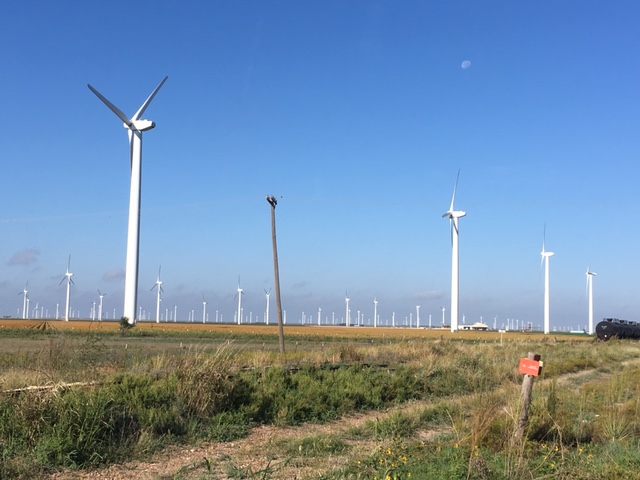
Flying with the wind! I pedaled through the largest wind turbine farm of my trip today, hundreds of turbines north of Roscoe spread out for more than ten miles. While they generated energy, I made time. A mid-morning wind shift that gave me a tail boost all day; I arrived in Abilene by 2:30 p.m.

screen-shot-2016-10-20-at-8-39-15-pm

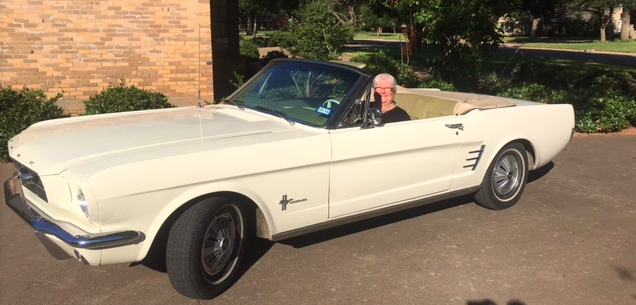
I had plenty of motivation to ride so fast. My host Cara, a designer and local artist, invited me to participate in a design charrette, downtownABI, where over a hundred people weighed in on how to improve the city’s core. Depending on your point of view I was either a ringer, since I’ve done dozens of similar exercises; or an interloper, since I’d been in Abilene all of three hours before the event began. Still, my impressions of the city were positive since Laura Lee, Cara’s mom and co-host, gave me a tour in her 1966 Mustang convertible.

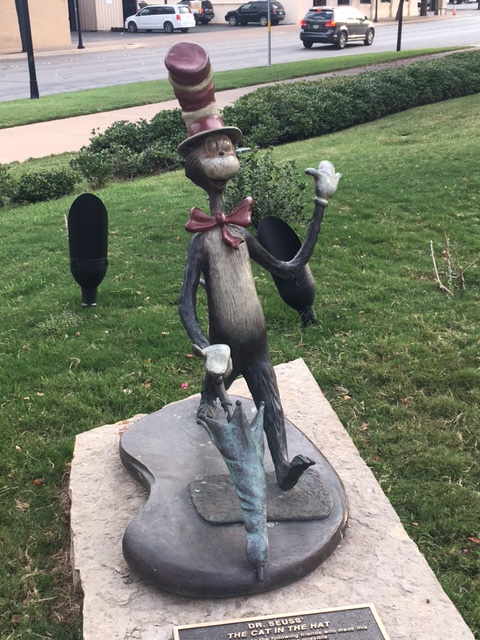
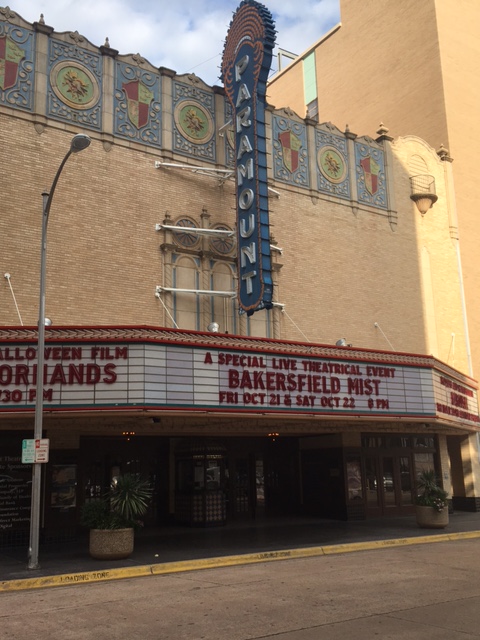
img_8034Downtown Abilene has seen better days, but it has more going for it than most small city downtowns: a handful of beautifully restored buildings, a linear green space along the railroad, whimsical sculptures that reflect Abilene’s home to the National Center for Children’s Illustrated Literature, and a handful of cool new bars and restaurants. Abilene is half the size of Lubbock, but it’s got twice the downtown.


img_8037After the charrette we all ate and drank at Vagabond’s and then continued our far-ranging discussion at home well past midnight. The people I meet make places memorable; Abilene etched a generous niche in my mind.

Posted in Bicycle Trip Log | Tagged , , | Leave a comment

Trip Log – Day 348 – Slaton TX to Snyder TX

to-snyderOctober 18, 2016 – Sun, 80 degrees

Miles Today: 75

Miles to Date: 18,111

States to Date: 45

Any day that starts with two mugs of black coffee and two helpings of sour cream and Sprite biscuits baked in a butter basted iron skillet heaped with sausage gravy is going to be a good day. My longtime West Texas friend and overnight host Leanne is a phenomenal cook.

img_7966 img_7964

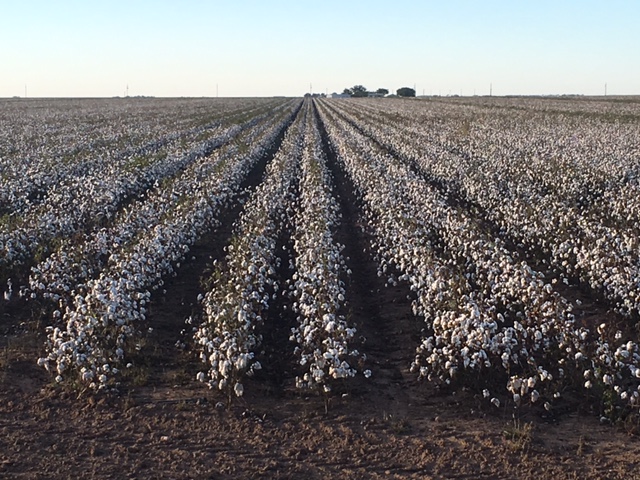
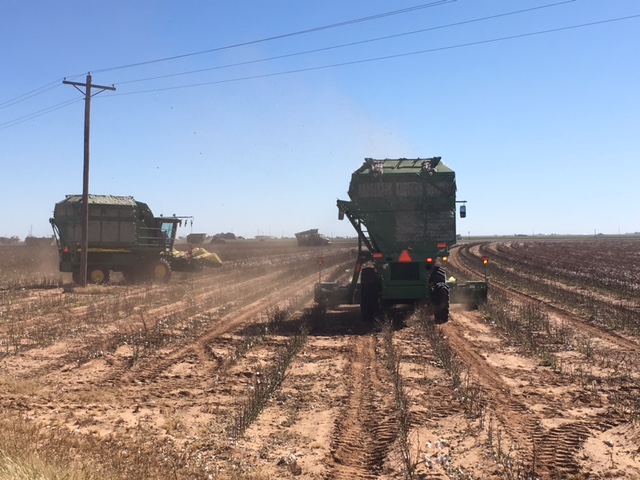
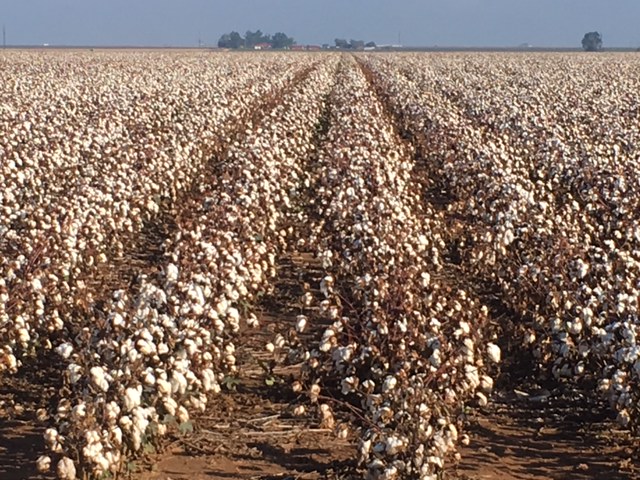
It’s cotton harvest time on the South Plains. Modern-day cotton pickers are GPS guided machines that remove the bolls off the plant and mechanically separate the seeds, hulls, and lint. One farmer told me, “I just sit there and play on my tablet, then turn around at the end of the field.”

img_7972 img_7975

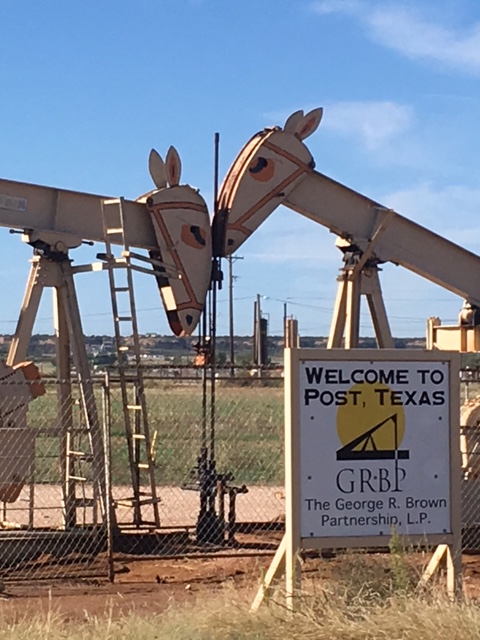
The plains end abruptly at the caprock. The earth drops 300 feet within a mile. I’m back in the land of sage and buttes, riverbeds, and oil wells. Despite the strong wind, the air is thick and stinks of tar. Post displays a sense of humor on its wells. The town’s founder, cereal magnate C.W. Post, spent over $50,000 in the early 1900’s trying to dynamite the atmosphere to produce rain. To this day, not much falls.

screen-shot-2016-10-18-at-7-14-11-pm screen-shot-2016-10-18-at-7-12-37-pm

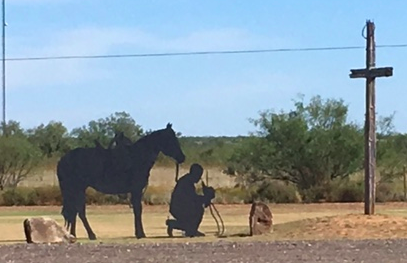
The string of windmills that line the edge of Llano Estacado remind me of Calvary, in a land where Christian crosses are plentiful.

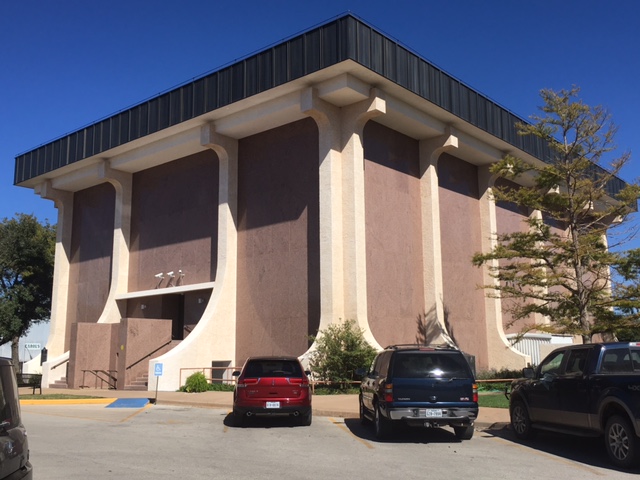
img_7991Snyder, Texas may have the single most inappropriate piece of architecture I’ve seen on my journey. A box of courthouse proportion sits in the middle of the town square. Its granite facade has no windows – none. On the center of each face is an entry door guarded by three security cameras. A brutal interpretation of ‘of the people, by the people, for the people.’

Posted in Bicycle Trip Log | Tagged , , , , | Leave a comment

Profile Response: Heath Ray, Bowling Green, KY

HWWLT Logo on yellowHosting couchsurfers is practically Heath Ray’s second job. He’s hosted over 120 different people since he purchased his ranch house northeast of Bowling Green less than a year ago. He’s had up to five people at once; one traveler stayed for 56 days. As a guy who stayed one night when Heath had no other guests, I snagged a private room with my own bathroom. But comfortable accommodations are never as important to couchsurfers as engaging interactions. Which is why Heath opens his home to so many. “I was born and raised here, I went to school here (Western Kentucky University), and now I work here. Hosting couchsurfers connects me to the wider world.”

img_7025Heath spent some time in the wider world in a major way as a Peace Corps volunteer in Tanzania from 2006-2008 and his time there has influenced his work ever since. Heath manages a refugee resettlement program for East Africans coming to Bowling Green, a job that allows him to use his Swahili every day.

Bowling Green has been accommodating refugees from many parts of the world since 1979. Every year, city and school officials evaluate how many to invite. Health believes they have assimilated rather well, primarily because local employescreen-shot-2016-10-16-at-4-41-49-pmrs have come to depend on this regular influx of good workers. Because of Bowling Green’s relatively low cost of living and eager employers, most refugees can arrive here, get established within their government loan/stipend, and be on their feet economically before that runs out.


Heath’s Peace Corps experience is also a major part of his social life: a local group of PC alums meets monthly. That fuels his interest in meeting couchsurfers from all over the world. Heath may live in his hometown, but in every respect, he’s a citizen of the world.


How will we live tomorrow?

img_7020“Our tomorrow will be lived with more inclusion and diversity.”


Posted in Responses | Tagged , , , , | Leave a comment

Trip Log – Day 347 – Lubbock TX to Slaton TX

to-slatonOctober 17, 2016 – Sun, 90 degrees

Miles Today: 27

Miles to Date: 18,036

States to Date: 45

Llano Estacado, the Palisaded Plains, also known as the Staked Plains because early Spanish explorers drove stakes to mark their route through the featureless grassland, has been geologically stable for ten million years. Larger than the state of Indiana, this flat land in western Texas and eastern New Mexico tips ever so slightly to the southeast. The Commanches called it ‘the place where nobody is.’ People passed through it for thousands of years; water was available from a series of springs that follow a line from present-day Lubbock to Portales NM. But nobody lived here permanently until the 1880’s, and meaningful settlement didn’t occur until after the First World War, when we developed mechanical methods for drawing water from the Ogallala aquifer.

img_7961To get an idea how flat this place is, consider that I have not crossed a bridge in five days. There are no rivers, even dry ones, on the Llano Estacado.

In less than a hundred years this area has become home to over a million people and an abundant source of cotton, sunflowers, sorghum, and watermelon. Lubbock is the defacto capital of Llano Estacado, home to a quarter million people, major hospitals, Texas Tech University, railroad hubs, and epicenter of rockabilly musical talent.

imgres img_7959

On a Monday afternoon, downtown Lubbock is a windblown, lonely place. But its most famous son stands tall against the West Texas Music Walk of Fame. Buddy Holly in his thick glasses. That’ll be the Day.


Posted in Bicycle Trip Log | Tagged , , , , | Leave a comment

Profile Response: Bruce Day and the Fogbees, Hendersonville, TN

HWWLT Logo on yellowBruce Day grew up on a farm in Cullman, AL, forty acres of cotton plus forty acres of subsistence farming and forest. They picked cotton by hand, which commanded a higher price than machine picked: $1000 a bale in the 1950’s. Two acres yielded one bushel: the family took in about $20,000 a year and netted $10,000. When price supports came in, they limited the crop to five acres, so the family sold the farm and moved into town. Bruce didn’t miss rising at 4:30 a.m. and three hours of chores before school. “Life was better in town.”

One of Bruce’s brothers died from a ruptured spleen, another in a car accident. Realizing that either might have survived with better medical care motivated Bruce to become a physician. He served in the army, interned at UAB (University of Alabama Birmingham), and practiced internal medicine. “It was all old people with high imgresblood pressure, diabetes, obesity and COPD. They all needed to quit smoking, cut down eating and begin exercising, which of course they wouldn’t do.” He married a woman from Knoxville, moved to Nashville to be between their respective families and became an ED Physician, which suited him better.

Bruce is a tinkerer and a Renaissance thinker. “I can see maps in my head. I can look at a coffee maker and visualize the wiring diagram. I don’t understand how people can go through life and not wonder how things work.”

img_7009Bruce began taking long bike rides in 1996 to counter the stress of ED work. He started touring, and has crisscrossed the US and England, more recently with riding buddies. The Fogbees (fat old guys on bikes) ride all around the region and are the primary bicycle advocates in an area with better bike lanes and signage than most I’ve travelled. For the past three years they’ve been championing US Bike Route 23, which will run north/south from Bowling Green KY through Nashville to Huntsville AL. The route is approved, though not yet signed.

Fogbees have discovered shared interests beyond their bikes. Bruce and a group of four others, ages 49 to 75, have a Wednesday Night Discussion Group that focuses on science and technology. They are currently taking a Stanford online course about machine learning. The night I visited, Bill invited the group to tackle my question. Some excerpts of our discussion:

How will we live tomorrow?

img_7005“The United States stopped investing in basic research in the 1980’s. That was the beginning of our competitive decline. Within twenty years, Watson is going to be able to take over the universe.

“Ten years ago I thought we had 200 years to continue as humans before we either evolved or disappeared. Now I wonder if we have that long. When you can get a gene kit for $100, the genie is out of the bottle.

“Look at CRISPR-CAS 9 (CRISPR = Clustered Regularly Interspaced Short Palindrome Repeats; CAS 9 = RNA sequence), bacterial viruses that can defined themselves against viral infection. We can use that process to cut out certain pieces of DNA and replace them with other genes. But once we put new genetic material out there, we can’t control how it will spread or mutate. We can create genetic wonders but we don’t know the genome well enough to know how the genes will respond.

“CRISPER CAS 9 was only discovered in 2012. It can change the way we live, or if we live, within a few years. Working on these bike routes, Tennessee Department of Transportation’s planning cycle is 20 years. Science is moving a different rate of change.

“What are the limits to our resources? So far, very few humans are living large, as we do, but more want to. What will happen when the Chinese start living large?

“I’m not a bit worried about resources. We will find ways to reduce water, use renewables. There is always a ghost that’s going to annihilate us. How many times did we duck under our desks when we were young? How many years has it been since the energy crisis? We have more energy now than ever.”

Posted in Responses | Tagged , , , , | Leave a comment

Trip Log – Day 346 – Lubbock TX

to-lubbockOctober 16, 2016 – Sun, 85 degrees

Miles Today: 9

Miles to Date: 18,009

States to Date: 45

When you travel so slow for so long ideas percolate over time until, one day, you meet a person or encounter a situation that illuminates a larger concept. All over our country people are wary of the government: almost always referred to as ‘the’ as opposed to ‘our’. They want less of it, and they want it to be more local. Yet, our government keeps getting bigger and reaching into more precincts of our lives. Why is this?

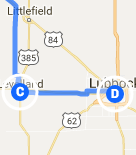
screen-shot-2016-10-17-at-4-23-02-pmOne answer can be distilled from a small building I passed in Levelland, TX: ‘South Plains Senior Companion Program.’ Forty years ago we began providing services for the elderly of this area. A few people had died in their homes and were not found for days, so we started phone trees. Some were not getting proper nourishment, so we started meals on wheels. We offered rides to doctor appointments, we insulated drafty houses, we opened senior centers to promote socialization. We did this mostly with federal block grant money, though what we provided didn’t need to come from the government at all. These services were not complex. They could have come from extended family, neighbors, churches, or civic groups. But they didn’t. So our government stepped in to provide.

The progression goes something like this. Some people in our communities don’t have family or neighbors to care for them. We create programs to fill the gap. The programs become the norm. Families and neighbors feel less responsible. More people need the services. Programs get larger, institutionalized. They develop bureaucracies, advocates, agendas; they take on lives of their own. As they grow, our sense of community shrinks.

There’s nothing wrong, in theory, with organizing society along institutionalized care and support, except the American duality of individualism and compassion renders us uncomfortable with centralized social services. We think people should be independent, and when they can’t be, we want them to be cared for locally. But families, neighbors and churches don’t have to serve everyone – only our government has that mandate.

imgresIt’s a long stretch from a federal government formed to provide for the common defense to one that provides senior companions. But until everyone is cared for locally, our government will step in, and it will continue to get bigger. We could get comfortable with that idea and stop bellyaching about the size of government. Or we could shrink our government by tending to our communities ourselves. Most likely, we just keep complaining.

Posted in Bicycle Trip Log | Tagged , | 1 Comment

Profile Response: Linda Marks and Dana Cooper, Nashville, TN

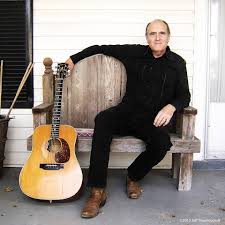
HWWLT Logo on yellowOver the telephone, Dana Cooper has a voice smooth as chocolate, rich and mellow. It’s easy to imagine this veteran singer/songwriter with twenty-five albums to his credit performing in clubs and concert halls all over the world. His voice is just as satisfying in person; we met for lunch with his wife Linda Marks at Fido’s, near Vanderbilt.

imgresDana was two days home from a US solo tour through Wisconsin, Colorado, New Mexico, Texas, and Oklahoma; just the singer and his guitar, his harmonica, and his songs. Dana describes his music as Americana: pop and rock and blues and country. He and Linda moved to Nashville decades ago because, well, this is where Americana thrives.


Linda is a visual artist and graphic designer at Vanderbilt. “I have a secure job. I have a boss who thinks that print is dead, but we keep needing print graphics.” Linda has a remarkable Facebook page that mines culture and history. “There’s a world of stuff out there that no one knows about.”

imgres-1Dana described how music’s evolution over the past fifty years. “Technology has changed how music is distributed and how we are paid. It also extends to who finds us. For instance, I like Soundhound, where you hear something and can find out what it is. But its difficult to get your music discovered even though it is more accessible Everyone can make their CD and have their website.” Without record labels keeping a reign on recording, the amount of music out there is overwhelming.

“The content has changed. There were more words and messages in the days of Top 40. Most of it didn’t have meaning, but some of it did. Now, everything is a niche.

images“I make a living at music. It’s a subsistence kind of living. Most songwriters struggle, most more than me. I’m not out to create ditties. I keep musical sketches of ideas, and come back to them. I tend to find the musical idea first and the lyrics follow. But not always. Storytelling is important to me. My songs convey mortality, carpe diem. I got to a place of ‘do no harm.”


How will we live tomorrow?

screen-shot-2016-10-16-at-4-23-32-pm“I’m a ‘be here now’ person. Aging terrifies me. Retiring terrifies me. Its something I want to do, but I’ll have to make my own life. I’ve always worked for someone else, been at the mercy of someone else’s opinion.” – Linda

“I vacillate between positive and negative, between a bleak view of the future and a cockeyed optimist view. I’d like lean toward the optimist. What will we leave behind? What will the next set of humans being have? Race will cease to be an issue. Maybe we’ll all be polka-dotted.” – Dana

“As someone who doesn’t have children, not having kids affects my view of the future. I’d be a mess if I had kids. The way they’d have to deal with religion. I worry about how religion colors our world.” – Linda

“It’s a madness, I was into religion as a kid. I was raised Catholic, I was going to be a priest. In the 1960’s, the Catholic Church was a place of discourse and inquiry. That’s gone.” – Dana

Posted in Responses | Tagged , , , | Leave a comment

Trip Log – Day 345 – Levelland TX to Lubbock TX

to-lubbockOctober 15, 2016 – Sun, 85 degrees

Miles Today: 39

Miles to Date: 18,000

States to Date: 45

img_7882

Nothing wilts an experience quicker than expectations. For months I’ve looked forward to returning to Levelland. Over the past week I’ve spent more time trying to connect with people related to my time here than in any other place on my trip. Howard Maddera, my mentor at South Plains Community Action, died in 2003; neither his predecessor nor his two daughters responded to my overtures. Emmer Lee Whitfield, who taught me about poverty and dignity, was killed in a car wreck in 1996; her daughter did not respond either. Ray Bradley, my Jaycee buddy, moved to Waco; his younger brother Hugh runs the family insurance agency. Duane Beachem, the dynamic young pastor of our church, cannot be found.

img_7883 img_7892 screen-shot-2016-10-16-at-2-32-37-pm

I woke to a grey sky, blank as my agenda. The haze burned off by ten. I pedaled out to revisit this geography of my past since I could not find any of the people that made it memorable.

Levelland hasn’t changed all that much, but it sure is different. In 1978, 12,000 residents were split in thirds: Black, White, and Latino. North of the tracks was the Black neighborhood. Despite paving all the dirt streets and renaming one Martin Luther King Blvd., the north side is a shadow of its former self. Industry, commercial, and garden apartments have replaced the shacks I used to visit. Emmer Lee Whitfield’s house is gone.

screen-shot-2016-10-16-at-2-35-34-pmI crossed the tracks and to the White part of town; now it’s Hispanic. The grid of numbered and lettered streets looked vaguely familiar, but nothing triggered specific memory. The SPCAA offices are the same, though they look smaller. Furr’s grocery has become a funeral home. The storefronts on the courthouse square are occupied by third-rate enterprises. A new supermarket and McDonald’s are out on 385; there’s a Super Wal-Mart just beyond city limits. The cluster of stucco apartments at Ninth and Avenue I where I lived among migrant workers has been demolished. The concrete slabs and sewer pipes are still there, the only testament to morning I woke up clutching the toilet after my first tequila encounter.

img_7903 img_7899

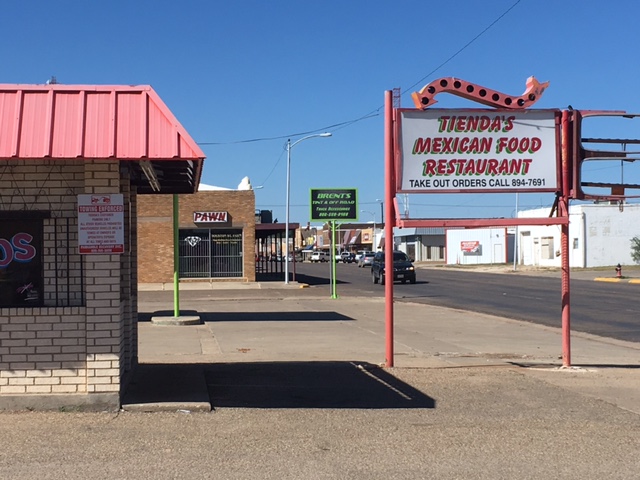
Enough of the pity party, I needed to talk to people. Mario, who runs the carnacerita around the corner from my old place, gave me a bag of cookies and lifted my spirits. I chatted with local college students, evangelicals, and went to Tienda’s for a burrito. Petra, the weekend waitress, also works at SPCAA. We shared common connections. Still, I left feeling only partly nourished. I wanted more from my homecoming.

img_7906I headed east to Lubbock; the day turned summery. The east side of town has gotten fancy: $800,000 houses where white folks can hide in mansions with four zones of air conditioning.

My Lubbock host asked me to arrive by five. Grant and his friend Shane explained we were going shooting. We loaded guns and ammo in Grant’s SUV and headed to their friend Lance’s ranch west of town. The trio use a VW microbus as staging area for target practice in a field of winter wheat. They shot hundreds of rounds at dangling targets, clay pigeons, and old records tossed in the air. I shot a pistol and a rifle. On my third round I hit a clay pigeon and retired in victory.

screen-shot-2016-10-16-at-2-40-19-pm img_7918

After sunset we retired to an old motorhome someone gave Lance to drink beer and vape. Toward eleven we drove back to Lubbock and stayed up a few more hours drinking Grant’s excellent home brews. A night of driving and shooting and drinking and carrying on like Willy and Waylon and the boys. Just like we used to do in Levelland, where I shot a gun for my first and only time in 1978. My hunger to recall that life, albeit with a different cast of characters, was fully satisfied.


Posted in Bicycle Trip Log | Tagged , , , | 4 Comments

Profile Response: Jeremy Raley and Chris Keshian, Nashville Entrepreneurial Center, Nashville, TN

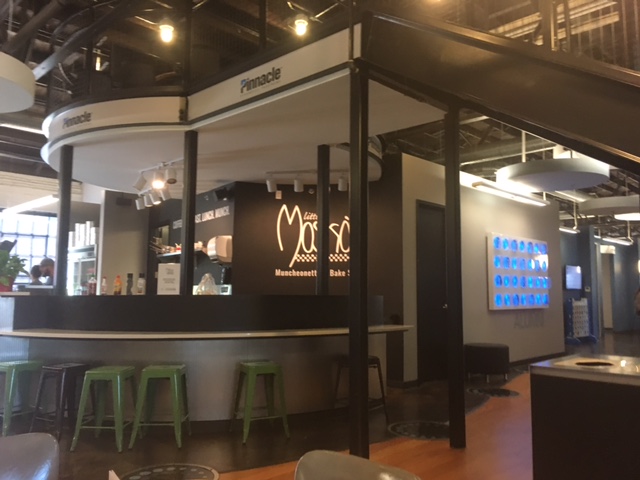
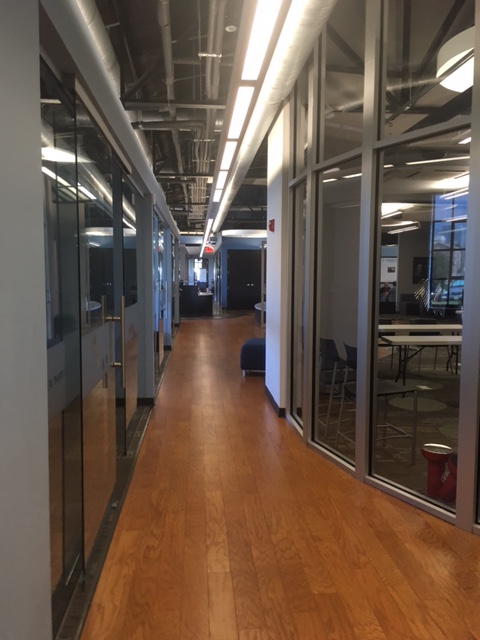
HWWLT Logo on yellowThe morning I arrived at the former Nashville Trolley Barns turned incubator offices and trendy eateries, I counted six cranes on the city skyline. Nashville is a happening place. It’s cool, it’s growing, and it has a vibe of urban sustainability. Those things do not occur only by chance. Urban vitality is a cocktail of planning, implementation, and good fortune.

Nashville has long been a music mecca, but these days it’s more. A decade ago, the Nashville Chamber of Commerce did a study of the area and decided to emphasize entrepreneurship. In 2010 they spearheaded NEC (Nashville Entrepreneurial Center).

Jeremy Raley is the membership chair. He explained NEC’s premise to me while also staffing the reception desk. Multi-tasking is key to the place.

img_6981 img_6976 img_6982

“Let’s say you have an idea for a new kind of blanket. You join NEC. You’ll get help from people in the retail space and the financial space. Advisors are local volunteers who come in three categories: start-up operations, industry expertise, and service providers, like attorneys and developers.” NEC currently has about 800 members. Memberships begin at $50 per month. Members get two sessions a month with the more than two hundred advisors to the center. They get co-working space, office support, and access to meeting rooms. “People use this as their office address. Individuals come in and ask for so-and-so, as if it’s their actual office.”

At question time, Chris Keshian, an NEC intern, joined the conversation.

How will we live tomorrow?

img_6984“We are not very far from a future of self-driving cars powered by electricity, drones that will deliver our goods. It’s going to extend to building construction, framing, there will be Internet connectivity of everything. When a window breaks, a drone will be called up to repair it. I also see a profound shift from oil to solar energy to nuclear fission.

“Augmented reality will come to the fore in a big way. That will be detrimental to humans. We already watch six hours of TV a day. We will lose our sense of community.” – Chris

“We will create a new form of community. We’ll play video games that are so real they will become our reality. I did an Oculus AR demo. I was so into it and could not be distracted because I was totally in it.

“Technology is both great and terrible.” – Jeremy

“I also think AI is not too far in the future. We will be unable to differentiate the human from the machine. The machine has access to everything simultaneously. It will have immediate response. I’m excited about what is happening.” -Chris

Posted in Responses | Tagged , , , | 2 Comments