Profile Response: BJ Krintzman and Richard Ortner

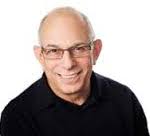
HWWLT Logo on yellowBJ Krintzman is an attorney and arbitrator from Newton, MA, and a Director of The Boston Conservatory, a private college of music, theater, and dance in Boston, MA. Richard Ortner is a wannabe tomato grower from Canaan, New York. Until he fulfills that dream, he is President of The Boston Conservatory. We met in Richard’s office to share Pad Thai and Ginger Pork takeout, and explore ‘How Will We Live Tomorrow?’ before attending BoCo’s annual Freshman Revue.

imgres-1BJ – How Will We Live Tomorrow? I go immediately to the dark side, lack of water, scarcity, conflict. Where is the world today? Everybody hates us. Terrorists, the developing world, the discord is huge everywhere.
imgresRO – I go to a tribal place. The Internet is returning us to word of small identity groups. We go online and find our tribe. It is the end of browsing. There is no unfocused exploration, just reinforcement of our particular ideas.

BJ – There is no question that we have defiled our nest.

RO – If you subscribe to the Gaia Hypothesis, that the earth is a balanced living system that results in catastrophe when that balance is lost, we are coming upon a time of great disruption. The human dominance of this plant will lead to our demise and the earth will reformulate along a new equilibrium with new life forms.

It is not just the planet and the environment we are corrupting, but what it means to be human. When the Supreme Court defines corporations as people we have lost an understanding of what it means to be a person. That is a recipe for Armageddon

BJ – The impact of the Internet is huge. Does it isolate or connect us?

RO – Yes.

BJ – Okay, you’re right there. But it’s unnerving to see groups of people together, in restaurants and other places, each on their own device.

RO – We – you and I – think that’s terrible, but we don’t speak the language, and I believe the language of texting and social media is a legitimate, though different, language.

BJ – But don’t we have to be able to read body cues?

RO – Did you see the article in The New Yorker about Affectiva, software that deciphers facial recognition? This woman from MIT developed a program that registers our emotional responses. Her initial interest was in understanding how children learned to read emotions, particularly within the autism spectrum. As we’re looking at our device, the program registers our emotional response to whatever we see by scanning dozens of subtle facial movements. Retailers got a whiff, now everybody wants it. They can use the algorithm to feed what we will experience next.

How do we explain the explosion of autism? It’s a sign that our tribe is growing more isolated. Pulling into ourselves is a survival response to too much stress.

BJ (turning to me) – Have you seen The Curious Incident of the Dog in the Night? I see a lot of theater, at least seventy plays a year. It is the single best piece of theater I have ever seen.

images

RO – BJ and I saw it together in New York. This little boy observes the chaos of the adult world and cannot process it. He cannot comprehend the actions of the adults around him. As we grow older, we loose sight of how complicated the world is because we become part of making the chaos.

BJ – It’s a simple story, so well told, with terrific staging. All viewed by a child. A child is all ‘id’, everything is about me. But autistic kids have no metaphoric sense. It’s a corollary to innocence. It revives that time before you were too afraid to ask the question. Adults don’t ask questions, we are too afraid to look weak.

But getting back to your question, I don’t stop and ask myself, “Am I on the path I want to be on.” I get up every day and do what is before me.

images-1RO – I am leading a much more deliberate life than I did a year ago. I assessed what I wanted to do here at the Conservatory and in the rest of my life and developed a plan that unspools me in a satisfying way. Within three years I plan to grow tomatoes at my place in Canaan. Have you seen my new rock wall? (Richard shares iPhone pics of a stone wall). I’m creating a sunny space for a tomato garden. I also want to do cucumbers.

BJ – You are building this wall, making this garden. The only way to achieve a goal is to have a goal. I don’t have that right now. I like what I’m doing, but there’s no big plan.

RO – Back to tomorrow. I don’t think we’ve finished exploring the affect of the Internet. We get a lot of content, but not much meaning.

BJ – And no form. I’m hard wired about grammar and punctuation. That is all falling by the wayside. I know it’s elitist to say, I know that if you can communicate you’ve achieved your objective, but I’m stuck on good form. I see the casual way stuff is thrown up on the Internet and I feel that our skills are devalued.

RO – Just as we devalued our grandparent’s ability to walk in the woods and know which mushrooms were good to eat. Each generation has its own knowledge needs and forms of expression.

BJ – You are lucky in that respect, working here, with so many young people.

RO – Every year I ask incoming freshmen, “What are you listening to, and how are you listening to it?” I am always pleased by the range, from Sibelius to Lady Gaga, and usually surprised by the form. There are so many ways to extract information in our world, and they are changing all the time.

imgres

Dinner ended in time to attend the Freshman Revue, a sort of ‘final exam’ for the Boston Conservatory’s freshman survey course in musical theater. The show features all freshmen in musical theater in performance vignettes that span musical theater history. This year, the ensemble included a moving tribute to the evolution of civil rights, with a plea for solidarity in Baltimore, the latest American city to erupt in reaction to police shootings of minority citizens.

images-2That was followed immediately by a pensive rendition of Stephen Schwartz’s ‘Beautiful City’. I was struck by how Richard and BJ’s concerns about tomorrow belie the reality that they invest so much time and energy in the optimistic pursuit of nourishing young artists. In Godspell, Jesus sings ‘Beautiful City’ to his disciples. The song responds to the question, ‘How will we live tomorrow?’ in a direct and positive way.

Out of the ruins and rubble
Out of the smoke
Out of our night of struggle
Can we see a ray of hope?
One pale thin ray reaching for the day

We can build a beautiful city
Yes, we can; Yes, we can
We can build a beautiful city
Not a city of angels
But we can build a city of man

We may not reach the ending
But we can start
Slowly but truly mending
Brick by brick, heart by heart
Now, maybe now
We start learning how

We can build a beautiful city
Yes, we can; Yes, we can
We can build a beautiful city
Not a city of angels
But we can build a city of man

When your trust is all but shattered
When your faith is all but killed
You can give up, bitter and battered
Or you can slowly start to build

A beautiful city
Yes, we can; Yes, we can
We can build a beautiful city
Not a city of angels
But finally a city of man

Posted in Responses | Tagged , , , , | Leave a comment

Trip Log – T minus Two Weeks and Counting

HWWLT Logo on yellowApril is prep month for “How will we live tomorrow?” I’m preparing for the trip and asking locals my question. The only official training I am doing is that I now ride my bike everywhere, in all weather. That’s no easy feat given the terrible weather we’ve had this spring. Dastardly potholes lurking beneath puddles caused back-to-back blowouts during downpours. However, I have learned that my Marmot parka is truly waterproof.

This week was the Cambridge Science Festival, and, since so much of science is focused on the possibilities of tomorrow, I participated in several events. Not all communities engage science with the fervor of Cambridge. Although Seattle may be have the highest proportion of college graduates of anyimages-3 major city (53%), Cambridge leaves the majors in the dust. Seventy-four percent of adult Cantabridgians have at least a four-year degree (which may be how we get away using terms like ‘Cantabridgian’). Still, the Cambridge Science Festival is an excellent indicator that our community is diverse and our thirst for knowledge strong,
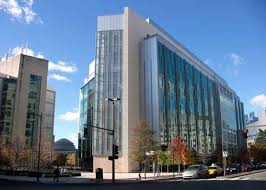
David H. Koch Institute for Integrated Cancer Research at MIT – Open House

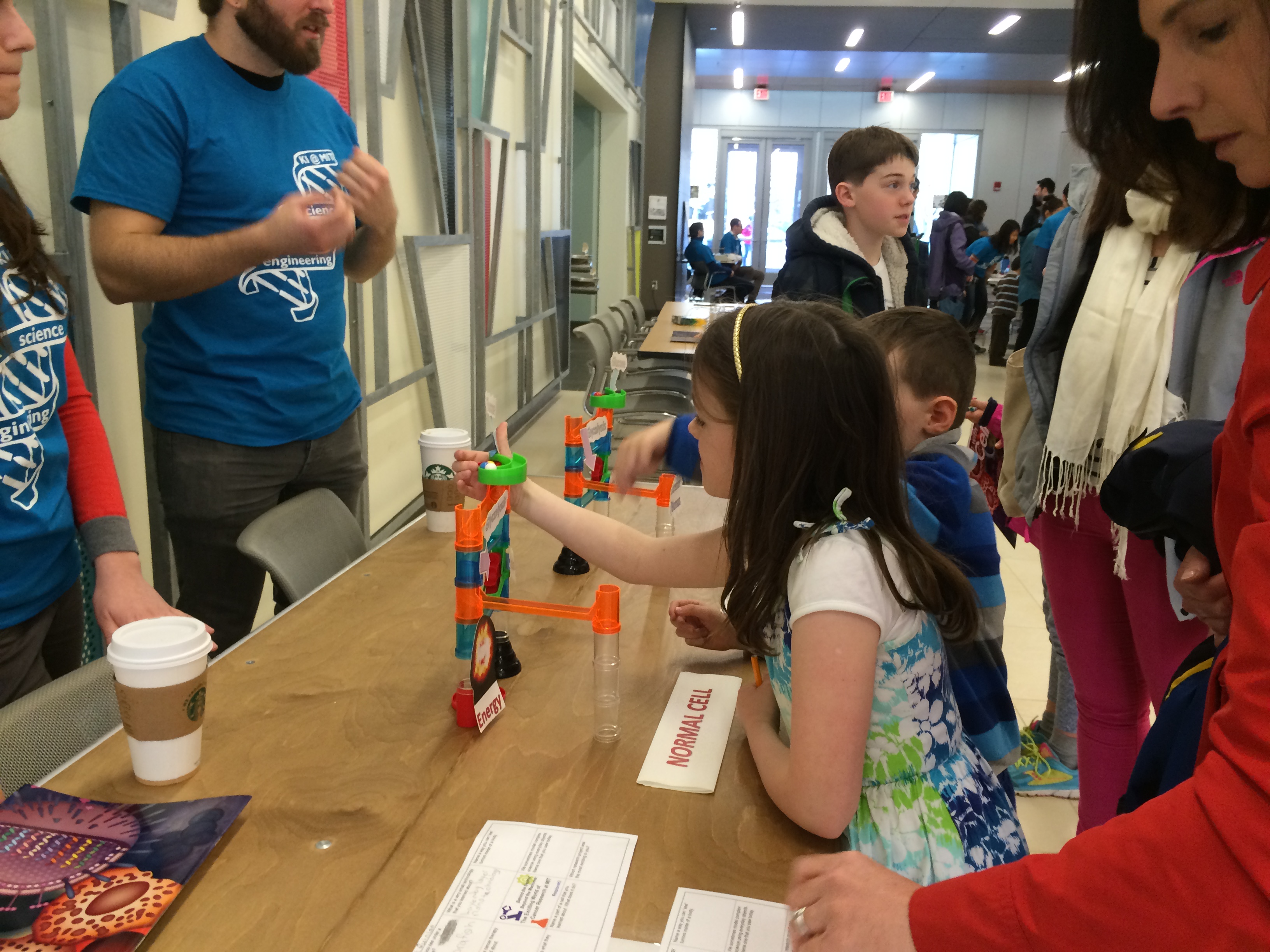
imgresThe Koch Institute’s slick new building with generous galleries makes a great place for demonstration tables staffed by eager graduate students and technicians in blue T-shirts with swirling DNA logos. The place was flooded with kids eager for science and the presenters focused on making cancer research accessible to all. A mouse trap game illustrated how cancer cells absorb more glucose and bypass the Krebs cycle, a Lego construction site showed how radiation breaks the DNA strand, Velcro attached to ping pong balls became ‘target cells’ when stuck to cotton balls, and children strained DNA from strawberries.

IMG_1575The real appeal of this open house, from the perspective of interesting children in science, was how each child could identify with the presenters. More than half were women, at least half people of color. MIT graduate students today look nothing like that did when I was there 40 years ago, and school children look nothing like my classmates of fifty years ago.

Sustainability unConference – Earth Day at District Hall in Boston

This was my first experience with an unConference. I was intrigued by both the concept and the subject matter. I wore my “How will we live tomorrow?” bike shirt for the first time. Cocktail hours are uncomfortable for me, especially when I am wearing bright yellow.

IMG_1572I wandered into the hall where organizers posted topics on a wall. “Write down what you’d like to talk about” a volunteer said. I added a note about how Boston might prepare to mitigate rising tides. I didn’t realize that my scribbling constituted offering to facilitate a workshop. Sure enough I got a bunch of votes and, in the spirit of an unCOnference, led a session. I drew a giant wave and some cool lettering on the white board, had people guess their home’s elevation above sea level as an ice breaker, led a brainstorm of the issues rising tides present to Boston, and outlined opportunities we could use to combat them.

Facilitating a workshop, even on the fly, is easier for me than cocktail party mingling. I know how to curb the inevitable monopolizer and make sure everyone gets to talk. Next time I attend an unConference, I’ll know what I am in for in advance.

Harvard Observatory – Open House

It seemed odd to visit an observatory in the middle of the afternoon, but throngs of people climbed Observatory Hill on a sunny afternoon. The parking area was littered with solar telescopes, each stIMG_1556affed by T-shirted scientists keen explain the mysteries of sunspots and solar flares. People from 3 to 83 fixed their eyes into viewfinders to observe the wild choreography that was just another day on the sun. I arrived too late to take any of the tours offered, but wandered through ‘Ask an Astronomer’ hall, teeming with children and parents quizzing geeks about black holes and dark matter.

In one classroom, three different volunteers demonstrated Microsoft’s Worldwide Telescope on immense screens. This is a free program anyone can download. It turns your laptop into a telescope, Goggle Earth for the stars. The clarity is amazing; the scale and scope of the program is phenomenal. It enlarged my understanding of what it means when we say the Internet puts the world at our fingertips. The children in the audience, mostly eight to ten year olds, a good mix of boys and girls but more heavily Asian than the population as a whole, asked question after question. The adults sat on the sidelines, dumbstruck.

images-2One little boy asked, “Does the Universe ever end? Mary Patterson, the Harvard Observatory Ambassador replied, “Well, these images are three billion light years away. At the speed of light, it would take us three billion years to reach them. And nothing in this image indicates it will end. So, realistically, the universe is infinite.”

That may be true, but Microsoft Worldwide Telescope illustrates that the universe is also intimate; that we each carry it around with us in our laptop; that we can view it at our leisure and manipulate our relationship to it. Science teaches us that the universe is vast, but science also makes us feel powerful within it.


Posted in Bicycle Trip Log | Tagged , , , | Leave a comment

How Will We Live Tomorrow? Responses – 2

How will we live tomorrow?

“I have two answers to the question. Literally, tomorrow we will live life as today, with too small a degree of change to notice. That could wind us up in a bad spot.

“Two hundred fifty years from now, there will still be widgets that claim to alleviate our suffering. But they won’t. Materialism and fear resonate. We feel incompetent without a sense of suffering.

“We are the agents of evolution. If I say, ‘I love you’ to everyone I meet for 24 hours, that creates an evolutionary energy. If I sit home by myself for that time, that creates a different type of evolution.”

Andrew Wood, Gas Equals Time, Cambridge, MA

____________

How will we live tomorrow? With our best effort.

Anthony Rhys Jenkins, Senior House Manager, Central Square Theater, Cambridge, MA

____________

How will we live tomorrow?

“We will live in peace within ourselves. That peace will reflect to the exterior. Whatever is within me is within you.”

Mahmood Rezaei-Kamalabad, Thelighter.org, Cambridge, MA

_____________

How will we live tomorrow?

“I think we will live tomorrow the way we live today. However, I hope that we live tomorrow more conscientiously, in a way that values the group. I want us to find fulfillment in deciding to live in a community way.”

Ross Richmond, Food for the Poor, Somerville, MA


Posted in Responses | Tagged , , , , , , | Leave a comment

Profile Response: Mark Davis

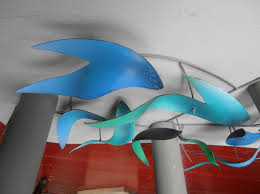
HWWLT Logo on yellowMark Davis is an artist of dancing light and ethereal shapes. His stabiles may be as small as desk accessories; his mobiles expansive as a flock of birds. His work is joyful and buoyant. Yet he revealed another side of himself when asked, “How will we live tomorrow?”


We are wearing out the planet. Our ability to conquer disease is increasing the number of people on earth, and increasing our lives, but we are thwarting nature.

imgres-3I counter my worries by spending time with young people, whom I find to be both well-intentioned and well-meaning without thirsting for power. Growing up with the Internet, the young embrace being connected to everything all the time. They can choose to act or not, but that cannot be unaware. Being so thoroughly connected to each other affects their private lives in fundamental ways. They may not be involved in creating political change, but they have absorbed the entire world in a fundamental way. Those of us who did not grow up with this connectivity don’t experience it so completely.

imgres-2The conservative backlash that we see in our country is just the response to changes in our society that are happening anyway. We are becoming more and more accepting of different ways of being. I mean, gay marriage? Who saw that coming, and yet here it is, and it is here to stay. Some people need the security of a world with a bad guy, something they can point to as wrong to make them feel okay about themselves.”

I ask Mark if we have to hate what we don’t understand:

Why is it that, when I have a day that I feel good 95 percent of the time, but then something bad happens for 5 percent, the 5% bad overwhelms the 95% good? There is actually scientific evidence that the neurotransmitters that respond to negative events are more powerful than thoimagesse that respond to positive ones. That’s how we learn to avoid dangerous and unhealthy aspects of our environment, from an evolutionary standpoint. Some also postulate that’s why anxiety is ever on the rise – the people who survive are the doubters.

Cultures go through phases of risk-taking and anxiety. Right now the United States is stuck. We have been a nation of risk-takers who got great rewards for a long time. But our supremacy is over and we have to accept a certain amount of humility.

imgres-1I am 61 years old. When I turned 60 I was doing okay, making a decent living and doing more and more commissions. But I was not doing what I wanted, I wasn’t doing what I am capable of, and at 60, just doing okay isn’t sustaining. By the time you’re 60, you want to feel like you’ve figured life out. And of course I haven’t.

I read this incredible article a few years ago about a writer living in a small town in Mexico. It was poor, and people died early, often tragic deaths. But the people were full of life. They had an energy and joy that we have lost. The American psyche is weighed down with big expectation. We have to be the biggest and the best. The result is power and greed, the ugly extreme of capitalism. People are disillusioned because we have not achieved our vision. What is left is empty greed and power. We overcame the frontier, we triumphed in World War II and we reigned over the American Century. But where are we now? We don’t know.

I ask Mark if he recognizes the dichotomy between his work, which is so light and playful, and his thoughts about the future:

My art is all joy. But I believe that my struggles and doubts, my darker side, contribute to it in important ways. My thoughts and my creations are complementary parts of me.


Posted in Responses | Tagged | Leave a comment

The Gear – A Year’s Worth of Stuff in Two Bags

HWWLT Logo on yellowWhen you plan to travel by bicycle for a year, you think hard about what to carry, because your feet have to propel every ounce thousands of miles. Although it’s possible to hang four, five, even six bags on the front, back, or sides of a bike, I want only one pair of panniers plus accessories that clip directly to the frame. Everything has to be compact, light, and essential.


I addressed the challenge, as I do most problems, by creating a spreadsheet. The main categories: bike-mounted items, clothing, communications, toiletries, repairs, and miscellaneous. I vetted the list through my son Andy. Since he hiked the Appalachian Trail a few years back, he’s expert at packing.

The bike-mounted items are easy: front and rear light, air pump, two water bottles, lock, helmet, and odometer. Whenever I lock the bike, the helmet stays with it. A pair of Ortlieb panniers will hang on either side of the back rack. My Surly Long Haul trucker has already aced a 3,000-mile junket. I know its dual brakes, 21 gears, and Brooks saddle are up for the challenge of pedaling five times that distance.

Although it seems counterintuitive, going from a ten-room house to a pair of panniers required more shopping than I’d done in years.

Clothes. My big splurge was three custom cycling jerseys (Pactimo) advertising my question. Bright yellow, of course. I layer on a yellow down jacket (North Face), and/or yellow shIMG_1554ell (Marmot) as the weather requires. Yellow is my fundamental color- I want to be seen. Add two pair of cycling pants (EMS), and five pairs of socks (iQ). I’ve never liked clip-on shoes, so I purchased a new pair of New Balance 856’s, my only footwear for the journey. Although one pair of shoes is sufficient, one pair of gloves is not. I have three variations of palm-padded bike gloves: fingerless for warm weather, Gore-Tex for the cold and wet, with insert liners for when it’s even colder.

IMG_1553For off-bike wear I’m packing two black Technic shirts (EMS), one collared sun-protection shirt (Columbia) a pair of black microfiber paints (REI), a pair of microfiber shorts (Columbia), a swimsuit / yoga short (City Sports), three pairs of nylon underwear (Underarmour), a wool hat for cold days, a baseball hat to shade my noggin, and an ancient pair of scrubs (Yale-New Haven Medical Center laundry, but don’t report me on that). That’s it. Everything can be rinsed and hung to dry for the next day, except for scrubs and the socks. That’s why I need so many pairs.

Communications. I am going all Apple: an iPhone 5S and 11” Macbook Air. Considering I did my last long trip with a cellular flip phone, paper maps, and a Dell Notebook, it’s a welcome upgrade. But I’m still old school in liking to use a mouse so I’ll tote one along with my chargers.

Toiletries. If there is anyone in the world with simpler toiletry needs, I have yet to meet him. A toothbrush, floss, and toothpaste (sorry dentist, leaving the Sonicare at home); first aid kit; soap with covered dish; microfiber towel; sunscreen; razor; Carmex; and Abreva. After having a short beard for over twenty years, I’ve decided it will be easier to shave regularly than carry my electric trimmer.

Repairs. This is not the place to scrimp. I am not particularly mechanical, but have to be able to keep my bike rolling. I’ll carry an extra tire, three tubes, Allen wrench set, three plastic tire levers and lubricant. I’ll need a tune-up and new chain every 2,000 to 3,000 miles. That will require a layover in Minneapolis, Denver, Seattle, and other cities along the route.

IMG_1547Miscellaneous. Every list needs a miscellaneous column. There’s the lightweight sleeping bag I’ll carry for particularly gorgeous nights. I’ll haul my already tattered personal copy of Architecture by Moonlight for reading events along the way. I’ll begin the journey with unread NY Times Magazines, but once they are consumed and recycled, I’ll pick up paperbacks along the way for casual reading and leave them for others. I’ll pack two additional water bottles just to claim the space, but won’t need to fill them until I get west of the Mississippi where water sources grow scarce. I’ll carry a portfolio with paper, tiny pads from Staples that fit in my bike shirt pockets, and several pens, as well as a 250-box of Vistaprint calling cards. I’ll have subsequent boxes mailed to me along the route. I’ll also carry three power bars to start, and add more snacks as the towns grow farther apart.

IMG_1550I laid everything out on my bed. A lot of stuff, a lot of yellow. Then, I organized groups of items into plastic bags. Finally, I put everything in my two panniers. One for dry stuff (computer, book, clothes), the other for wet stuff (water, repair supplies, toiletries).


IMG_1552

The good news – everything fit! The plastic bags were too flimsy, so I got an assortment of mesh bags to help organize the bags. Now my only worry is, what did I forget?


Posted in Bicycle Trip Log | Tagged , , , , , , , , , , , , , , , , , , , , | 2 Comments

Featured Response: Susan Schiro

HWWLT Logo on yellowSusan Schiro, Executive Director of Career Collaborative in Boston was the first person to respond to my question. Here is her response. I look forward to receiving yours:

You’ve got me thinking: what question are you asking? How should we live? How do I hope we will live? How are we likely to live? Who is “we”? How do we prepare each other and ourselves for the future we want?

The last of the questions strikes me as the most interesting and the one that is the most useful to answer.  How do we prepare each other and ourselves for the future we want?
imgres-1Our actions today create the future. For those of us who are (generally) satisfied with the world, it is likely that we will live tomorrow as we live today.  For those who want it to be different, it is likely that we are trying to change the world so that it is closer to the world we want.

I want a world in which every person can support himself, a world in which every woman can support her family. For me, this means helping people figure out what career they want, and then helping them onto a path where they can move toward the lives they want.


Posted in Responses | Tagged , | Leave a comment

How Will We Live Tomorrow? Responses – 1

How will we live tomorrow? By not sweating the small stuff.

Emma Lipton, Yoga Instructor, Nashua, NH

__________

How Will We Live Tomorrow?

More people are talking about the future now than at any time in my life, and that is a good thing. The problems facing us are great – the carbon footprint, the corporate ownership of government. But at every level, from Obama’s opening of Cuba, to the negotiations with Iran, to average people discussing among themselves, people are engaged in the future. I don’t know how we will live tomorrow, but I am optimistic that it will be good, because things cannot improve unless people talk with each other, and more people are talking now than ever before.

Theo Colburn, Effective Movement and Leadership Embodiment, Jamaica Plain, MA

_________________

How Will We Live Tomorrow?

“I am going to get a massage. I am going to my chiropractor. The massage is going to pull me apart; the chiropractor is going to put me back together. I am going to Trident Bookstore to learn how to tell a story from different points of view and why that is important. Oh, and I’m going to look for a chance to eat.”

Globiana, Dedicated Provocateur, Arlington, MA

_______________

How Will We Live Tomorrow?

My short answer to your question is – BETTER!

I am a lifelong optimist.  I believe history favors optimists.  Many people tend to pessimism because they predict the future based on the present state of things.  This is a mistake.  Imagine we were having this discussion in 1915.  We would have had no idea of what was to come in the next hundred years.  We have no idea now.  However, there is good reason to believe that whatever does happen will happen a lot faster, and the human condition will improve.  That is not to say things will be perfect, just better.

Philip Adams, Civil Engineer, Scotia, NY

_______________

imgresHow Will We Live Tomorrow?

“Just arrived in Varanasi, India. Next two days we are taking hoops to two different red light districts and working with rescued kids and also kids of the sex workers. So thankful, but with a heavy heart, to do this work.”

Carissa Caricato, Hula for Happiness, Tampa, FL

_______________

How will we live tomorrow? 

To answer this question we must first define living and then define tomorrow.  Living implies having a life as opposed to mere survival.  To the spiritual mind, living implies being awake as opposed to just going through the motions of life.  If we live in a wakeful state of consciousness, the physical conditions in which we experience life are merely that, experiences.  In my youth, I read a book by Kilgore Trout (aka Kirk Vonegut) called Venus on the Halfshell.  The premise of the book is that the last living human on earth is left with a spaceship and a robot programmed for sex.  Their mission was to travel the universe asking the primordial question of ‘Why was man created to suffer and die?’  Man was not created to suffer and die, man was created to experience creation.  Once while pondering these thoughts of purpose, the following statement came into my mind.  ‘Your awareness allows me to experience my creation’.  I wrote this on my mirror so that I would see it every morning.  Then I received an overwhelming feeling that the statement was wrong.  The correction came as “My awareness allows me to experience my creation.  So back to the original question of ‘How will we live…’, we will live in a state of awareness of who we are.

So the second part of your question concerns tomorrow.  How will we live tomorrow.  What is tomorrow for there is only now?  Quite an esoteric statement that has become a cliche.  We are living in a linear, time based consciousness and therefore there will be a tomorrow within this reality.  For the mystic, even if we destroy the world, mankind is destined to wake up to the reality of who we really are.  That is the tomorrow we are all waiting for.  So how we live tomorrow will be dictated by how we live today.  If you believe in the eternity of the energy we identify with as being human, then we will never cease to have experience but the experience of tomorrow will be determined by our actions of today.  There is a meme that pops up in my fb feed occasionally about the wisdom of the old man that plants a tree whose shade he will never sit under.  The real wisdom of this meme is that the old man is planting a tree that will provide shade for a future incarnation of himself.  We are the children that will inherit the earth we leave behind.  This is the irony of tomorrow.  

Perhaps your question should be ‘How will we live today?’

Ed Barron, Artist Model, Boston, MA


Posted in Responses | Tagged , , , , , | Leave a comment

The Responses: Whom am I Going to Ask?

HWWLT Logo on yellowThe more people who want to answer my question, “How will we live tomorrow?” the better. For starters, I plan to ask four specific groups: people I know; people I don’t know, people in power today; and people who offer up their ideas. That covers pretty much everybody in one form or another, but I’m open to other suggestions to encourage participation.


People I Know. This is the obvious, easiest group. I will contact the friends, family, and deep thinkers I already know and ask them whether they will grant me a single question interview. Alternatively, they may choose to script their response to my question instead, which is also fine by me.

People I Don’t Know. Like most Americans, I live in a bubble of like-minded folks. My particular bubble is well-educated, affluent, secular, male, and white. In other words, I’m privileged. Some might say I’m self-made, since I’m more educated and affluent than my family of origin, but I’ve received special benefits bestowed upon clever white guys. I don’t apologize for my position in society, but I acknowledge it stems as much from luck as effort. I am grateful for my good fortune.

Although I know a few individuals outside my bubble – my Mormon brother, my Army nephew, and my black lesbian theologian friend – I need to get outside my bubble for a wider perspective. That’s why everyday I plan to ask at least one person I don’t know, “How will we live tomorrow?” More importantly, that’s why I’m planning a route that consciously brings me among people I don’t know. I want to go to Dearborn, MI because I don’t know any Muslims. I want to go to Williston, ND and Fresno, CA because I don’t know any itinerant workers. I want to go to Huntsville, AL because I hardly know anyone in the South. I want to ask eccentrics and journeymen, rich and poor, mansioned and homeless, young and old, ailing and robust.

People in Power Today. Tomorrow will not spring full-blown from nowhere. It will be built upon today. Therefore, I want to offer individuals in power now a podium to articulate their vision. In advance of coming to each state, I plan to contact the governor, U.S. Senators and Representatives to solicit their answer to my question.

imgres-2When I get to Iowa, I’ll invite all the Presidential candidates to respond. I also plan to ask business, religious, social, and cultural leaders. I’d like to know whether there is confluence between Howard Schultz’ (Starbucks) and the Walton’s (Wal-Mart) view of tomorrow. Do Peter Morales (Unitarian-Universalist Association) and Pat Robertson share any common ground? What do entertainers who dabble in tomorrow, from the indie band, The Lisps (Futurity) to Christopher Nolan (Interstellar), have to say about tomorrow?

Please send me suggestions of influential people I should invite to answer my question. Make a comment here or contact me at fallonpaule@gmail.com. They won’t all answer, but if even some do, we can help shape our national conversation.

imagesPeople Who Offer Up Ideas. Finally, I welcome anyone to answer my question, and I promise to post on this blog all the responses that meet the guidelines included below. Anyone who has an idea of how we can live tomorrow is invited to contribute.

I look forward to hearing from YOU.

__________

Guidelines. How to submit you answer to “How will we live tomorrow?”

  • – Answer the question, “How Will We Live Tomorrow?” in 500 words or less.
  • – Provide up to three supporting images, audio or video clips.
  • – Substantiate all statistics and references with relevant hyperlinks.
  • – Respect other people and their opinions – no trolls, rants or insults.
  • – Include your real name. This will be posted with your response.
  • – Provide a line or two about you – location, age, occupation, passion.
  • – Provide you contact information and tell me whether to post it with your response.
  • – Email your submission to fallonpaule@gmail.com. Thanks!


Posted in Participate! | Tagged , , | Leave a comment

The Question: How Will We Live Tomorrow?

HWWLT Logo on yellowAs I travel across 48 states, I plan to ask people along the way, “How will we live tomorrow?” Why ask a question? Why ask that particular question?

A ready question is a conversation starter. Traveling alone is conducive to meeting new people, but a question kickstarts the interchange. A provocative question expands my interactions beyond pleasantries.

More importantly, asking the same question across the full spectrum of people will frame my experience. The most rewarding travel balances a general plan with serendipity. It’s useful to have a route, some destinations, and expectations in mind, but not be a slave to preconception. My question is a key part of my general plan. I’m not just interested in seeing stuff. I’m interested in exploring America. I want an idiosyncratic, unscientific immersion into what makes our eclectic country tick.

So why ask, “How will we live tomorrow?” Because it is simple and open ended. It can literally refer to the next day, or invite speculations of the future. Yet like many seemingly simple things, each word is imbued with conscious thought.

How. ‘How’ is a logistical wimgres-6ord. In strategic planning we developed a facilitation approach with clients that focused on first defining ‘why’ there was a problem or opportunity, then determining ‘what’ the appropriate response was. Figuring out ‘how‘ to accomplish the objective came last. If the ‘why’ and ‘what’ were well articulated, the ‘how’ followed naturally. But too often we got so bogged down in ‘why’ and ‘what’ we never got to ‘how’.

The United States is, without doubt, rich in snarly problems and ripe with fabulous opportunities. ‘Why’ we should move in a particular direction or ‘what’ most strongly binds us might offer interesting speculation, but they’ll generate less traction than one tire rotation among the millions I plan to pedal. ‘How’ is more tangible. ‘How’ acknowledges that we already have a bevy of rights and responsibilities, privileges and prejudices. We don’t act in a vacuum. Everything we do moving forward will tweak existing systems. It will shift the perceptions of who’s a winner and who’s a loser. In an existing, complex system, ‘why’ and ‘what’ can’t inform ‘how’. Instead, ‘how’ we act will determine ‘what’ we become and ‘why’ that’s worthwhile.

images-4Will. I like this declarative word. “Should’ or ‘could’ are too squishy. True, our future isn’t in our full control. But we’re human beings, not dust mites floating on a random breeze. We have more control over our fate than any other creature on earth. We cannot prescribe our future, but we will influence it.


images-5We. This is the key word in the question. Its not ‘I’, its not ‘you’ and its not ‘they’. ‘We’ is the only pronoun that fuses the individual and the collective. It acknowledges that the only viable future on a planet with seven billion people must consider the needs of many as well as singular. It’s a word a lot of Americans choke over, since history and geography have blessed us with more opportunities for individual expression than any other country on earth. But it’s a word worth embracing as we become ever more connected to each other.

images-6Live. This is my optimistic word. I like to think we are going to live, as individuals, as a nation, as a species, for a long, long time. Many say otherwise. Some welcome our demise through The Rapture, others quake in fear that our planet will turn inhospitable. But I choose to think that we are caring enough and resourceful enough to find ways to continue living.

imagesTomorrow. Tomorrow is never more than 24 hours away. It is also the distant future. This is the word that makes my question both practical and ephemeral. It invites specific answers as well as fantastic speculation. It takes today as a given and projects us forward as far as we wish to go.


Posted in Uncategorized | Tagged , , | Leave a comment

The Route: Where and Why?

HWWLT Logo on yellowI want to ride my bicycle to all 48 contiguous United States. I don’t know why. The idea lodged in my head a few years ago and the itch just keeps growing.

Bicycling across country is noteworthy but hardly unique; hundreds of people do it every year. I’m striving for more. There are limits to the adventurer in me. Cycling from, say, Barrow, Alaska to Tierra del Fuego is beyond my capabilities. But trying to pedal through 48 states is a worthy goal: an improbable, though not impossible, accomplishment. There’s a fair chance that life’s circumstances or personal health will intervene and force me to return to Cambridge. But there’s also a fair chance I’ll complete the journey.

Rolling my wheels cross 48 states is the overarching parameter. Beyond that, there are thousands, millions of routes. How do I choose which roads to travel and which towns to visit?

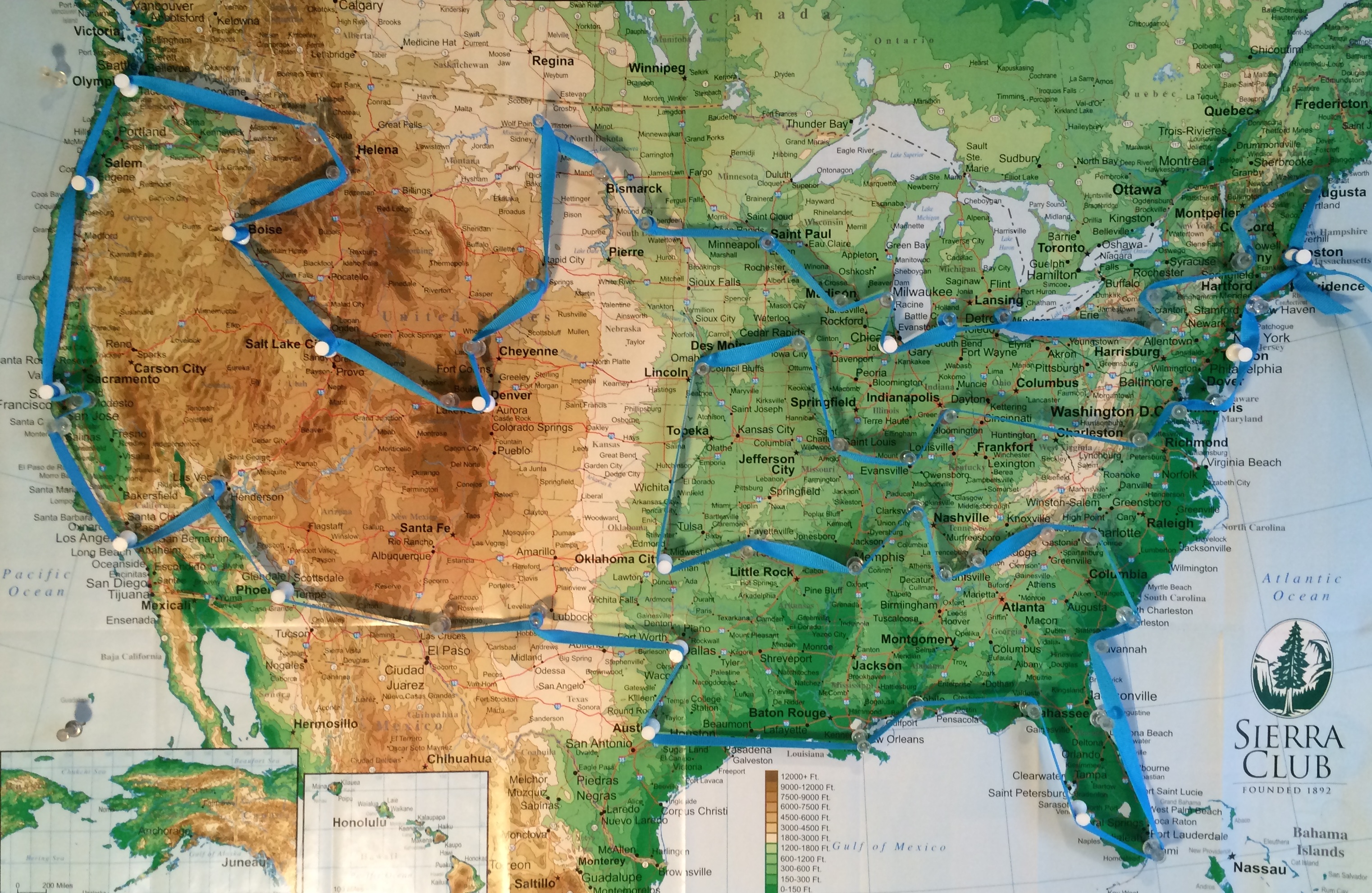
150327 Route Map

First, I want to visit everyone I know. My family is strung out across the country. Besides four sibliings, I have lots of nieces and nephews who live their own. I plan to drop in on them all. Then there are my friends. Childhood friends, high school friends, college friends, adult friends. I don’t know how they wound up living in Boise, Idaho; Slaton, Texas; and Sanibel, Florida; but I plan to see where life landed them. I’m particularly keen on visiting Sanibel, which is both flat and warm in winter.

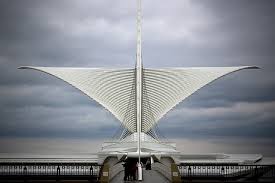
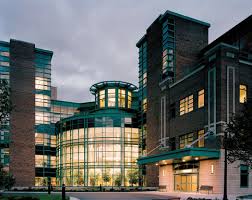
Next, I want to see cool architecture. The new glass pavilion in Corning, New York; Calatrava’s museum in Milwaukee, Frank Lloyd Wright’s Taliesin, E. Fay Jones’ chapel in Arkansas, the Getty in L.A. But I also want to see my own architecture – the buildings I laid my hand upon during my career. How does my first hospital, Dartmouth-Hitchcock Medical Center, hold up after 25 years? Is my very first project – 24 units of housing for folks with cerebral palsy – still standing in Norman, OK?

imgres images-1 images imgres-1

I want to visit places that reflect the pulse of America, past and present. I’ve always been enthralled with nineteenth century utopian ideals, so I hope to visit Oneida, New York and Amana, Iowa. I want to visit ‘enlightened’ company towns like Columbus, Indiana and Racine, Wisconsin. And I’m keen to visit places on the cutting edge of American life. That includes the usual glamour spots like Silicon Valley and Nashville, Tennessee, but also the places where change is challenging: Dearborn, Michigan; Williston, North Dakota; and Ferguson, Missouri.

What became interesting, as I spun blue ribbon around my destination pushpins, were those features of our country without immediate appeal. My initial route map doesn’t highlight any national parks. It’s also rather empty through the South. This reflects my prevailing interest in how we live and what we build, over nature, as well as knowing less about the South than other part of our country. I am anticipating that both of those predispositions will change. On the road, I may be so inspired by our natural beauty that I want to visit natural wonders. In the South, I hope to be captivated by its legendary hospitality and charm.

The only thing I know for sure is that the route I have mapped out will not be the one that I take. Who and what I want to see will change. It’s so easy to turn my bicycle in a new direction when something interesting beckons.

Posted in Bicycle Trip Log | Tagged , , , , , , , , , , , , , , , , | 2 Comments