Profile Response: Chad Weidert, Gramercy, LA

HWWLT Logo on yellow“The rules are simple. Show up three afternoons a week. Bring a snack and something to drink: no sugar drinks, no sweet snacks. Invite the parents to come along and run with their children. Do warm-up stretches in a circle; there are no lines. Compete against yourself, not others. Complete the half-mile track as many times as you set for your goal, and cross the finish line.”

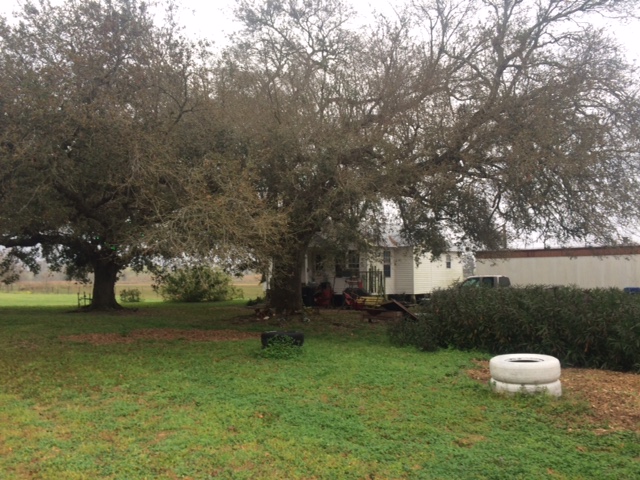
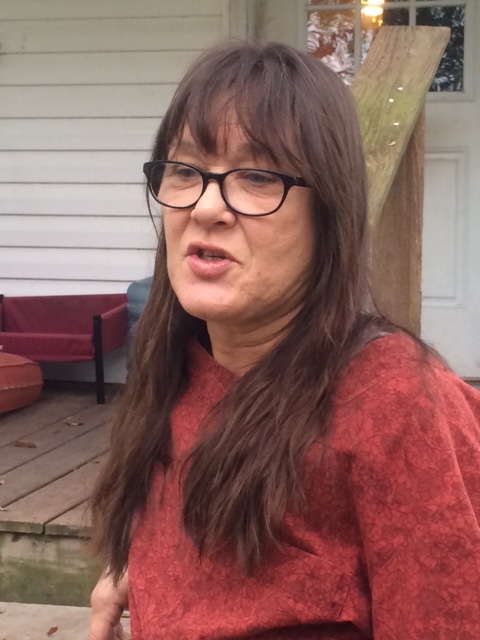
The most effective way to reach out and make a difference is to take on something you love and share it with others. Chad Weidert and his wife Susan are neither self-proclaimed, nor selfless, do-gooders. Chad supervises painting crews on offshore platforms for Shell Oil (each platform has twelve full-time painters; salt air devours paint), Susan is an administrator at the local Catholic school. They have three children, mostly grown, and are looking forward to a vacation at Disney World, just the two of them, to celebrate Chad’s 50th birthday.

imgresA few years ago Susan and Chad decided to invite children to the track after school. Not the kids on the track team, or even athletes. Anyone, any age, any ability was welcome. Their message: come out and move and you’ll feel good. “You never have to do better. You may not be better on day two than on day one. But I guarantee you’ll do better on day ten.”

Over a hundred children, and many parents, have participated. They meet three times a week for an hour or so. “We have a second-grader who does the 5K in 21 minutes. Others walk one half-mile. Most of those who start by walking a half-mile end the season by running one to two miles.”

Screen Shot 2016-04-18 at 2.58.33 PMThe kids don’t compete against each other; their only measure is with themselves. But there are rewards. Four different groups sponsor 5K races around Gramercy. The local community hospital provides medals to any youth who runs in three of the four local races. Last year, over fifty of Susan and Chad’s kids earned a medal. That’s a nice boost to childhood wellness from a program that costs nothing but a few hours a week and a caring attitude toward each child.

How will we live tomorrow?

Screen Shot 2016-04-18 at 3.08.49 PM“Dustin is our middle son. He’s at LSU and wants to be a doctor. Your question makes me think of Dustin when he was four. We were at the grocery store. We stood in line at Piggly Wiggly. He asked if he could have a candy. I said ‘yes.’ He asked if I would get one for Chase, his older brother, and Emily, his younger sister. I said ‘no,’ since they didn’t come with us. He put his candy back.

“Dustin had a scholarship opportunity at Spring Hill College. On our way to his interview I said, ‘They might ask you where you want to be in 10 years.’ ‘Oh that’s easy. I’ll be where He wants me to be.” Dustin is a young man of great faith. Tomorrow we’ll be alright.”


Posted in Responses | Tagged , , , | Leave a comment

Profile Response: Reverend William T. Walter, Gramercy, LA


HWWLT Logo on yellow“Here, I got another one for you.” When Revered William T. Walter catches your eye and commands your attention, he doesn’t let go. Since I’m in the business of seeking out people who want to talk, we’re a natural match.

“Guess how big I was when I was born? I figure William’s going to boast of being small rather than large, since he’s mighty ample now. He’s in his sixties at least and it would unusual for a four-pound baby to survive in the 1950’s, so I guess three pounds eight ounces. “Lower.” He grins. “Two pounds twelve ounces?” “Lower.” Since we’ve entered the realm of fantasy, my guesses hardly matter. “Two pounds.” Lower, man, lower. I weighed eight ounces when I was born.” Once I accept that fairy-tale size, anything is possible.

images-1William is a patchwork quilt of astounding facts. His mother had thirty children. He has no idea where he fits in the order. His birth mother was a drunk who hung around the fields and was repeatedly raped by hands. His father was a Cherokee, which might be true considering the man’s reddish ebony sheen. After being born so small his birth mother gave William up. The doctors in the orphanage declared him dead, but his adoptive mother took the infant, placed him in shoebox and fed him with an eyedropper. She brought him to church, placed the box a prayer circle that prayed the fledgling boy to life.

imgres“Here, I got another one for you.” William tells stories out of school. He was called ‘Ugly Jim.’ His mother told him to throw taunts back at the aggressors by exclaiming, “You’re jealous.” He banded with the other social rejects. Sometimes, when they triumphed over the popular kids, his peers saw an aura envelope Ugly Jim. “At age fourteen I was called to preach. Been preaching ever since.”

imgres-1“I’m writing a book about my life, Death of a Preacher. I asked God if my book would be a best seller. He said ‘it’s our book, not your book. It won’t be a best seller. It will be a best teller.’

“Here, I got another one for you. I was sick and needed dialysis. I told God my fingers were cramped and I couldn’t write. The next night I woke in the middle of the night and there on the TV they were selling a dictation machine. So I got one, and that’s what I’ll use.

images“There’s one part I don’t want to write. About my mother and getting raped. I told the Lord I could not write that. God told me I had to write that to free others with problems from the shackles of their past. The Lord is giving me the strength to tell all.”


How will we live tomorrow?

IMG_6325“First, we are going to live by faith, by faith in God. Second, you got to live in reality. Third, we have to get along with each other. I have more to say, but that’s just the start.”


Posted in Responses | Tagged | Leave a comment

Profile Response: Ashley Rogers, Whitney Plantation, Wallace, LA

HWWLT Logo on yellow“Tisn’t he who has stood and looked on that can tell you what slavery is – ‘tis he who has endured.” – John Little, fugitive slave, 1855

After touring Whitney Plantation, I met with Ashley Rogers. As I approached, Ashley was discussing research of a former slave with another staffer. “We’ve documented that Lucinda Williams had fifteen children by fifteen different men in fifteen years. Apparently, she was hardy and fertile and each year the overseer would pair her with the strongest man in his stock.”

IMG_6300As Director of Operations Ashley oversees daily business, yet she is deep into Whitney’s research as well. Ashley grew up in a family of museum curators, pursued history and museum studies in college, and was assistant director of a small house museum in Colorado when she learned about Whitney Plantation. She knew where she needed to be. “I read my first slave narrative of my own volition at age 10. I found this position open and just came down.” She started working in September of 2014; the museum opened three months later.

“We are the only plantation museum in Louisiana the deals directly with slavery; one of a handful of sites that deal with ‘difficult history.’ Plantation house tours have existed for 40 years; all the others focus on the lives of the masters. We are turning that upside down. A lot of people come here and do another tour: Oak Alley or Laura. I think it’s beneficial for people to see the differences in interpretation.

imgres-2 IMG_6310

“Slavery is something that a great number of people have only a fuzzy understanding about. Some guests ask us what created slavery. Others ask how plantations came into existence.” But the story doesn’t have a simple narrative sealed in the past. “12.5 million people were taken from their homes in Africa. After 1807, the international slave trade was abolished. This prompted an increase in domestic slave sales. More slaves were moved to the south where there was greater need.” Ashley and her staff have firm documentation of 354 people who lived at Whitney Plantation, though since the plantation operated with 250 to 300 slaves at any time, the total number must be higher.

IMG_6307During the Civil War, slaves remained at Whitney on their own accord; no one was running the plantation yet there was no place for them to go. The effects of slavery lasted beyond the war, to this day. “Slavery is not as far away as we like to think. There are people walking all around us who have been touched by slavery. We have a local matriarch whose father was a slave.

“Our schooling is that there was slavery and then there wasn’t; there was Civil Rights and then there were no new wants. The descendants of the African Diaspora are still here. Many are still shortchanged as citizens.

IMG_6308“There is a rich history in 20th-century sugar labor; people who worked this area until a few years ago. Anyone who lived on the margins of society worked here.” Ashley has found records of African-American, Hispanic, and illegal immigrant labor used throughout the 20th century in the fields that were originally part of the Whitney Plantation. “It’s also interesting how descendants of slaves continue to work in the sugar industry. One of our tour guides; five generations of her family worked this land.”

How will we live tomorrow?

imgres-1“I hope we will continue to learn from our past and live more thoughtfully and more gently in the future.”


Posted in Responses | Tagged , , , , | 1 Comment

Profile Response: Adina, Whitney Plantation, Wallace, LA

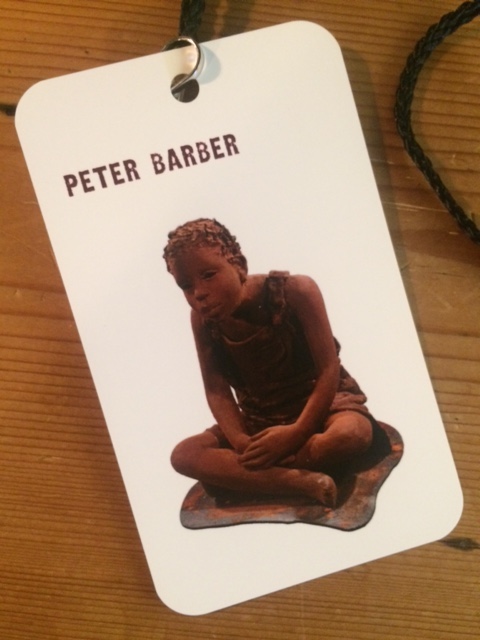
HWWLT Logo on yellowEvery visitor to the Whitney Plantation wears a slave around his neck. Tour tickets are lanyards with placards bearing the name and sculpted image of a slave child on the front. The backside includes an autobiographical statement from The Federal Writer’s Project, FDR’s Depression-era narrative history initiative. Since seventy years elapsed between the Emancipation Proclamation and the Federal Writers Project, the recollections of former slaves are tales of the elderly reliving their youth. I wore Peter Barber, a slave from Charlottesville, Virginia, sold down to Louisiana as a boy, 96 years old when his memories were recorded.

IMG_6302Seventy years after the Federal Writer’s Project scribed American lives, John Cummings, a successful New Orleans attorney, acquired Whitney Plantation and turned it into the only plantation museum to look beyond the Big House to focus on slavery. Ten million dollars and fifteen years later, Whitney Plantation opened its doors in 2014. Testimonies from one lifetime ago provide the foundation for reconstructing the slave world of two lifetimes ago. At Whitney Plantation, distant history drums near.

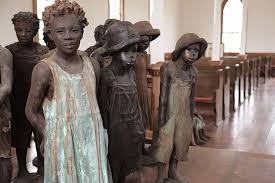
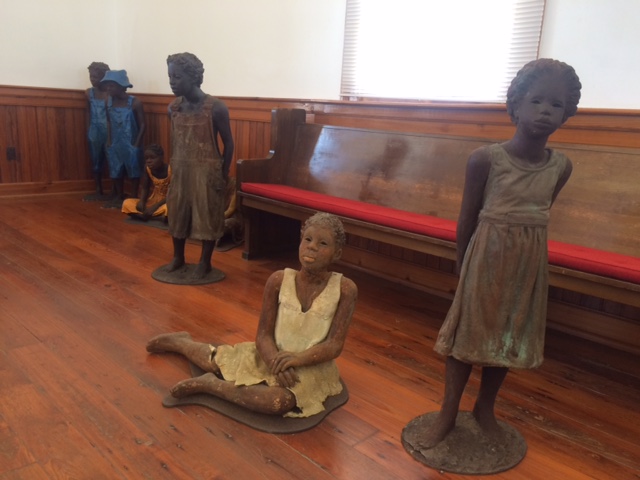
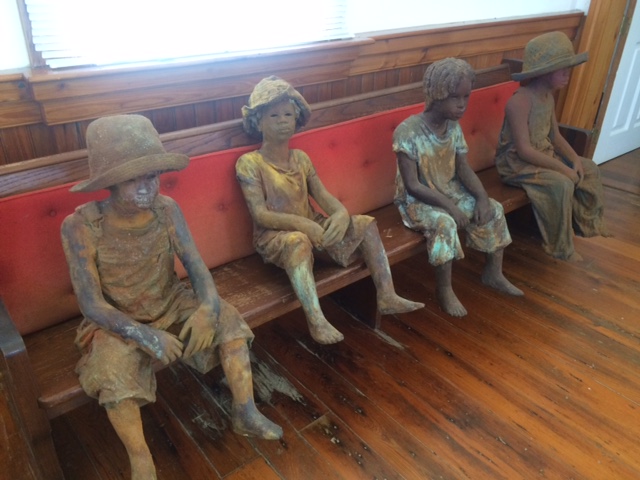
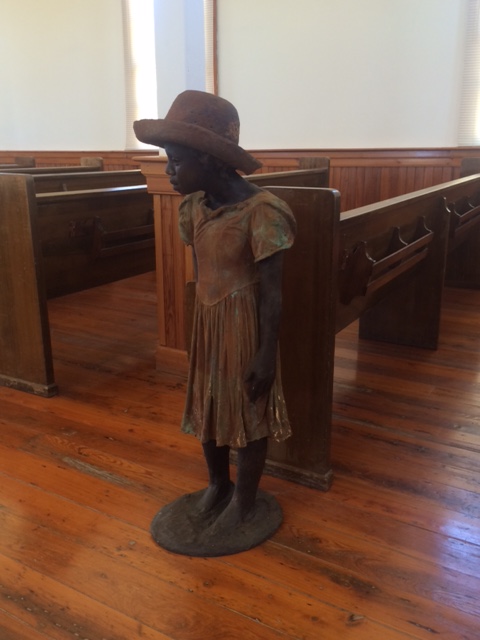
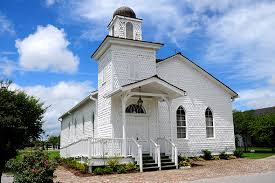
The plantation tour includes four distinct elements. Our guide Adina, a local woman with ancestral ties to slaves who worked these fields, began at the Antioch Baptist Church, the oldest African-American church within three parishes, which was relocated here. The church is a solid architectural specimen, noteworthy for the slave children statues scattered about the space. Their spirits, given substance by contemporary sculptor Woodward Nash, haunt the sanctuary. I sought out Peter Barber, sitting pensive near the altar.

images-4 images-2 images-3

imgres-1Then, Adina escorted us to three memorials that both honor slaves and forge the link between this former sugar plantation, the Federal Writer’s project, and Whitney Plantation’s mission. The Allees Gwendolyn Midlo Hall Memorial includes the names of all 107,000 slaves documented in the Louisiana Slave Registry. The Wall of Honor is dedicated to all of the slaves who served at the Whitney Plantation. The Field of Angels honors the 2,200 Louisiana slave children who died in St. John the Baptist Parish. Quotations of former slaves, collected through the Federal Writer’s Project, bring the plaques of names and dates to life.

imagesBy the time we reached the actual slave compound, two rows of shacks plus a blacksmith shop and a carriage house lining a lawn dominated by gigantic sugar kettles, the place was so crowded with ghosts the still air buzzed with life. “During harvest, slaves kept the sugar kettles boiling twenty-four hours a day. They needed to be stirred constantly. Heat, burns, accidents, no matter; for days on end, the endless churn of the sugarcane kettles stopped for nothing.”

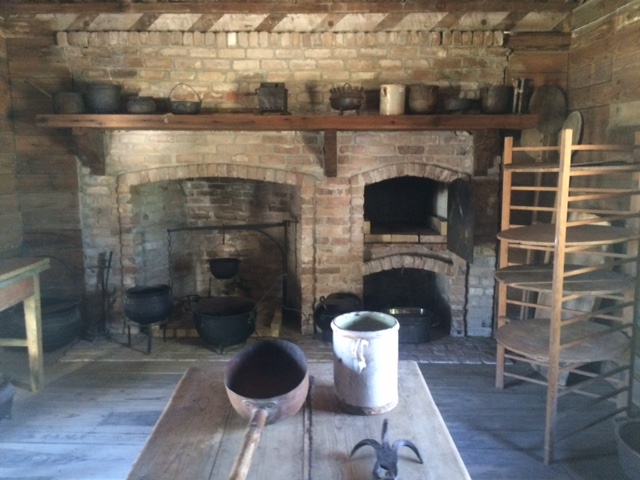
IMG_6315In the oldest outdoor kitchen in Louisiana, Adina described how two cooks and two apprentices, “prepared six meals every day. Three meals served on china with silver for the family in the Big House. Three meals carted to the commons in buckets for the 300 slaves.

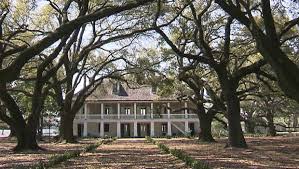
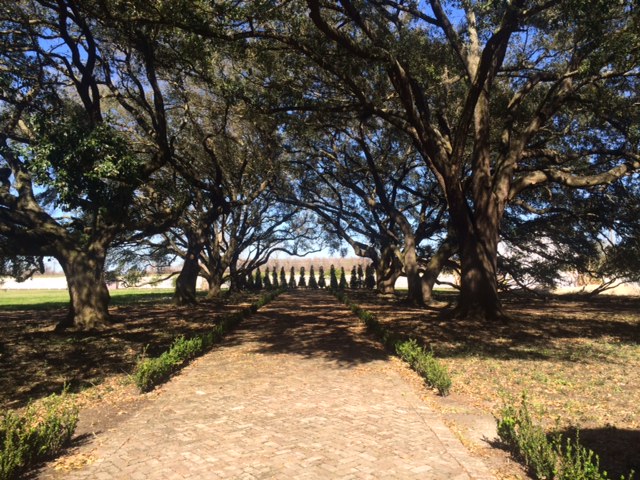
Last, we toured the refurbished plantation house at the end of an allee of trees that leads to the Mississippi River. The house is large, though not so grand as others along River Road. It has interesting features, elaborate faux painting, and notable furnishings. Adina described the history of the Haydel family, who ran the plantation for four generations before selling it to Mr. Whitney just before the Civil War. But compared to the slave quarters, the mansion is lifeless.

imgres  IMG_6321 IMG_6318

The Whitney plantation presents a more balanced view slavery than I anticipated. Quotations mounted on the memorial walls from the Federal Writers Project depict as many heartwarming vignettes as tales of inhumanity and violence. Perhaps it’s because human memory grows generous with the passing of seventy summers. More likely, it’s because even within life unjust as slavery, there are humane moments. Adina, whose ancestors stirred those kettles, admitted, “The institution of slavery was a bad institution, but within it you find the good, the bad, and all variations of human behavior.”

How will we live tomorrow?

Screen Shot 2016-04-18 at 12.26.54 PM“I hope that we will live peacefully. I just buried my husband four months ago. I’ve witnessed ugliness close-up. If we can live in peace, it doesn’t have to be perfect, but it will take us far.”

“In high school I was athlete but I have an attitude. A college professor took me aside and told me my attitude was in my way. Shortly thereafter my car broke down. A woman stopped and helped me. She gave me a yellow ribbon. I wanted to pay her. She said, ‘pass it on to someone else.’ She may not even remember me now, but that woman changed my life.”


Posted in Responses | Tagged , , , | Leave a comment

Profile Response: Wendy, Konriko Company, New Iberia, LA

HWWLT Logo on yellowThe four-dollar tour of the Konriko Rice mill includes a short film on the history and culture of Acadiana and a guided stroll through our nation’s oldest rice mill still in operation. The cypress timber and galvanized steel facility opened in 1912, became a National Historic Landmark in 1981, and continues to process, package and sell rice the same way it has for over one hundred years. Yet I can’t help thinking how the tour script has changed with the times. My guide Wendy focused on the inherent sustainability of century old methods.

IMG_6258

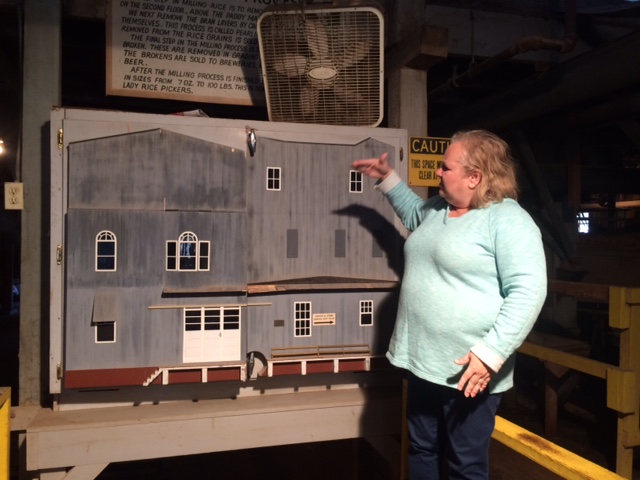
“Gravity is working for us all time.” Wendy unfolded the shadow box section of the mill that illustrates how raw rice is conveyed to the top floor and its bran is pearled off to become livestock feed. Pearled rice drops to the second floor to separate full grains from nubs. Nubs are used to make beer while full grains are polished for human consumption and conveyed to the first floor for packaging.


Wendy explained how the vertical organization creates a chimney effect that keeps the non-air-conditioned building habitable even in summer, how they reuse every byproduct so the six building complex generates only one dumpster of waste per week, even how the cats roaming the place provide organic pest control.

IMG_6259 IMG_6260

The Konriko tour also fed me grains of rice truth: no one is allergic to this gluten free wonder that comes in over 500 varieties. But the real question the tour posed was, can we survive if we loose the cheap energy that’s allowed us to construct a world without regard to gravity, sun, and wind? According to Wendy, if we return to the ways of our great-grandparents, apparently so.

images-2 images-1 images-3

However, shrinking production to the scale of Louisiana rice processing circa 1912 won’t be easy in a globalized economy where even small communities like New Iberia are subject to political and economic winds far away. When I asked Wendy the current price of rice, she replied, “It’s mediocre. Everyone’s waiting to see how the Cuba market is going to flush out. Cuba eats more rice than the entire statue of Louisiana can produce. If relations open and they stop buying from Asia, that will be good for us.”

How will we live tomorrow?

Screen Shot 2016-04-15 at 5.05.01 PM“We will find a way. We think we need bigger plants, bigger production, but we can do with less pretty well.”


Posted in Responses | Tagged , , , , | 3 Comments

Profile Response: Rosary House, New Iberia, LA

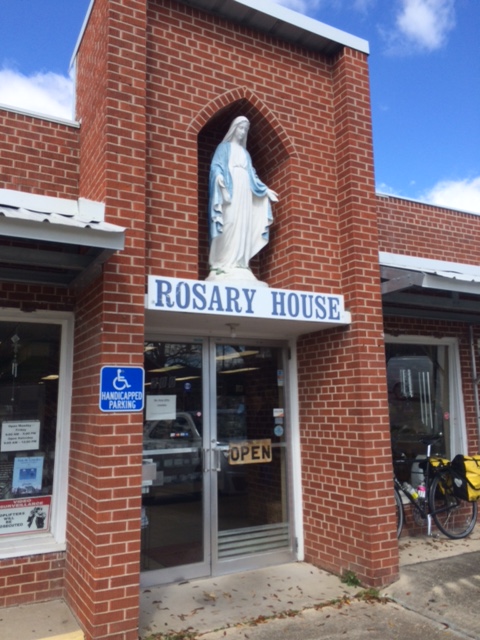
HWWLT Logo on yellowWhen the Rosary House store opened, during the 1960’s peak of Catholicism in the United States, it was about the size of an A&P grocery or Woolworth 5 & 10. Since then both A&P and Woolworth have gone bust. Meanwhile their successors, the Albertson’s and Wal-Mart’s of the world, sell food and sundries in structures larger than football fields. Rosary House holds steady, with plenty of space to display vestments, chalices, statues and Bibles as well as rosaries, cases and cases of rosaries. But don’t look for a Rosary House franchise to open in your town anytime soon. The market for handmade rosaries is a shrinking one, and this throwback retail/handicraft outlet can handle all of our devotional demand.

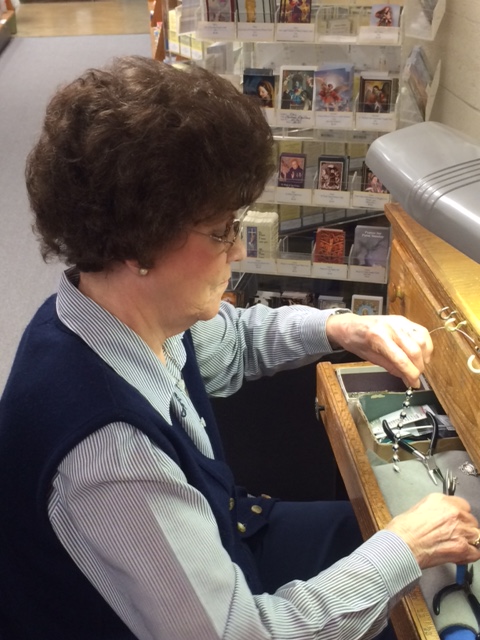
IMG_6246A highway sign, painted on the wall of an abandoned warehouse in New Iberia, advertised rosary manufacture. Since I love factory tours, I had to stop. Turns out, there is no factory; Rosary House assembles rosaries by hand. Half a dozen small desks with mirrors and a drawer of supplies are scattered around the store. The middle-aged women who wait on customers and stock the shelves bead rosaries between tasks. Ruth Herbert usually assembles two or three a day. “It depends on how busy we are with other things.”

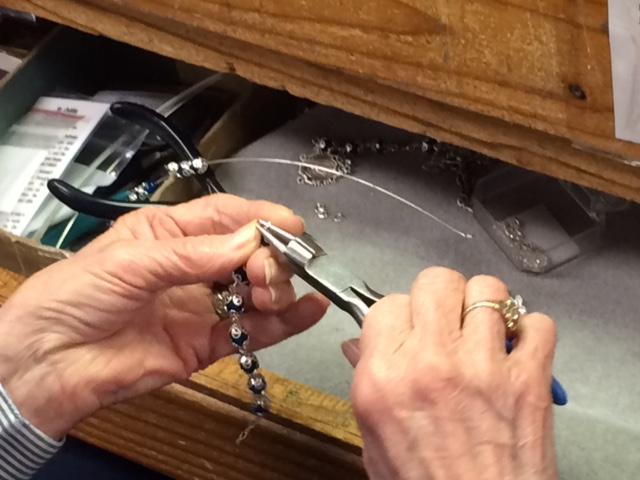
IMG_6247Rosary House’s signature creation is composed of 58 single color glass beads, each with a decorative sterling silver cap on either end, pieced together in reverse order from which rosary prayers are recited. The women crimp and curl a silver wire to the Madonna medallion that forms the rosary’s locus, slide a cap, a bead, and another cap onto the wire, snip it, and curl the end. Then they curl another wire in place, add another cap/bead/cap, and so on. Five decades of ten Hail Mary beads each with chain spacers and an Our Father bead between each decade. They attach the three introductory prayer beads from the bottom of the Madonna medallion. Last step is to attach the crucifix that prompts The Apostle’s Creed, the first prayer of the rosary.


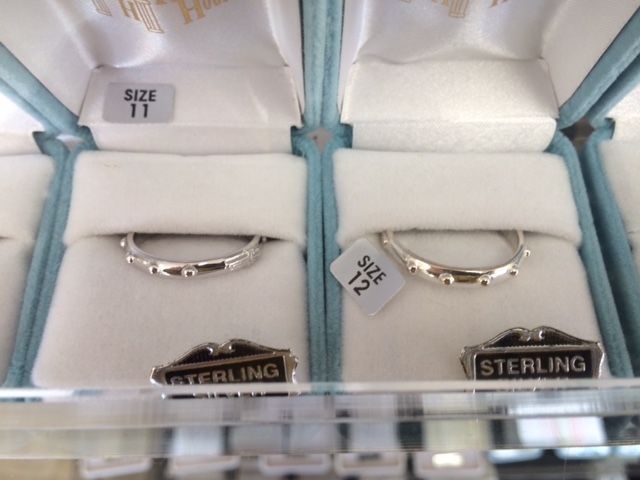
A handmade sterling sliver rosary in a jewelry case costs about $350. Rosary House also makes rosary bracelets (a set of ten beads that the faithful finger forward and back), and rosary rings that count prayers by twirling. In silver, these run from $30 to $50. For the budget minded, Rosary House offers manufactured rosaries and trinket rings, shipped from the other side of the world rather than assembled on site, for as little as 95 cents.

IMG_6248 IMG_6249 IMG_6250

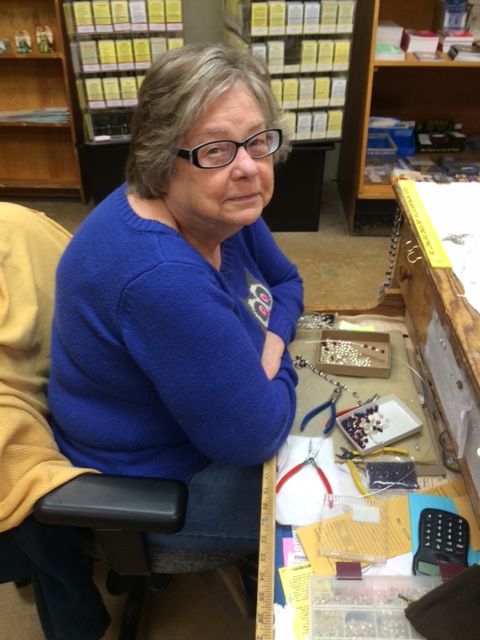
Ruth has worked at Rosary House 29 years. She’s the oldest employee by age, although Rose Istre has worked there longer. Rose manages the inventory and determines who needs to make what. She usually creates the special orders herself. “We do birthstone rosaries with beads for the birth month of each child or grandchild. They get pretty colorful.”

IMG_6254 IMG_6252

Linda makes funeral rosaries, nickel instead of silver, and therefore less expensive. “The men say the rosary over the body and then give the beads to the family. Sometimes the family keeps them. Sometimes they lay them with the body. Nickel’s not as good as silver. Once it turns, it can’t be brought back. You can make silver shine forever.”

How will we live tomorrow?

IMG_6255“I am going to New York City in May. My son is graduating from John Jay School of Justice. I’ve never travelled away from here before.” – Rose Istre

“Amen. We live with Jesus each day. His will be done.” – Ruth Herbert


Posted in Responses | Tagged , , , | 2 Comments

Profile Response: Mike Broussard, President, Cajun French Music Association, Lafayette, LA

HWWLT Logo on yellowBroussard Avenue, Broussard insurance, Broussard attorney, Broussard gastroenterology, Broussard on every third mailbox, even a town called Broussard. Like the surname Yeager in Ohio, Meyer in New York, (or Fallon in Boston); Broussard is common lingo in Acadiana. Mike Broussard, President of the Cajun French Music (CFMA), explained his lineage over shrimp etoufee and jambalaya at Don’s, Louisiana’s First Cajun Restaurant. “Cajuns came here in the 1750s. First we went to the French territories in the Caribbean and then to Louisiana. Seven Broussard brothers came to Acadiana and split between Lafayette and Baton Rouge. They had many descendants.”

imgresMike was born and raised in Beaux Bridge, just east of Lafayette. The telephone company transferred him to Baton Rouge, then Munroe. “North of Alexandria is different; Monroe was culture shock to me.” He returned to the Hub City and retired in 2001. “Lafayette is the most hospitable place on earth.” Eighteen months later Mike went back to work for small-company but finally retired for good last fall.

“We Cajuns like to party. We work hard and party hard. In Baton Rouge, my wife and I heard about CFMA’s local dances, joined the club, and kept our membership when we moved back to Beaux Bridge.” Now, Mike is president of the organization’s eleven chapters, which span from southern Louisiana to Houston, San Antonio, even Chicago. “CFMA’s mission is to promote Cajun music andimgres-3 culture. Mardi Gras is rooted in Cajun culture. It started with big celebrations around Biloxi area, then NOLA took over.” From CFMA’s perspective, New Orleans’ Mardi Gras has strayed from its Cajun roots. The organization focuses on traditional celebrations like Courir de Mardi Gras, a rural pilgrimage where a band of locals in costume go from farm to farm to collect items for a collective celebration.

Those of us who hail from north of I-10 know Cajun culture through its music. “Most Cajun bands have five members. You have to have an accordion and a fiddle. Others add a steel guitar, bass, rhythm guitar, triangle, and drums.” Bands used to be all male, but many are now co-ed. “One has all girls but the drummer and Sheri Cormier’s the Queen of Cajun Music.” All Cajun songs have lyrics. Any musician can be the singer. “Vocals are done in French. Some musicians can’t even speak French, they just sing the hell out of it.”

imagesAlthough just about every band produces CD’s, live performance is Cajun music’s soul; dances happen every weekend. “There are a lot more Cajun bands now than there were thirty years ago. Cajun music is a slow waltz or two step; Zydeco has a snappy beat. It comes from Black Americans and Creoles with Cajun influence. There are traditional songs and new songs; CFMA stresses new songs in the traditional styles.”

Screen Shot 2016-04-15 at 4.29.11 PMCFMA sponsors Le Cajun Festival, “a three day event that takes place the third weekend in August. On Thursday we have a dance with awards to children for French immersion and ‘Youth Night’ to celebrate new talent. Friday evening we present awards. Saturday is an all day dance: five bands from 10 a.m. to 6 p.m., followed by a feast of pork stew, gumbo, hamburgers, and jambalaya. There’s no politics: just culture and music.”

I asked Mike why he thought Cajun music was increasing in popularity. “The music grows from the family. Parents and grandparents bring children to festivals from an early age. Young people play at our monthly meetings. It is an active music. We ask the children that win our awards what motivates them, and they talk about being introduced to this music by their parents.”

images-5 images-1 images-2

When I asked Mike if he played an instrument, he smiled. “I’m not a musician; I’m a dancer. I told my wife I want Cajun music at my funeral.”

How will we live tomorrow?

IMG_6237“I thought about it a lot. Here, in Louisiana, in Cajun country, we are going to bring our culture with us for sure. Many kids are learning our music, it will survive me.”


Posted in Responses | Tagged , , , , , , , , , | Leave a comment

Profile Response: Katie Hucker & Jonathon Langlinais, Lafayette, LA

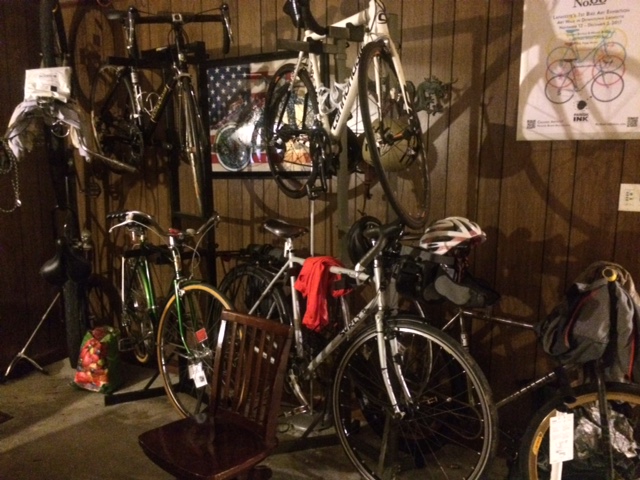
HWWLT Logo on yellow“This is my life. I have an obligation to actualize my own happiness. That justifies the bike shop, tool store, animal rescue we are running here.” Jonathon Langlinais’ tract house; the last one on a modest street next to a drainage channel, two miles from downtown Lafayette and a few blocks south of I-10; has an unassuming exterior. But inside, the carpets have been ripped out to reveal the concrete slab, a tool cart fills half the kitchen, and bicycles hang from the living room walls and ceiling, including a vintage Schwinn circa 1930 and a 1960’s Sting Ray with banana seat and hi-rise handlebars.

IMG_6227The great thing about Jon, his partner Katie, and others I’ve met here, is that the Cajun prescription for actualizing your own happiness isn’t sitting in front of the tube in your Barcalounger; it’s mixing it up with others in the community. Jon and Katie spend about thirty hours a week running their pool service. “Working three days a week is great for everything but retirement.” The rest of their time is devoted to bicycle riding, advocacy, music, dogs, celebrating life and all things Cajun.


Lafayette, the Hub City, is the center of a region playfully described as Acadiana. People here share the tragedy of their roots. “The story of the Acadians was the first genocide in North America, what the British did to my people.” But they also share the festive temperament embedded in their motto, ‘Laissez les bons temps rouler!’ (Let the good times roll.)

IMG_6228Acadian identity is actually growing stronger. Jon’s parents spoke English as a second language and discouraged him from learning French. Today, that assimilation has reversed. John’s children attended French immersion schools. “We are tied to tradition, not just in language. We still hunt and fish; the butcherie is still the traditional killing of the pig.”


Katie moved to Lafayette from the Midwest nine years ago. Though she’s not Cajun, the dual threads of honoring history and celebrating the moment resonated with her. “I have a party streak. I’m a huge Amanda Palmer fan, and went to her show every year in Chicago. At my first Dresden Doll concert, I wore a wedding dress. Afterwards I went up to Amanda and asked her to marry me. Unfortunately, she said no. Fortunately for me, I met Jon.”

IMG_6229Ten years ago, Jonathan started Bike Lafayette to advocate for better cycling conditions. The City of Lafayette asked his group what they wanted so they marked up a map. The city accepted their plan, no pushback, and is implementing it as streets are repaired and replaced. “I never knew it would be so easy; all we have to do is ask.” Recently he started Bike/Walk Louisiana, a statewide advocacy group.

IMG_6230A few years ago, Jon made his own bicycle tour, traversing the country from north to south along a route that roughly paralleled the Mississippi River. “I biked 30 days, gained 15 pounds, and lost one shirt size.” He loved touring but was happy to return home. “This is the best people on earth in this town.”


How will we live tomorrow?

IMG_6233“Interesting because it’s ‘we,’ not ‘you.’ Is it ‘we’ as a community or a larger ‘we’ as a nation? I will continue to live as I have, being a good steward to the environment, focusing on family and friends.

“As a ‘we’ it’s disheartening. I spent six years in the army. I met people from all over the country. Diversity is our strength, not our challenge. It makes us stronger, but the polarization I see is a problem.” – Jon

“Hopefully we’ll wake up. And then we’ll go from there.” – Katie


Posted in Responses | Tagged , , , , , | Leave a comment

Profile Response: Juanita Campbell, Pecan Island, LA


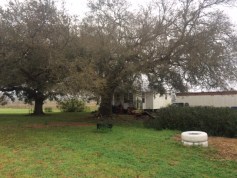
HWWLT Logo on yellowWe have a home and hearts that know no strangers. Currently six dogs, three cats, chickens. We have a futon and two air mattresses and can push furniture around to make a lot more floor room. We are not fancy here, pretty simple living in a very rural section of Highway 82 between Abbeville and Cameron. Smokers and drinkers.

When I read that warmshowers profile, I changed my route. I stuck tight to the Louisiana coast in order to meet Juanita Campbell. Anyone who wraps up a profile aimed at cyclists with the phrase, ‘smokers and drinkers’ is worth pedaling a few extra miles for.

IMG_6219Juanita greets you by clasping both hands. She looks into your eyes and says, “Welcome to my home. Be at home here. Stay as long as you like.” She directed me to put my bike in the shed and introduced a few dogs. Inside, she stuck a cold beer in my hand and outlined house rules. “I prepare the first meal, after that, graze on your own. There’s plenty of food. Don’t leave one spoonful in a container, finish it up and add it to the shopping list here on the refrigerator.” She showed me my futon, the bathroom, the Louisiana map on the kitchen wall, and the atlas for route planning. “I love maps. Can’t stand fiddling with them on the Internet. Give me latitude lines.”

Before I’m quite settled we’re out feeding the herd: dogs have free reign anywhere, but cats are not allowed indoors, “because they won’t stay off the counters.” There are fifteen egg laying chickens – “I get six or seven eggs a day” – a pair of new chicks, a half dozen larger chicks, a dozen meat chickens and a bunch of ducks. “I haven’t figured out what to do with the ducks yet.” Juanita has no children but there’s a husband over in Cameron who runs the supply point for Halliburton, where the multinational assembles everything from pipefittings to ketchup for transport to off shore rigs.

IMG_6214Juanita grew up in northern California, but her mother was born here. “We didn’t get electricity until 1958. Highway 82 was a ridge in the marsh; you could traverse it by land in low tide. Otherwise, people travelled by boat. The ponds along the south side of the highway were made from the excavation to build up the road.”

After Juanita’s mother left her several parcels, Juanita returned to Pecan Island, bought a house in Abbeville for $9,000 and moved it to the 9-1/2 acre parcel along Hwy 82 where she lives with her herd in the shade of ancient oaks. “I’ve lived here long enough to forget that the world works different north of I-10.”

The whole group evacuated during Hurricane Rita, returned afterward, lived in a tent for five months, stripped the flood-damaged house to its bones, and added a sizable addition. “We don’t put our folks in nursing homes. I want my husband’s parents to come here when they need.” Between the expanded house and the trailer on the property, Juanita envisions, “a community of old farts. A place where we remind each other to take our pills.”

imagesHurricane Rita changed Pecan Island, and from Juanita’s perspective not for the better. “Everybody came back, but not everybody stayed.” The School Board closed the local school. Juanita believes it had more to do with oil royalties than education. “We had 600 families before the storm; we have about 200 now. What few children there are have to travel twenty miles to school.”

While Pecan Island is not a place for families anymore, it’s become a place for ‘camps,’ vacation houses on eighteen-foot stilts that sit empty most of the year. “Its a rich man’s paradise built in a poor man’s field. They build a million dollar camp and come a few times a year to shoot duck. By the time you add in all the permits, ammo, and boats involved, each dead duck costs about three hundred dollars.” Juanita was offered $250,000 cash for her parcel, but she’s not selling.
IMG_6220


Juanita is simultaneously earth mother and political siren. When she gave me a hug goodnight she commended me to rest in ease and grace. She rose in the morning with a lilt in her voice exclaiming the new day. But she also railed against the extraction economy that permeates the Louisiana coast and decried the swaths of dead oaks where dredging allowed salt water to seep into fresh water zones.

Her approach to ‘How will we live tomorrow?’ was similarly bifocal. Like many people, Juanita instantly shifted the ‘we’ to ‘I’. She wanted it to be more projective, for the very reason that I don’t state it that way. Yet, as our conversation wore on, she came back to the question again and again, each time with deeper, more inclusive views.

I rose the next morning, helped with a chore, and left by 9 a.m. as planned. Juanita was surprised by my diligence. “Most people don’t get going until at least noon; one cyclist stayed here four months.” However bewitching the bayous, Louisiana can’t alter six decades of this Yankee’s habits. Perhaps some day I will return and follow Juanita’s parting advice: “Leave slowly, come back quick.”

How will we live tomorrow?

IMG_6223“The question is sneaky, as if you are trying to get into our minds. I will live tomorrow the way I live today. I will use less, be humble, share more, and do what I want to do.

“I think you should ask, what are your intentions? That allows me to project what I want. What’s the point of this question? I can see lots of bar fights coming out of it.

“There, I answered your question. Life will be quiet, loud, fast, slow. Is that what you want?”

__________

“Your question, maybe its about the environment. What are we doing, taking all this from the earth for the fat cats?”

__________

“I’m still thinking about your question. We have more than we need, more than we want, and more than we can do without. Maybe we’ll learn that better tomorrow.”


 

Posted in Responses | Tagged , , | 10 Comments

Profile Response: Stephanie Harren, Museum of the Gulf Coast, Port Arthur, TX


HWWLT Logo on yellowBack in the days of vinyl, I put Janis Joplin’s Greatest Hits on the turntable every Saturday morning and set the volume to 10 while I cleaned my apartment. I made my bed with ‘Me and My Bobby McGee,’ scrubbed the kitchen floor to ‘Piece of my Heart’ and top dusted to Janis’s version of ‘Summertime,’ the most searing rendition ever recorded of the world’s most popular cover. I read Buried Alive in college. So, when I came near the lonely lady’s birthplace, I pedaled to the far corner of Texas to visit Port Arthur, Janis Joplin’s hometown.

Downtown Port Arthur is not merely dead. The broken windows of the empty shells that line Proctor Street actually suck the life out of the occasional motor vehicle or wayward pedestrian. The most decrepit urban center I’ve encountered on my journey is a no man’s land, a haven for pigeons and seagulls to roost, a deChirico landscape below sea level. A place once throbbing with life – about the time Janice was coming of age – is now dead as the singer herself, and in it’s own way, just as tragic.

imgres-1 imgres-2

Smack in the center of the abandonment sits a former bank building, a mid century mausoleum to the capitalism that’s shifted away from the refinery fumes, to the higher ground and big box stores along the highway. The double door facing the street is locked. But around back, off the parking lot, is the entrance to the Museum of the Gulf Coast. I was the only visitor on a February Friday afternoon. Somehow, my communication with the staff had gotten confused. Stephanie Harren, Education Coordinator, forgot I was coming. Perhaps she never even knew the director palmed me off on her. Regardless, Stephanie gave me an insightful tour and shared personal insights about tomorrow.

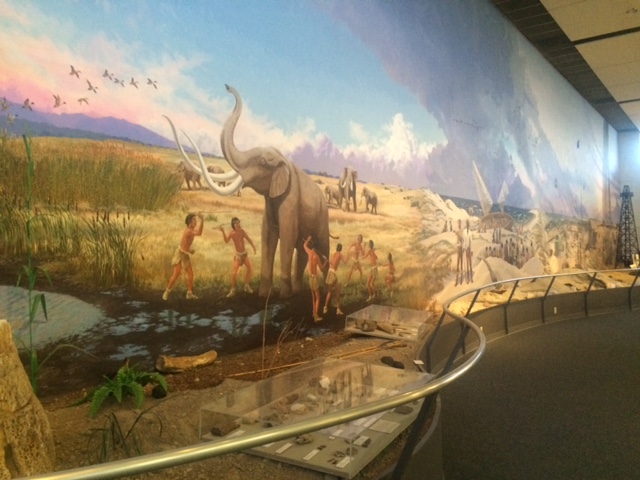
IMG_6134The most striking element of the Museum of the Gulf Coast is a two-story mural covering the west wall of the main gallery. The largest indoor mural in Texas illustrates the region from prehistory to the present. Stephanie explained the museum’s mission; to present the geology, archaeology, history, art and culture of the Golden Triangle: Beaumont, Port Arthur, and Orange, Texas. “We take this area where things come together and tell its story. Houston marked the limit of the glaciers. This was a savanna where animals from the north and south converged.”

Stephanie is particularly keen on Cabeza de Vaca, who shipwrecked here in 1528, and proceeded to explore Texas; the same de Vaca that Andy Cloud told me about in Big Bend, 700 miles to the west. According to Stephanie, “He was an explorer, not a conquistador.”

imgres copyStephanie left me to wander the artifacts on my own: a fantastic confection of wooly mammoths, oil derricks, Fresnel lens’, stuffed alligators, fiberglass cars, Robert Rauschenburg abstractions, and homages to the popular musicians who herald from this sandbar of Texas swagger and southern charm. Although Janis occupies the prime corner of the second floor music gallery, she shares the spotlight with sixty other musical notables, including Percy Sledge, ZZ Top, Tex Ritter, Johnny Rivers, and the Boogie Kings. Oil and water mix well here to create music.

images-3 images-1 images copy

Stephanie found me a few minutes before closing. “Port Arthur was always a very progressive town. Now it’s dead.” When I asked what happened, she shrugged. “Life.” Then, Stephanie revealed an entirely different side; a divorced mother who’d homeschooled her children, explaining history as she thought it needed to be taught, until her ex-husband took her to court and gained custody due to her unconventional parenting. “The system needs to be disrupted; it took away my kids.”

How will we live tomorrow?

Screen Shot 2016-04-14 at 9.48.29 AM“I don’t like the wording ‘we’ I can’t speak for ‘we.’ I wouldn’t want to speak for this community.

“Since coming here I’ve gotten very much into history. Why do we think the way we do? What drives us forward? We do amazing things but we have a dark side. We all have the same DNA. We have to see people for what they are and what we do. Schools have a tendency to whitewash history. But the true story is so much richer than the myth. I want to tell the true stories of how the past created our present. Without these seas that covered this area thousands of years ago we would have no energy jobs.

“Our stories need to be disrupted. It’s about working for the truth as opposed covering it up. How you live tomorrow, as an institution, is to know your past and use that to avoid mistakes in the future. It’s a cliché to say history will repeat itself, but it’s true.”


Posted in Responses | Tagged , , , , , | 1 Comment