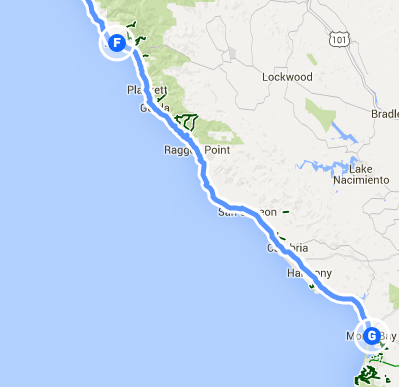
Trip Log – Day 172 – Los Osos, CA to San Luis Obispo, CA

Morro Bay to SLOOctober 24, 2015 – Sun, 70 degrees

Miles Today: 21

Miles to Date: 8,925

States to Date: 25

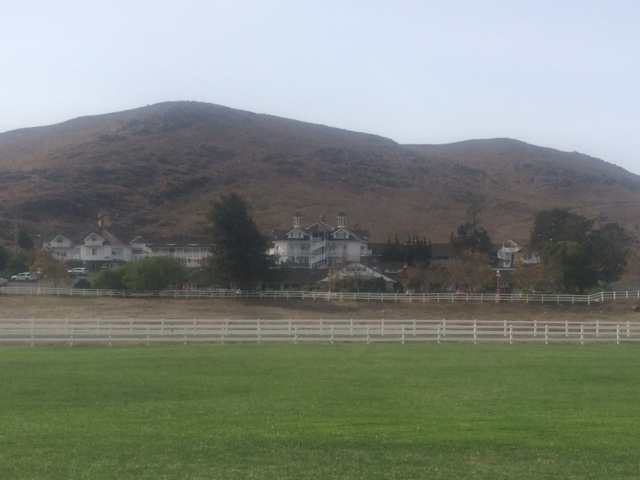
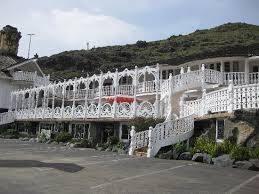
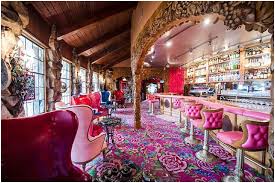
IMG_4909When you have an unavoidable day of administration work to set up travel plans for Santa Barbara and Los Angeles, it’s lucky to be in San Luis Obispo, where the Madonna Inn offers a midday diversion from reality. Although I visited Cal Poly’s campus and SLO’s vibrant downtown, the main event of this college town is the eclectic Madonna Inn, a three-dimensional confection that Alex Madonna constructed at the base of his very own mountain.

imagesThe urinal in the men’s room is so famous it’s impossible to use. Women are always barging in to take a peak.


images-4The cakes are also noteworthy. I had a piece of Toffee Crunch for lunch – it was a complete meal, except perhaps for its nutritional content.


images-3 images-1

images-2I didn’t get to see any of the 100+ unique rooms, but the lobbies and cafe were plenty garish for me. Besides, two hundred bucks a night and up is well beyond my taste. Instead, I stayed with a terrific friend-of-a-friend host whose house has a commanding view of the entire valley – including the Madonna Inn.

Posted in Responses | Tagged , | 2 Comments

Responses: How will we live tomorrow?

HWWLT Logo on yellowHow will we live tomorrow?

“I try to live in today. Yesterday is gone. Tomorrow is not here yet. I try to be in the moment. It’s like Christ and the cross. Christ was crucified between two liars. Today is real. Yesterday is clouded by memory; tomorrow is unknown. We can only trust Christ. We can only trust today.”

Denise Adams, CALPERA Conference attendee, Monterey, CA

How will we live tomorrow?

“However you want to live.”

Abraham, real estate developer, at GooglePlex, Mountain View, CA

“Religions are like brothers. They each have their similarities but also their differences. I am Jewish. I was in a dark place. I read Rumi, the Persian poet. Through him, I found myself, and then I found my Jewishness.”

How will we live tomorrow?

“Like today, but with less alcohol and friends.”

Bree, Santa Cruz newcomer at Seabright Brewery Neighborhood Night, Santa Cruz, CA

How will we live tomorrow?

“I assume tomorrow will represent some sort of Orwellian nightmare! One can only hope lol.”

Xander Panda Bear, event planner, Santa Barbara, CA

How will we live tomorrow?

“Retirement is when no one works for you.”

Tom Black, helicopter search and rescue volunteer, San Luis Obispo, CA

How will we live tomorrow?

“I’ve always worried about what my worth is; what am I giving? My goal is to touch people. I know I’ve done that.”

Debbie Littlejohn, Alaskan hiker, San Luis Obispo, CA

How will we live tomorrow?

“Private Google and Apple transport services rob us of community. We have to reign in the elites.”

Will Bartee, Software Engineer, Santa Cruz, CA

How will we live tomorrow?

“I m going to the tip of South America to teach English.”

O’Brian Reilly, 81, Public School Teacher for 38 years, Aptos, CA

How will we live tomorrow?

“In order to understand how we will live tomorrow, we have to be able to know where we are today. We cannot access that. We can’t see where we are from the inside.”

Scott Joly, Social instigator, Santa Cruz, CA

How will we live tomorrow?

“By helping each other.”

Mike Nelson, surfer from Atlantic City NJ in Big Sur, CA

How will we live tomorrow?

“I am creative. I will cook, sew and make things for others. I am living my dream right here. I have the sea, the sun, and I sell cookies.”

Stephanie, Brown Butter Cookie Company, Cayucos, CA

Posted in Responses | Leave a comment

Trip Log – Day 171 –Pacific Valley, CA to Los Osos, CA

Lucia to Morro BayOctober 23, 2015 – Sun, 70 degrees

Miles Today: 66

Miles to Date: 8,904

States to Date: 25

 IMG_4864Warmshowers superhost Murdock is a San Francisco 49’rs superfan, so even though the Seahawks trounced the 49’rs Thursday night, I still woke up more sports paraphernalia than I’ve even seen. Murdock lived up to his reputation by fueling me with waffles topped with ice cream and real maple syrup for breakfast. I pedaled mighty well on that combo.
IMG_4870

IMG_4877The first portion of my day was more Big Sur terrain – incredible hills cut into the coast with occasional exclusive estates hanging over the sea. At one vista a guy hovering on the guard rail exclaimed, “You never get tired of this.”  Which is true.  Watching the waves is mesmerizing and majestic.

IMG_4879The world leveled out into a broad coastal plane where the cycling was easy and the ocean gorgeous. Crowds of elephant seals sunned themselves on the sand, and a few splashed in the water.

IMG_4881 IMG_4883

IMG_4888I stopped in Cambria for lunch – the burrito at Sandy’s Deli is very good. South of town California One pulls away from shore, and the landscape reverts to California’s trademark bald brown hills.

I fell in love with the beach town Cayucos, and not just because it’s home of the Brown Sugar Butter Cookie, though that would be reason enough. Cayucos is funky and friendly and the air’s a perfect mix of sun and sea. Besides, the local church touts noteworthy messages.

IMG_4892 IMG_4890 IMG_4893

Morro Bay, just down the road, is larger and less charming. Highway One turns into a freeway and I felt the first surge of Southern California speed. Fortunately, I turned away from the highway to my host’s home in Los Osos and witnessed a dramatic sunset over the marshes.

IMG_4894

Posted in Bicycle Trip Log | Tagged , , , , , | Leave a comment

Trip Log – Day 170 – Monterey, CA to Pacific Valley, CA

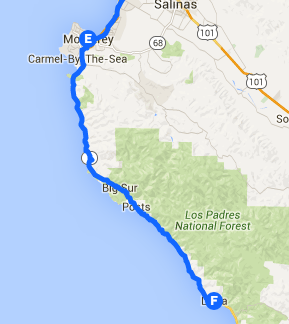
Monterey to LuciaOctober 22, 2015 – Sun, 70 degrees

Miles Today: 63

Miles to Date: 8,838

States to Date: 25

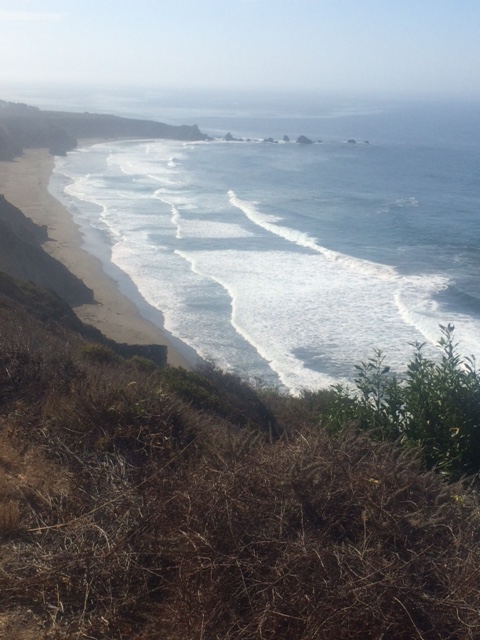
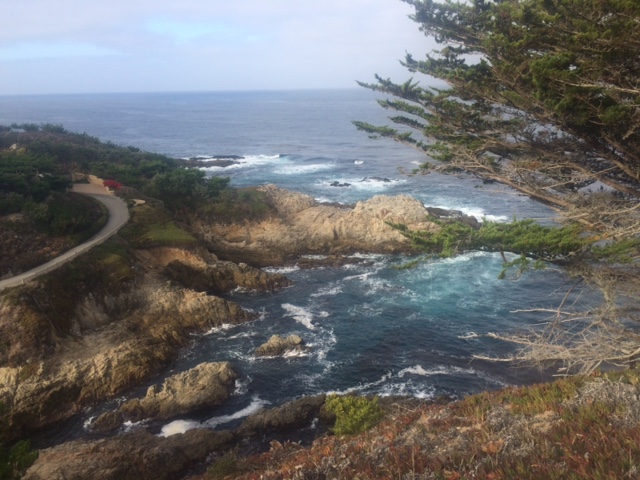
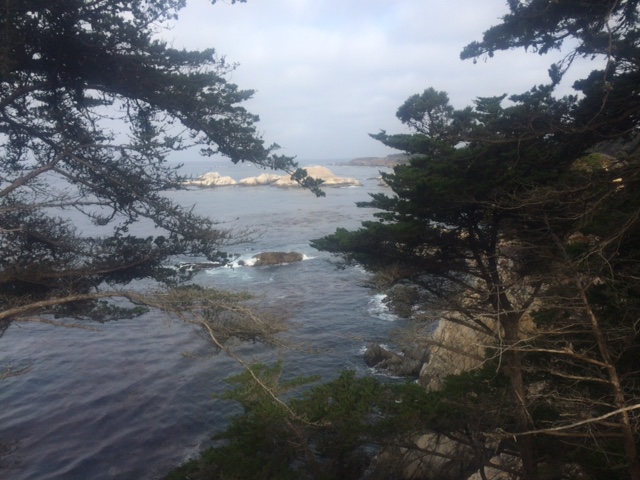
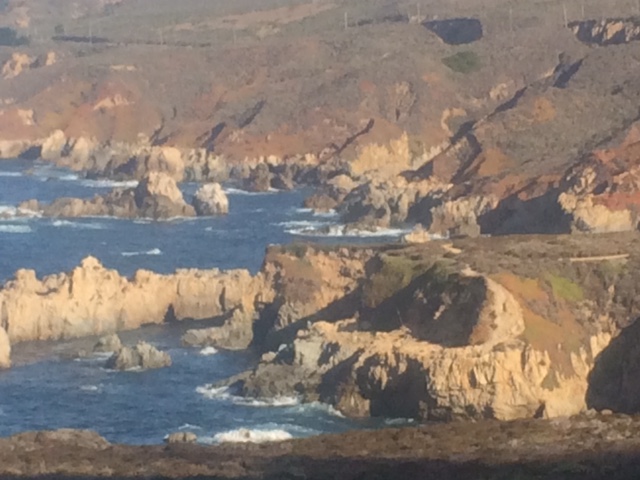
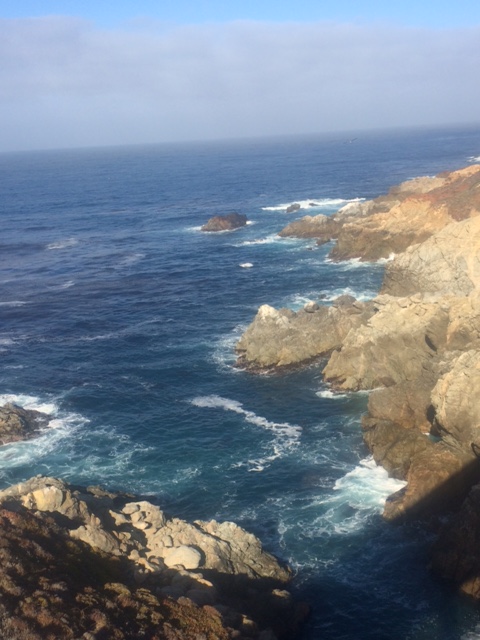
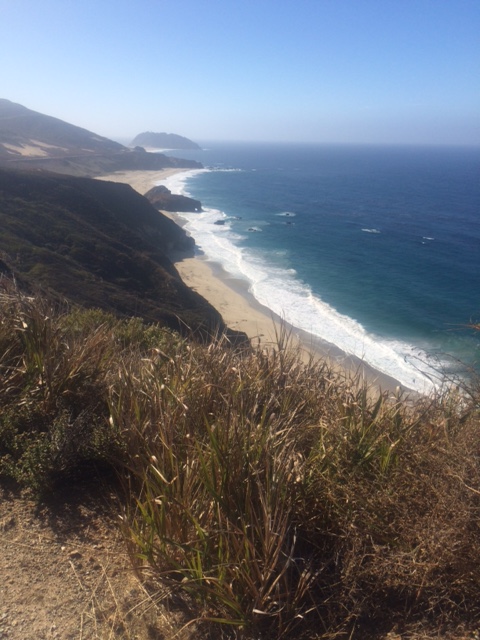
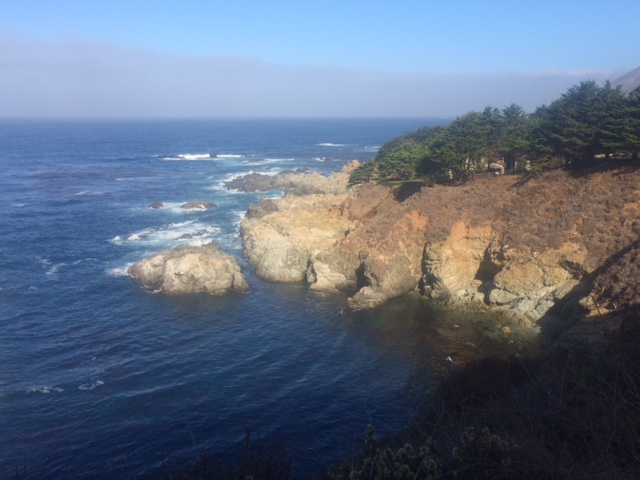
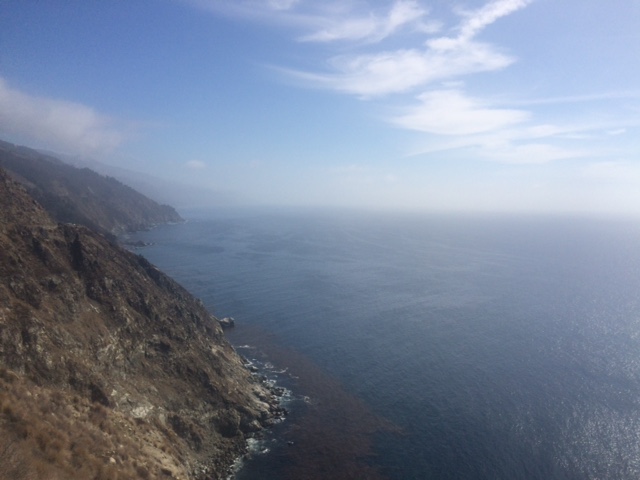
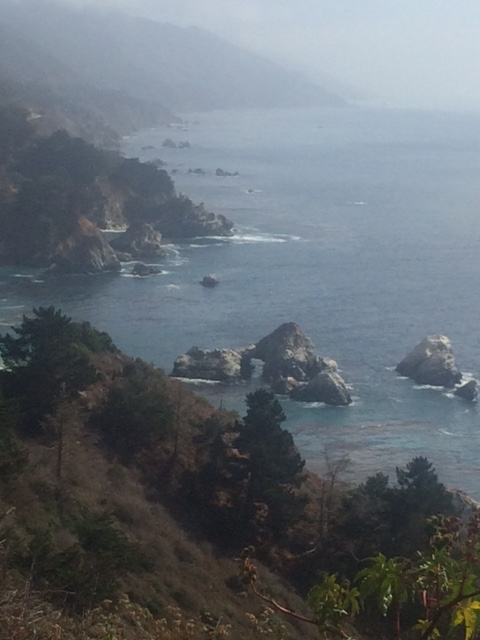
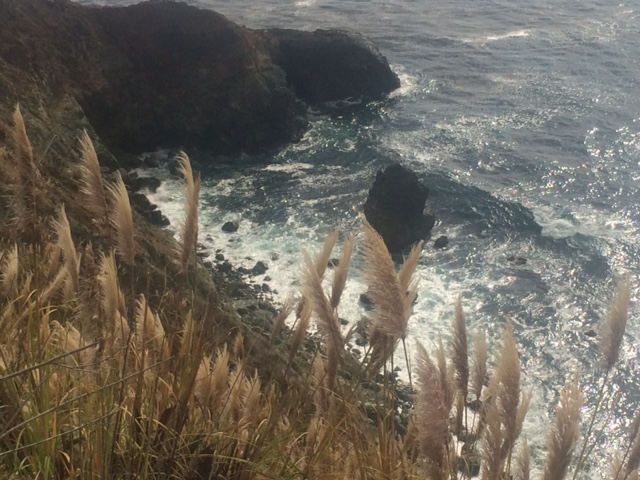
 The fabled ride down California Highway One south from Carmel through Big Sur is a captivating sequence of the sea meeting the land. There are silky beaches, shallow shoals, waves crashing against granite outcroppings and water spouting up sheer cliffs. I began the day beneath a carpet of clouds, pedaled through hours of bright sun, until misty fog rolled over the hills. The sea scent was strong. The sun’s heat was dissipated by thermal drafts and crosscurrents through the canyons. Giant hawks swooped and circled, playing on the tricky breeze. The road itself is gorgeous, a sinewy ribbon that weaves up and down cliffs. Elegant bridges span deep creeks. Highway One was built during the Depression; California’s first scenic highway. It’s still the best.

IMG_4822 IMG_4821 IMG_4825 IMG_4826

IMG_4832 IMG_4842

IMG_4828 IMG_4849 IMG_4852 IMG_4853

IMG_4860

Posted in Bicycle Trip Log | Tagged , | Leave a comment

Profile Response: Dennis Perry, Wayerhaeuser, Longview, WA

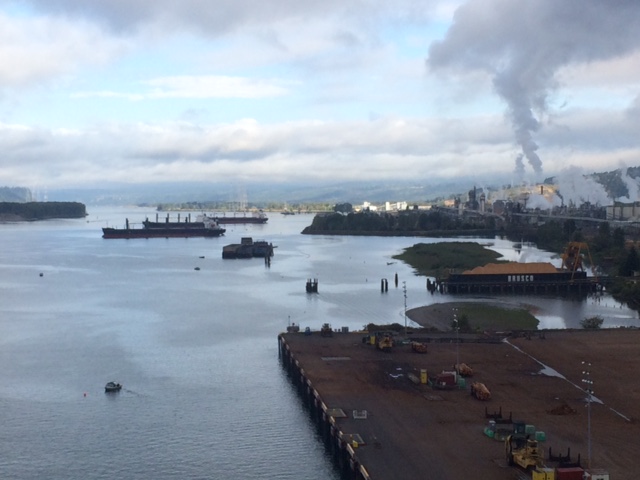
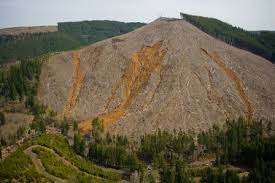
HWWLT Logo on yellowWeyerhaeuser signs are all over Washington’s western forests, dating when the company harvests and replants forests. There are other signs of the giant company as well – huge mills, billowing smokestacks, rows and rows of workers’ housing near the two-mile long plant in Longview, impoverished Raymond where the industry has pulled back. Dennis Perry has been a systems analyst at Weyerhaeuser for over thirty years. He loves the company that has been good to him and has done so much to help America grow. But he is cognizant of the tricky balance between agriculture, ecology, and industry which factors into everything Weyerhaeuser does.

IMG_3843Frederick Weyerhaeuser purchased a bankrupt mill in Wisconsin in 1900, bought up surrounding forests, clear cut them, and made a fortune. He moved the company to the Northwest in search of more forests, and by the 1940’s the company realized it needed to rethink the entire enterprise. Instead of considering trees a one-time resource, they began to treat their land as agricultural holdings to be replanted and harvested anew. Lumber is an unusual crop because trees take so long to yield. Still, Weyerhaeuser’s scientists have genetically modified Douglas firs that used to be fully mature in 75 to 80 years. Now they’re ready for harvest within forty years. This seemed like an unambiguous good until the 2000’s when studies revealed that faster growing forests don’t support the range of bio-diversity found in traditional forests.

imgres-2

The company, which now owns over seven million acres of timber, exists in a complex web of regulation and preference, such that one can argue that it is unfairly coddled or inhibited depending on your point of view. As an American company, Weyerhaeuser has access to lumber in federally owned forests, which foreign firms do not, but it must sell that lumber to domestic mills. On its own land, Weyerhaeuser still clear cuts. The company has few milling operations anymore. It produces mountains of pulp for paper and disposable diapers. The rest of it’s own lumber it ships overseas.

imgres-3Dennis is not a policy maker, advocate, or protester. He is expert and making whatever Weyerhaeuser chooses to produce as efficiently as possible. But the history of the company is representative of the challenges we have in moving toward a sustainable world. Historically, we’ve rewarded people of great initiative, even when that initiative pillaged the land. Although the Weyerhaeuser family no longer owns the company that bears their name, the shareholder’s objectives that shape how seven million acres of our country are treated do not necessarily align with the objectives of the rest of us.

How will we live tomorrow?

IMG_3839-1“I am biased by how I am looking forward to living in retirement. I enjoy cycling and calling home a place where I do many things without getting in a car. I have a Honda, though I can’t recall the last time I put gas in it. When I retire, I look forward to having a lower impact in the world.”


Posted in Responses | Tagged , , | Leave a comment

Trip Log – Day 169 –Santa Cruz, CA to Monterey, CA

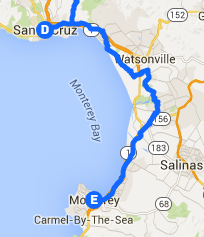
Santa Cruz to MontereyOctober 21, 2015 – Sun, 70 degrees

Miles Today: 51

Miles to Date: 8,775

States to Date: 25 

IMG_4798Pedaling south along the cusp of Monterey Bay offers something for everyone. My day began with great coffee and chat with my Santa Cruz couchsurfing hosts about the state of the world. Before leaving town, I ate a healthy but pricey breakfast at Staff of Life’s community table, and then cycled side streets to avoid California 1 traffic.

IMG_4806Eventually I got on Alameda Road, which parallels the bay with lettuce, kale, and strawberry fields. It was strawberry harvest time, which is a labor-intensive activity. Crowds of Mexicans bent over the low plants, picked the fruit, and placed them directly into the plastic Driscoll’s containers we find in every supermarket. Perhaps the containers get rinsed somewhere along the line, but I will be extra diligent to wash them out of the box from now own.

IMG_4802 IMG_4800

Newly planted fields are wrapped in plastic sheathing that shimmers in the sun. Laborers walk each aisle and cut a circle in the plastic every foot or so to let the plants emerge. Additional laborers hand dig tranches along the ends of each row for irrigation. The crews are so large portable toilet trailers and taco vendors service the hardworking people.

I stopped in Watsonville for some excellent Mexican pastries. Unfortunately someone ripped my tire pump off Surly while I ate. I replaced it at the next bike shop, with one that actually works better. Still, it’s disheartening that people are compelled to damage and steal.

IMG_4810Moss Landing has a landmark power plant, incredibly cheap fruit stands, and really easy riding across the lowest portion of the bay.

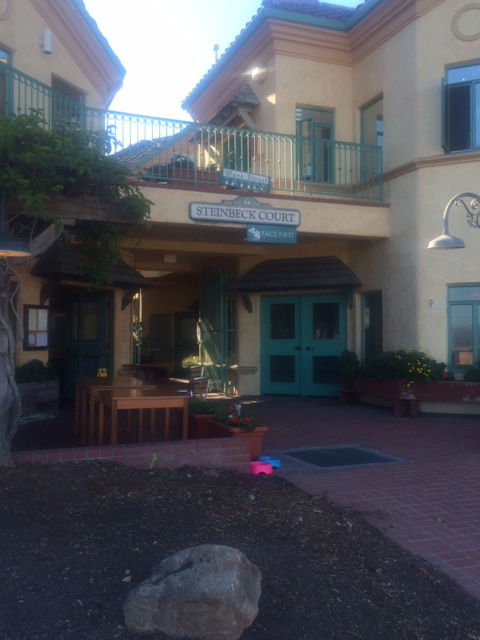
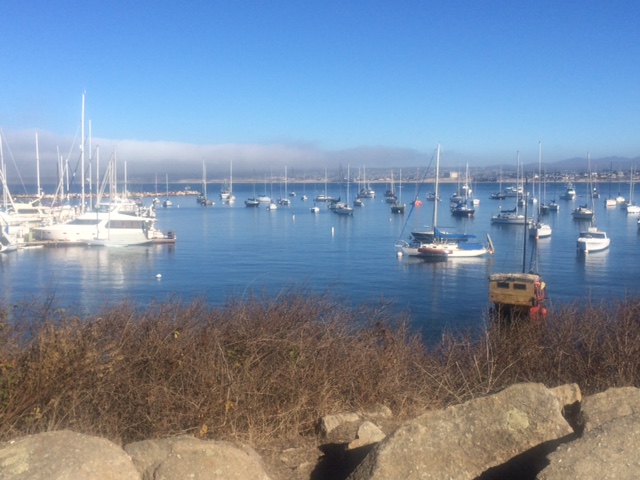
The southern half of Monterey Bay has a dedicated bike path that follows the dunes and runs right into town. Cannery Row has been turned into condos and restaurants, but Monterey is still full of colorful looking characters that John Steinbeck could write about with flourish.

IMG_4815 IMG_4818 IMG_4817

I stayed with a group of four army officers studying non-violent methods at the Naval Institute. We ate steak and drank beer and chatted about the state of the world. There were more similarities than differences between my morning and evening hosts. Its a good omen for tomorrow when a military man states, “Non-violent action is twice as likely to succeed in it’s objective than violence.”

Posted in Bicycle Trip Log | Tagged , , , , , , , , | Leave a comment

Trip Log – Day 168 – San Jose, CA to Santa Cruz, CA

San Jose to Santa CruzOctober 20, 2015 – Sun, 75 degrees

Miles Today: 48

Miles to Date: 8,724

States to Date: 25

imagesThe ride from San Jose to Santa Cruz was both beautiful and shorter than I anticipated. That’s a winning combination. After a good breakfast with my super-fun warmshowers host family Meg, Dean, Dexter and Kylie, I climbed Los Gatos Canyon and around Jefferson Reservoir. I don’t even bother to take photos of near empty California reservoirs anymore; there’s no visual or news value in that. I had been warned about gravel and dirt sections, and so was prepared for a bit of slow going, but once on Old Santa Cruz Highway the pavement was super fine and the traffic was – what traffic? Cars here are stuck to their freeways, which are bumper-to-bumper until ten in the morning. My descent was speedy but not too steep. I arrived in Soquel by eleven and in Santa Cruz before noon.

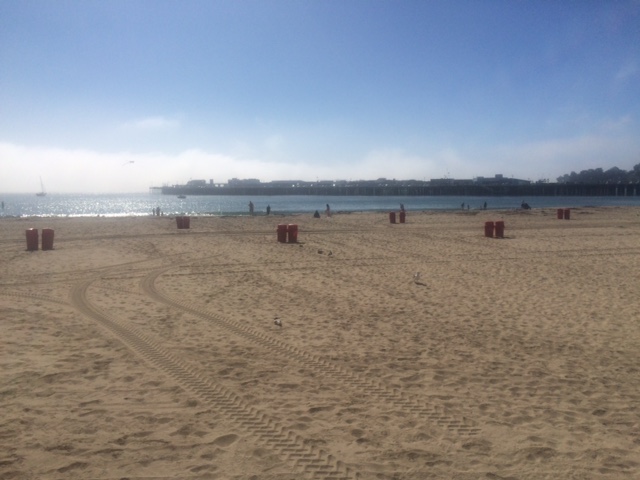
Santa Cruz is a tricky place to define. Part honkytonk, part hippie-funk, part high-end retail. A place where Rocky Horror Picture Show and Steve Jobs – the Movie play at the same theater.

IMG_4788 IMG_4793 IMG_4791

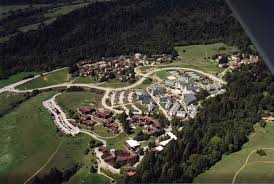
After lunch along the dappled light of quant Main Street I decided to visit UC Santa Cruz. I’ve known several people who went to school there, and the campus plan was much discussed when I studied architecture forty years ago.

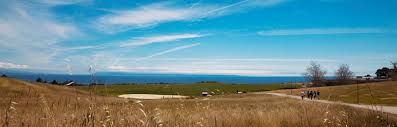
imgresToday, the fifty-year-old campus epitomizes both the good and the bad about 1960’s architecture and planning. For me, the problems outweigh the attributes. First, UCSC is miles from town. What is the point of being so far away? It’s a gas guzzling hassle to get there. Once on campus, immense fields separate students from any facsimile of real life, which was the point at the time but seems exclusive today.

images-2When you finally get there, it’s all long slung, asymmetrical buildings that are afraid to make a statement. The students reflect the detached nature of the place. While Berkeley and Stanford are crowded with Chinese and Indian students, the folks here are overwhelmingly white. To be sure, Berkeley and Stanford are too intense for their student’s wellness, but UCSC appears extreme in the opposite direction.

images-1

imgresNot everyone agreed with me when I met my couchsurfing host Scott and a bunch of his friends at Seabright Brewery for Neighborhood Night – nine-dollar pitchers and three-dollar tacos on Tuesday night. A bunch of us clustered around a few tables, some UCSC graduates, a few current graduate students, and several others who landed in Santa Cruz and decided to stay. It’s tough to make a living wage in this pricey town, but people bunk together and make a go of it because the engaging people, perfect climate and easy attitudes are worth a few inconveniences.

IMG_4790

Posted in Bicycle Trip Log | Tagged , , , | Leave a comment

Profile Response: Cory Wright, UPS, DuPont, WA

HWWLT Logo on yellowIt’s satisfying and reassuring to meet with someone who confirms expectations. When Corey Wright explained how four separate UPS distribution facilities in Portland OR were reengineered to process 100,000 packages an hour and how the Worldwide Distribution hub in Louisville, KY processes 500,000 packages an hour during plane transfers, he gave time and scale to what I already knew was an impressive logistical feat. But I always learn more when I discover ancillary aspects of a process that I never knew existed. So when Corey explained UPS’s drive to add value to a commodity service (shipping) and how they deal with their biggest competition (Amazon, not Federal Express) I marveled anew at the complexity of our world.

Corey is an executive in UPS’s Lending Division, one of the ways UPS ‘creates value’ by differentiating itself from other delivery services.

imgresWhy does a shipping company lend money? For the same reason General Motors has GMAC – to get more people to use their product. GM’s incentive is linear; they lend direct to consumers to buy GM products. UPS’s lending is one step removed from the consumer. They loan money to companies whose products require shipping. When UPS lends money to a T-shirt manufacturer, they lock in all the shipping that company requires. Besides, UPS, like many companies flourishing in the technology sector, is flush with cash (to the tune of $2 billion). They can lend money at one or more percentage points less than a bank and come out with a higher total return because of the increased shipping their investment generates.

imagesBut how is UPS, a delivery service, a high-tech company? UPS, and is its companion Fed Ex, are two of the largest ‘traditional company’ beneficiaries of online retailing. They may not be growing as fast as Amazon (15%) Target online (36%) or Wal-Mart online (18%), but all those online sales need to be shipped. High-tech revenues trickle down to UPS and Fed Ex.

So why does UPS see Amazon as more competition than Federal Express? “In the future, we’re not looking at companies competing. We’re looking at supply chains competing. Amazon is at the genesis of the buy/sell relationship. They drive every aspect of the market. Every component – payment, finance, distribution, delivery, customer service – all used to be different parties. Not anymore. Amazon does it all. UPS is just a piece of the puzzle.” Amazon sets tight contracts with UPS and Fed Ex and plays them off each other. It also has the option of going into the delivery business itself. “If you send a two-pound box of cookies, it will cost about thirteen dollars. Amazon might pay us four dollars, but they charge even less. Amazon subsidizes over $3 billion a year in shipping costs because people perceive the value of free shipping as two to three dollars.”

imgres imgres-1 imgres-2

How does the United States Post Office play into package delivery? “There is no political will to get rid of the post office, so it is here to stay for some time. However, I can see a time when Washington embraces Amazon leveraging the back of the house. We’ll still have USPS mail carriers, but that’s about it.”

What are the limits to this increased amount of shipping? “The last mile is always the hardest and most expensive.” Wal-Mart stores get the consumer to handle the last mile. They assemble everything you want in one place convenient to home and you go and pick it up. Online retail brings goods directly to your home. “But no one is home. We are going to see more designated locations, small-scale neighborhood locations, where people can pick up their packages. The stores holding the packages might get a small fee, but they’ll also get increased foot traffic.” Another factor will be decentralized production. “We already have 3-D printers in Louisville. When sellers get an order, they simply send the electronic file to Louisville, where the 3D item is printed and then shipped to the final destination.” The number of shipment legs has been cut in half. “Once the 3D printer is in your town, or in your home, you’ll just order the file for what you want. Delivery will disappear.”

How will we live tomorrow?

IMG_3754“I’m tying to keep it simple. If you look over time, we are all trying to meet Maslow’s Hierarchy of Needs.

“How we’ll live depends on how resources are allocated. Look at the places where people now live that were uninhabitable but technology made viable. How will we be able to sustain that?

“Look at how communities react to challenges. The Salem Witch Trials and ISIS are examples of people responding to what they don’t know in fear. We’re on earth for such a short time. I hope that we can retain our individual liberties and maintain our collective will.

“Bottom line, I don’t know but it’s fun to speculate. Personally, I am fortunate and comfortable. For most Americans, debt is the single biggest challenge to a satisfying life. Beyond the US, the question is how do we create stable societies? “

Posted in Responses | Tagged , , , , , | 2 Comments

Trip Log – Day 167 – San Jose, CA

San Jose to Palo AltoOctober 19, 2015 – Clouds and sun, 65 degrees

Miles Today: 38

Miles to Date: 8,676

States to Date: 25

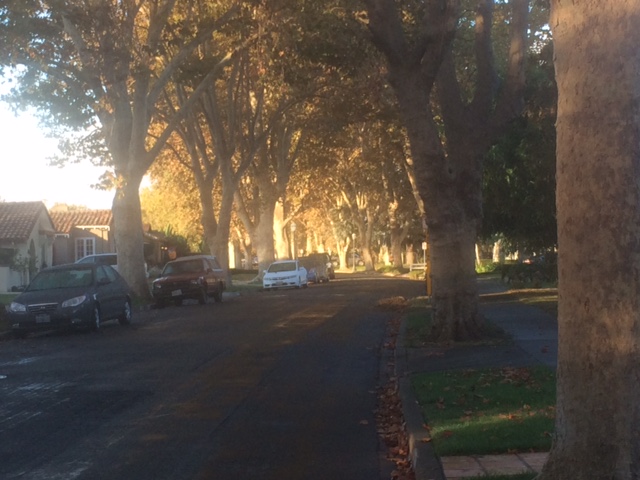
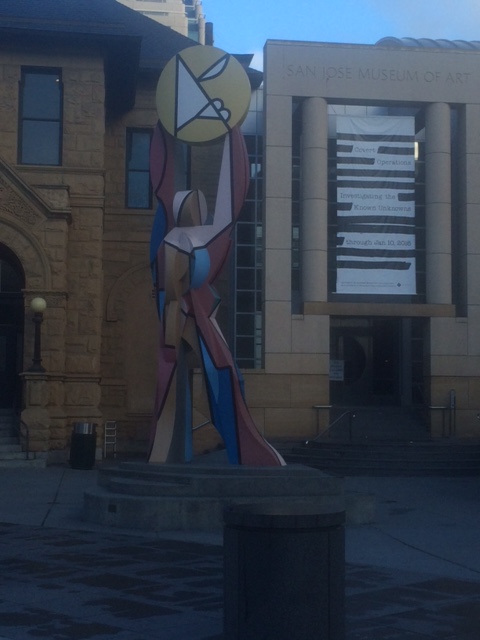
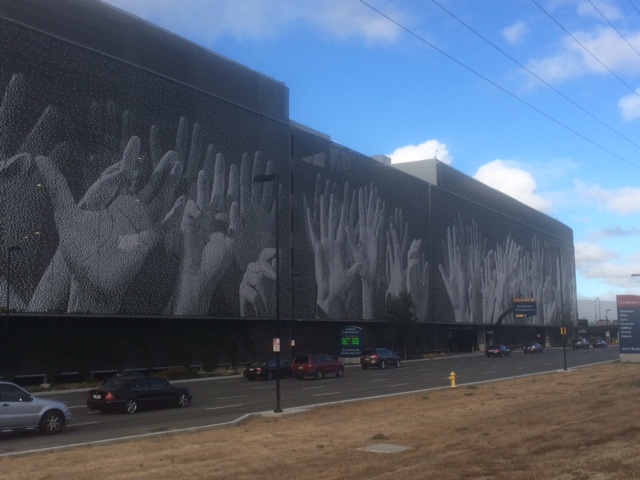
More tootling around San Jose and talking with Silicon Valley folks. San Jose has a few lovely residential areas and several blocks of real downtown, but it never feels like a city just shy of a million people. San Jose actually has more residents than San Francisco. Just a precursor to the urban sprawl I will witness for miles in LA.

IMG_4772 IMG_4773 IMG_4774

Throughout Silicon Valley I’ve been warned more about my safety than in any other area of the country. People here are wary of the ongoing war between cyclists and motorists. The epicenter of the controversy is on Kings Mountain Road in the tony town of Woodside where cycle-haters have put tacks along this narrow, scenic road to blow out tires. Not just sprinkled them on the surface, but actually glued them point up to the pavement. Its on the news, wrongdoers are being sought, and lawsuits are threatened.

IMG_4779Locals don’t like the weekend cyclists and I imagine the cyclists may not be the most law-abiding of vehicles. But sabotage that could injure someone? We need perspective. I stay to designated trails and paved roads. I might get a blow-out or be struck by someone, but I doubt it would be purposeful. Around here, others disagree with my cheery perspective.

Posted in Bicycle Trip Log | Tagged , , , | Leave a comment

Trip Log – Day 166 – Santa Clara, CA to San Jose, CA

San Jose to Palo AltoOctober 18, 2015 – Clouds, 65 degrees

Miles Today: 45

Miles to Date: 8,638

States to Date: 25

Welcome to my Silicon Valley Day. I was up early and off to a 7:30 a.m. breakfast meeting – on a Sunday – with Piaw Na software developer, cycling enthusiast and how-to book author. Piaw lives in a modest million-dollar house in Sunnyvale with synthetic grass, Mandarin speaking in-laws, and two young boys as American as any I’ve met.

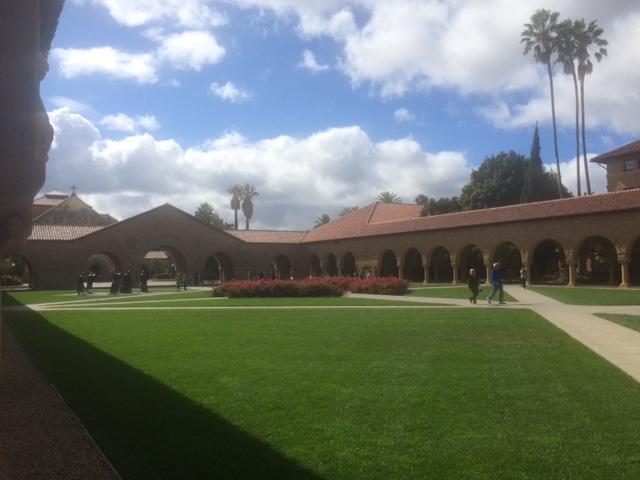
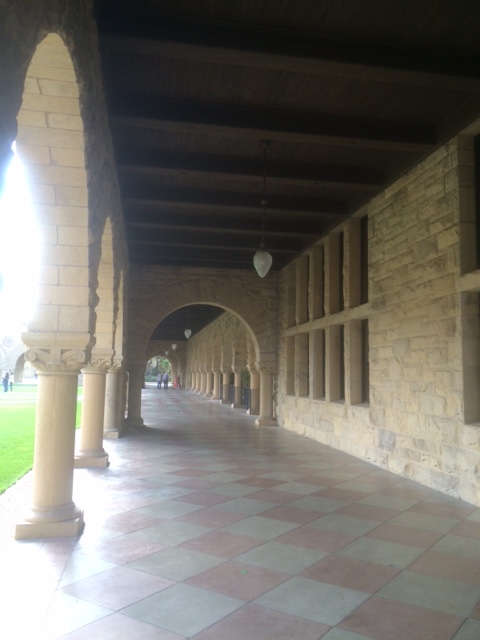
imgres-1After a solid breakfast I headed up Foothills Expressway, one of the many cyclists in the weekend flow of pumping legs. They all passed me, of course, engineers on customized bikes with thin tires and competitive determination. I got to Stanford by noon and strolled the campus for an hour or so. Physically, Stanford is as much like Harvard as Silicon Valley is like Boston, which means they have nothing in common. Stanford is spread out and lush. I particularly liked the Rodin Garden next to the Art Museum, though the Gates of Hell are completely out of context in the bright California sun.

IMG_4762 IMG_4761 IMG_4765

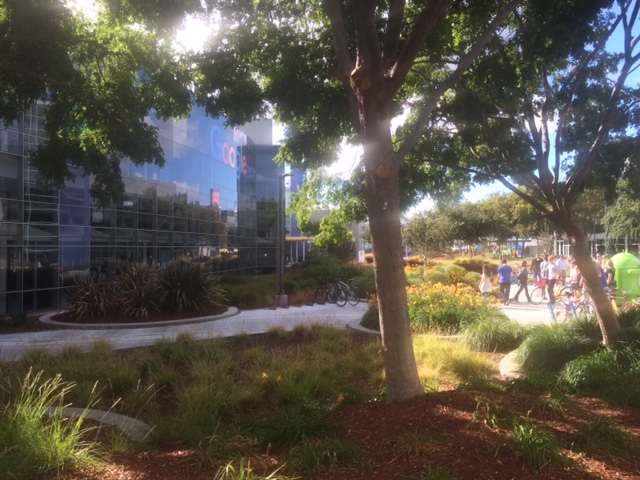
On my way back to San Jose I passed many of the major headquarters. I visited the Googleplex and enjoyed my lunch sitting in the shade in a bright Adirondack chair at their secondary campus. I pedaled by Cisco and Linked-in, Samsung, Adobe, and Avaya. I even rode past Apple’s mammoth new Norman Foster Headquarters in Cupertino. I’d seen renderings but didn’t quite realize why the circular form was so fitting to what everyone says is the most secretive of Silicon Valley companies. It will be a glittering fortress set apart from the 1200 square foot 1960’s ranch houses across the street.

IMG_4768 imgres

From San Jose to Cupertino, Palo Alto, Mountain View, Sunnyvale and Santa Clara, Silicon Valley is a continuous, featureless environment of long slung buildings and immense freeways. People here are the maters of our electronic universe. They seem to have little interest in the physical reality around them.

Posted in Bicycle Trip Log | Tagged , , , , , , | Leave a comment