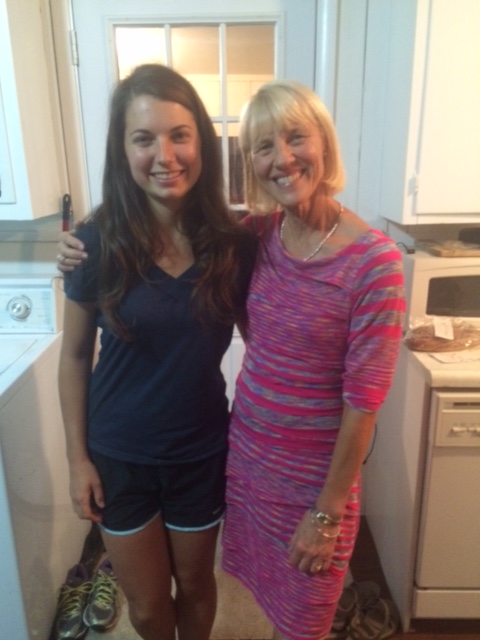
 When Katie Ferguson invited me to stay with her family, she added the caveat, ”as long as your OK with a preschooler asking a zillion questions.” Her comment sealed the deal for me. After all, I love questions, and am fascinated by preschoolers’ inquisitiveness, which, sad to say, drops precipitously as they enter school. But Katie’s simple comment also cued me that the Ferguson household, like so many in the United States, revolves around their three-year-old.
One giant cultural shift of the last generation has been what constitutes ‘good parenting.’ I grew up in a world where ‘children are better seen and not heard’ and can count the times my father and I spent time together on one hand. In my 1960’s Catholic world of multiple children, we pretty much entertained and raised ourselves.
 That all changed by the time I became a parent. We read parenting books, acquired parenting skills, and debated the merits of ‘quality time’ versus ‘quantity time’ with our children. Working outside the home and raising well-adjusted children became measures of success in our increasingly complex world. Children didn’t just grow up; they were raised; and like all prize-winning crops, the best required a lot nurturing. When I left my regular job in the 1990’s to care for our children, it was featured in the local paper. Fortunately we’ve moved beyond considering male parenting newsworthy. Still I was fascinated to visit the Ferguson’s and see how, almost another generation on, our desire to be ‘good parent’s’ defines so much of our lives.
 Katie and Ian are beyond good parents – they are exemplary parents. Ian, a big guy who writes software that cities purchase to coordinate ADA-required ride share for disabled people, eases to the floor to play with Ben, balances time between informal play and structured reading, helps his son understand time and sequence, and gets the boy off to bed on time. Katie, who used to be a competitive cyclist, works a flexible schedule, cooks amazing food from whatever arrives in their weekly CSA basket, and takes Ben on regular bicycle outings.
Ian and Katie live the most sustainable life I’ve witnessed among people inhabiting four bedroom suburban houses. They are conscious of the environment and their imprint at every level. Most importantly, they rarely drive. The Prius sits in the garage as Ian busses to work and Katie cycles. Each admits their commitment to living sustainably ramped up after Ben was born.
I arrived at the Ferguson’s fresh from riding through wildfire smoke. This led to a discussion of the people who refused to evacuate, risking their lives by remaining with their homes and possessions. Ian summarized it well, “Think about what your life is meaningless without. That defines your life.” For Katie and Ian, and so many other American parents, our children define our lives.
How will we live tomorrow?
“Since having a child I think more about being a better person. I want to treat people better, love people more. Living on the East Side is wealthy and entitled. I want to make the world better by respecting others more. I want to expand my respect for others beyond my immediate family.
“I recently read Falling Upward by Father Richard Rohr, a Franciscan Priest. The first half of life is building up definitions. The second half is breaking down the boundaries we set up and realizing the divinity in all of us.” – Ian Ferguson
 “For me, it is an issue of control. I can control how much food I take. When I feel hungry, my response is to do something else to divert my energy. Having a child has been great aversion therapy. You have to give up control. When I was pregnant I had to eat what I needed and look like what I looked like. Before, when I started feeling out of control, I controlled what I put in my body and how I exercised my body. Now, when I feel out of control, I stop, look at the symptoms, what is going on around me, and identify what is out of control. Usually, identifying the symptoms is all I need to move forward. Having a child did that for me.
“In the Bible, Paul says learn the secret of being content. That secret is accepting where you are at this moment.” – Katie Ferguson





 Brian is one of the most well integrated Iraqi war veterans I’ve met. I asked how he managed to circumvent PTSD. “People with PTSD are not in the present. They are trapped in their minds. I had a strong family unit back home. They provided the gravity that kept me grounded. Not all vets have that support, and they can’t leave what happened behind. They are still living then, instead of living now. When I came home, I had to learn to let go of the tough guy thing, but still keep those traits.”