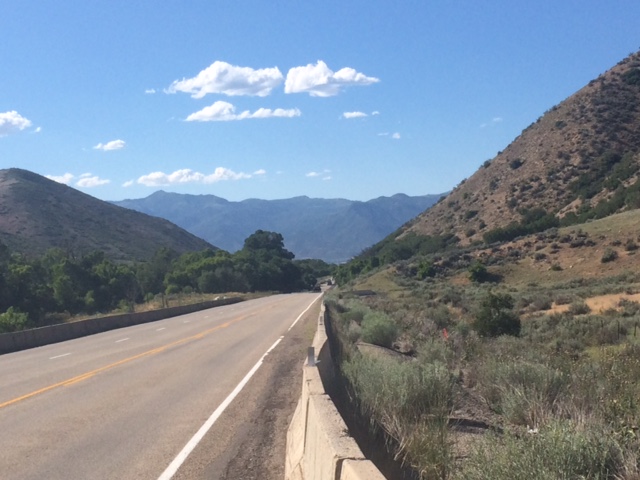
Trip Log – Day 86 – Kaysville, UT to Logan, UT

Kaysville to LoganJuly 30, 2015 – Sunny, 90 degrees

Miles Today: 62

Miles to Date: 4,828

States to Date: 19

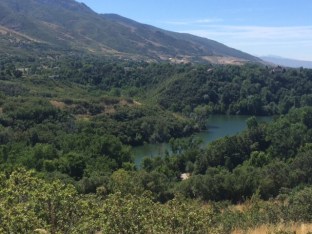
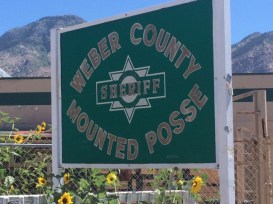
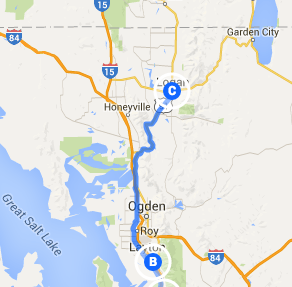
Today I was a bicycle tourist in the truest sense of the word. I left Kaysville about 10 with the general idea to go to Logan, though if something interesting came up along the way, I didn’t have to get there, for I had meetings scheduled and no lodging arranged in advance.

IMG_3217  IMG_3220

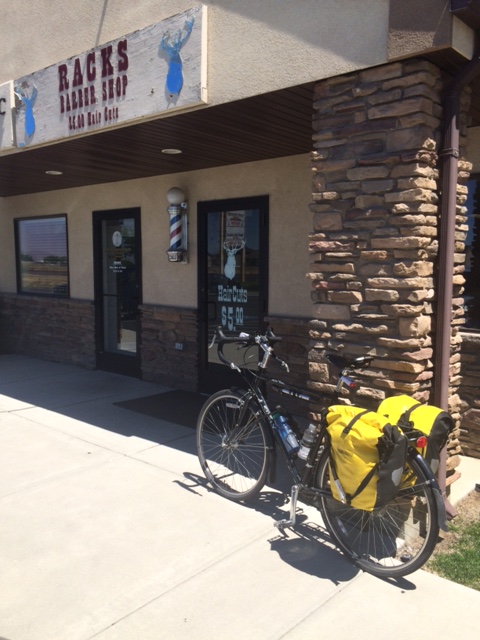
I rather liked Ogden, which is less affluent than other places along the Wasatch Valley, but also less homogenous. The main street is littered with immigrant stores and restaurants: Mexican bakeries, Chinese buffets, Indian Tandoori, Mongolian Barbeque. Too bad I wasn’t hungry. Downtown featured wonderfully painted horses at the street corners. Just north of town I saw a sign for $5 haircuts. Really? I was straggly and so went in, where Corinne, the chatty wife of an Air Force solider, did a terrific job cutting my hair, at any price.

IMG_3221 IMG_3222 IMG_3223

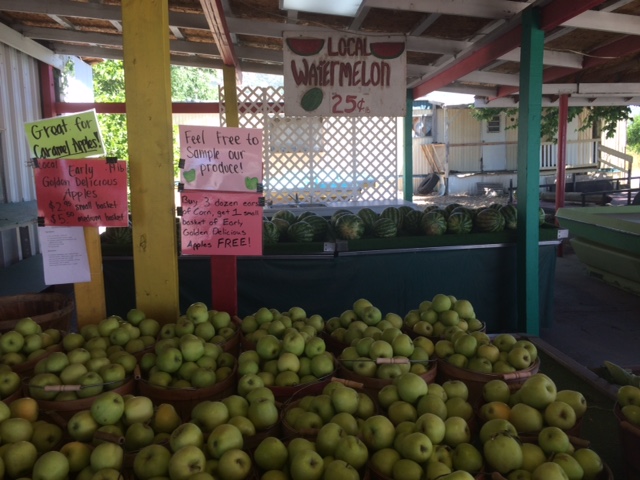
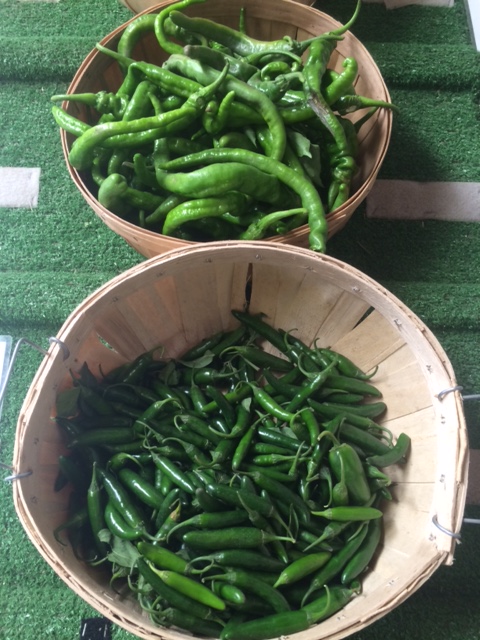
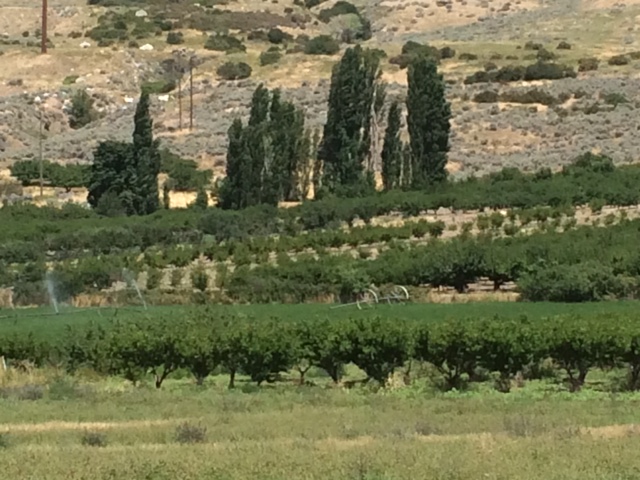
The next third of my ride was a perfect stretch of cycling. The breeze was cool. US 89 had light traffic and a great shoulder. The Wasatch Mountains loomed over me to the right, the Great Salt Lake spread out on my left. This stretch of agricultural land is like none I’ve seen in the West – sweet corn and fresh tomatoes; cherries, peaches and watermelons. Handsome orchards march up the mountainsides and farm stands sell terrific produce at ridiculous prices. I stopped at Granny’s for some watermelon, but I couldn’t eat it there, as they aren’t licensed for on-site consumption. They looked juicy and good, but not good enough to weigh down my pannier.

IMG_3225 IMG_3226 IMG_3227

I decided that if Brigham City looked neat I might stay there. However, US 89 took a sharp right before the town presented a good face and so I decided to pedal on. Up, up, up another eight mile rise to a pass that eventually bought me into Logan Valley. I wasn’t psyched for such rigorous cycling. I just did it.

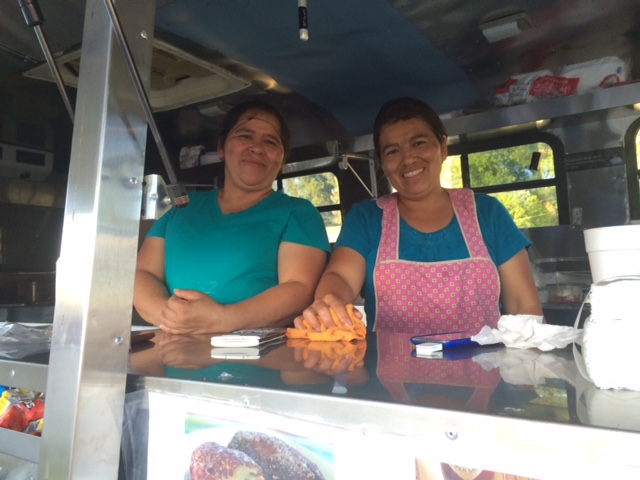
IMG_3231It was pushing six by the time I pulled into the Econolodge near downtown Logan. The town presented nothing but wide streets and preoccupied motorists, and I was too tired to seek out more character. At least it’s within walking distance of a few eateries. I got cleaned up and set out for dinner, pleased to find a Salvadoran food truck with tables under tents. I ordered the special, which included pamposas, yucca, fried pork and a sweet pancake dessert. Edgar, a local Guatemalan construction worker and college student, joined me in a great dinner conversation.

Posted in Bicycle Trip Log | Tagged , , , , , , | 2 Comments

Profile Response: Tammy Bohn, Sturgis Motorcycle Rally, Sturgis, SD


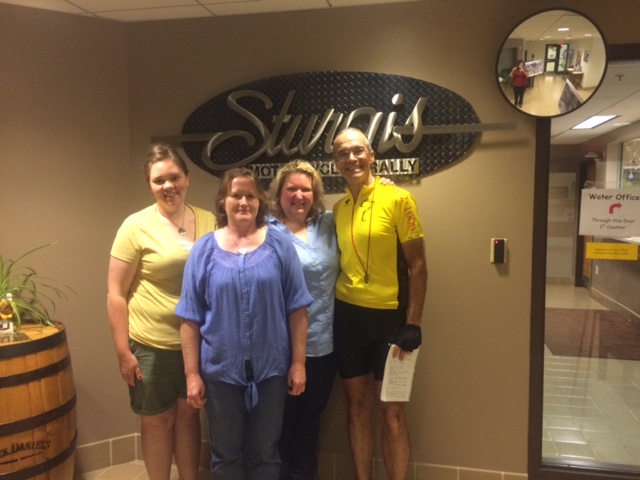
HWWLT Logo on yellowAugust 3 through 9, 2015 is the 75th Annual Sturgis Motorcycle Rally. Over a million motorcyclists will descend on this small town; the largest assembly of motorcycle enthusiasts in the world. I stopped by Rally Headquarters, hoping to snatch a few moments with the organizers to talk about tomorrow. Tammy Bohn and her rally gals spent over an hour with me, explaining the details of this mammoth event, its impact on Sturgis, how it evolved and will continue to evolve in the future.

JC ‘Pappy’ Hoel organized the first rally in 1938. 200 motorcyclists came to Sturgis to ride through the Black Hills in high summer. The Jackpine Gypsies Cycle Club sponsored the event, with a few lost years during World War II, until the 1980’s, when the Sturgis Rally had grown so large the city took it over. Tammy and the other three rally organizers are actually part of the City of Sturgis ‘Rally Department’. They work out of City Hall.

imgresWhen I arrived Tammy was in the middle of a phone call with one of the events many suppliers. A few moments of eavesdropping helped me fathom the complexity of coordinating crowd barricades, snow fencing, dirt hauling, ambulance procedures, medical supplies, grandstands, and trash hauling. When Tammy got off the phone she explained it was for only one smallish activity. This is what Tammy does all day, every day – work out the details no one much considers so people can roll into town for a good time.

Which is what biking enthusiasts do, not only for Rally Week, but all year long in Sturgis. Between May and December, Sturgis will host 31 events, most centered on two-wheeled vehicles. Road bikes, off-road bikes, bicycles, motocross – they each have special rallies. There’s even a few events for four wheeled machines like Volksmarch and a Camaro Rally. As Tammy puts it, “We know how to host over a half million people. We have the campgrounds and motels and event spaces. We also have incredible rides through the Black Hills. We can make a unique four to five day experience. Since we know how to run these, we might as well run many.”

imagesI ask Tammy what makes Sturgis so special. “People meet up here for fun times. It’s an America we don’t get to see anymore. We all puts aside our differences and enjoy ourselves. The gangs know that when in Sturgis, there is no trouble. Everyone here is passionate about riding, and that is what brings us together.”

The rally defines Sturgis, and is also a significant part of the city’s budget. The city puts out $1.5 million to run the annual rally, but it’s a worthwhile expenditure and the city’s claim to fame. Tammy admits that the rally used to be a drain on the city, but Sturgis’ new city manager operates the city – and the rally – in the black.

IMG_2636Tammy is a natural party planner. Before I leave she stuffs my panniers with Sturgis goodies, gathers me with her staff for a group photo, gives me a warm hug and wishes me Godspeed. She wants me to come back in September for the Grand Fondo, Sturgis’ road bike rally through the Black Hills. I wish I could loop back for that.


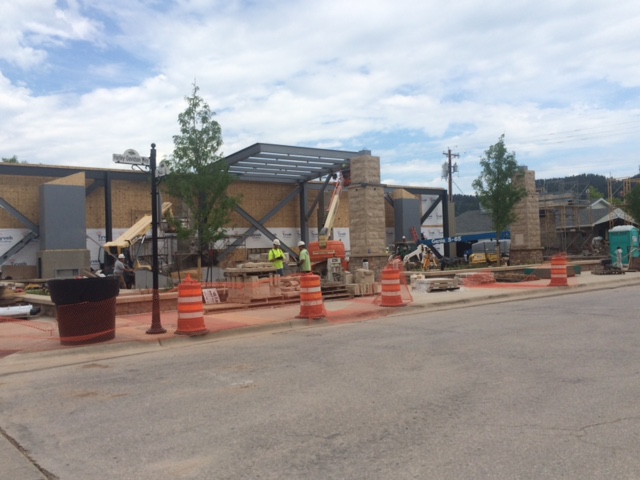
IMG_2632When I leave City Hall and pedal through downtown, Tammy’s report of the positive economic impact of the Sturgis Rally is evident. A new plaza is being built for this years anniversary rally, and every third store is undergoing improvements in advance of August 3.


How will we live tomorrow?

“When we look at the world and our country and our politics, we just want to have a great time. That’s why people come to Sturgis, where everything is fun and everyone gets along.”

Posted in Responses | Tagged , , , , | Leave a comment

Trip Log – Day 85 – Bountiful, UT to Kaysville, UT

Bountiful to KaysvilleJuly 29, 2015 – Sunny, 90 degrees

Miles Today: 16

Miles to Date: 4,766

States to Date: 19

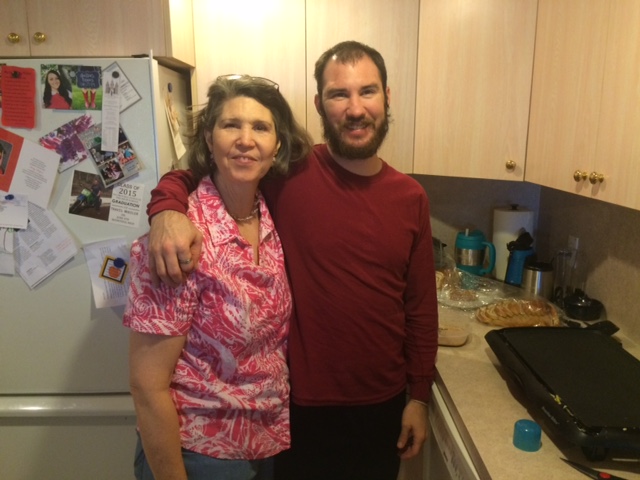
IMG_3189Today was a day of connecting with my own family and meeting another who is quite extraordinary. I spent the morning with my sister-in-law Julie and her son Steve. He makes an awesome breakfast.


IMG_3196 IMG_3194Then I visited Kadee and Brad Troop and their seven adopted children, four of whom have EB (Epidermolysis Bullosa) a rare genetic disease; the other three were born with drug-related syndromes.


IMG_3214I pedaled up the Rio Grande bike trail to my niece Jessica’s and spent the evening with Jes and her two children as well as my nephew David and his wife Jennifer. Ammon is a Lego fiend; we spent time concocting Star Wars sets at his Lego table. Emma is only four but just ditched the training wheels on her bike. She’s fearless on two wheels. I figure she’ll be ready to join me, maybe next summer?

Posted in Bicycle Trip Log | Tagged , , | 2 Comments

Profile Response: Gerard Black Elk, Rapid City, SD


HWWLT Logo on yellowGerard Black Elk is a Native American from the Sioux Tribe. I approached him on the street in Rapid City, SD and we talked.

How will we live tomorrow?

“The urgent answer is, can we all get along? I would like to see people be more approachable.

“I am concerned about addition, which is see so much of in my community. Addiction is a sign that we have something we cannot control, but are unable to acknowledge that. I was in a group once when the leader said, ‘Who’s the second most selfish person here? The person sitting next to you.’ We have to accept ourselves as we are. We have to accept that we are all selfish; selfishness is part of our nature.

“So many people are drowning in addiction. I struggle with people allowing that to happen to them. Then I look at my own life. I am 58. I’ve been to college, I’ve been in prison, I’ve been President of the University of Washington Native American Club and I’ve hung out with folks who don’t spend a minute thinking about anything beyond the next drink. This allows me to connect with anyone.

IMG_2657“When Native Americans began to lose our language we began to lose part of ourselves. Picture this. You and I are Native Americans. We are standing on top of a hill. Suddenly I fall over. I’m dead; struck by a bullet. I have never seen a rifle; I don’t know what one is. I have no context for what happened. That is the Native American experience: rifles, small pox, Western civilization. We had not context for what happened when the railroads came.

“I could not live with myself if I thought there was no tomorrow. I wake up in the morning and I think: all the good that happens will flow from Jesus; all the bad, from man.

“This is the best of all worlds. I wake up in the morning and I am alive. It doesn’t get better than that.”

Posted in Uncategorized | Tagged , , , | Leave a comment

Trip Log – Day 84 – Pleasant Grove, UT to Bountiful, UT

Provo to BountifulJuly 28, 2015 – Sunny, 80 degrees

Miles Today: 47

Miles to Date: 4,750

States to Date: 19

Salt Lake City Adventures!

I got up and out early – back on the Murdoch Creek trail by 5:30 a.m. to get to CR England trucking company’s headquarters in industrial west Salt Lake by ten. The 42 miles trip looked manageable – almost all bike trails. My directions showed a gap between the Murdoch Creek Trail and Jordan River Trail, but the trail signage indicated they were connected. So I followed the signs and was feeling confident. By seven I had logged fourteen miles and turned a beautiful bend along the Jordan River Trail when – bam – it ended in a gravel quarry.

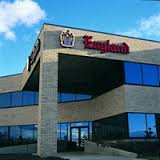
imgresI backtracked four miles, my mind racing as fast as my feet to make up lost time. I couldn’t possibly make it to my appointment by ten. Time to ramp up to faster mode. I’d passed the Lehi City commuter train station and decided to catch a train to Salt Lake City and pedal to CR England from there. A train approached as I rolled into the station, I slid down the ramp below the tracks and pressed up the ramp to the platform. The conductor waved me into the bicycle car and I rumbled north with only a general idea where I was going. The route schedule listed disembarking options. The conductor walked by and gave me a knowing smile; she never asked for my ticket. Earnest looking people can commit minor infractions with impunity. I got off at Salt Lake Central Station, cycled south and west through the city grid and arrived at CR England by 9:10 a.m.

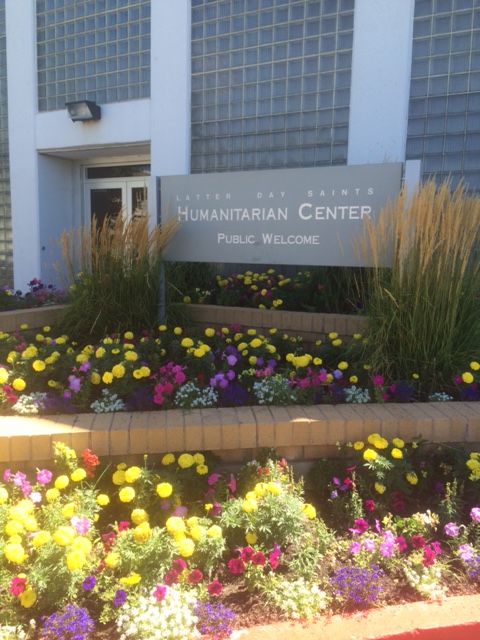
After talking about trucking tomorrow I meandered back toward the city and passed the LDS Church Humanitarian Center. Intrigued, I stopped. The engaging receptionist explained the center’s purpose and invited me on a tour, where I learned about the Mormon’s international relief efforts. Back in the saddle, I pedaled to my one o’clock meeting at Palmer Court, a supportive housing program for homeless people. I left, close to three, famished, and overwhelmed by three consecutive interviews.

imgres-1 IMG_3165 copy IMG_3185

I stopped by Winger’s in downtown for a burger and fires. My waitress was a warm, chatty woman fascinated by my trip. She revealed that she’s homeless. I shuddered at the eerie coincidence, as I just came from meeting formerly homeless people. We talked about her options for permanent housing and wished each other well on our respective pursuits. I rode through downtown, past Temple Square and the Capital, on north to Bountiful.

I arrived at my sister-in-law Julie’s place after five. Jessica and David, two of Julie’s children, joined us, along with David’s wife Jennifer and Jessica’s children Ammon and Emma. My niece and nephew left after dinner; Julie and I had a lot of catching up to do. We talked ‘til midnight.


Posted in Bicycle Trip Log | Tagged , , , , , , , , | Leave a comment

Profile Response: Chad Lundberg, Spearfish, SD


HWWLT Logo on yellowChad Lundberg left a traveling sales position a few years ago to be the social media coordinator for the Alumni Association of Black Hills State University. Chad bought a century old house in Spearfish that has been added to many times. He’s configuring it into a series of separate living spaces that he can rent as apartments or Airbnb accommodations as part of an ongoing effort to make his life more independent and sustainable. Chad was my warmshowers host in Spearfish, SD. After dinner we walked to a local pub for a beer where we had a wide-ranging conversation about tomorrow. Chad’s story of two bicycles struck me as the essence of his ideas.

“I bought two new bikes last year. First, I bought a carbon fiber lightweight mountain bike. It retails for $5500, and I got it for $3000. But the bike has had ongoing costs. The brake pads went. It needed new tires often, at $80 a pop. At some point I picked up a second bike, a single speed, for $700. The single speed was harder to ride at first. Once you get the feel of it, it actually makes you a better rider.

IMG_2621

“I go for a ride every day after work, at least an hour, usually longer, up through the trails. For a while I traded off the carbon fiber bike and the single speed. Then I found myself taking the single speed bike more and more. I kept putting money into the expensive bike; it hardly cost anything to maintain the single speed. At one point I needed to replace a loose bolt on the carbon bike. It was $21. That numbed my mind.

“I started to evaluate the ride on the carbon bike versus the single speed with a simple question: ‘At the end of the ride, am I happy?’ I realized I am happy when I don’t have repairs, when I don’t have to oil the chain as much. I am happy when I don’t have to worry about changing gears. The simpler bike brings more happiness.

“There’s a trend in mountain bikes now to have a single front sprocket instead of a dual sprocket. They add a few more sprockets on the back and it gives you almost as big a range without having to shift from two places. But you know what – they charge more for the single front sprocket than the dual. Why is that? It doesn’t make any sense, it’s marketing.”

How will we live tomorrow?

“We are making things way too complex. Good design needs to take the complexity of an object and make it simple.”

Posted in Responses | Tagged , , , | Leave a comment

Trip Log – Day 83 – Midway, UT to Pleasant Grove, UT

Midway to ProvoJuly 27, 2015 – Sunny, 80 degrees

Miles Today: 46

Miles to Date: 4,703

States to Date: 19

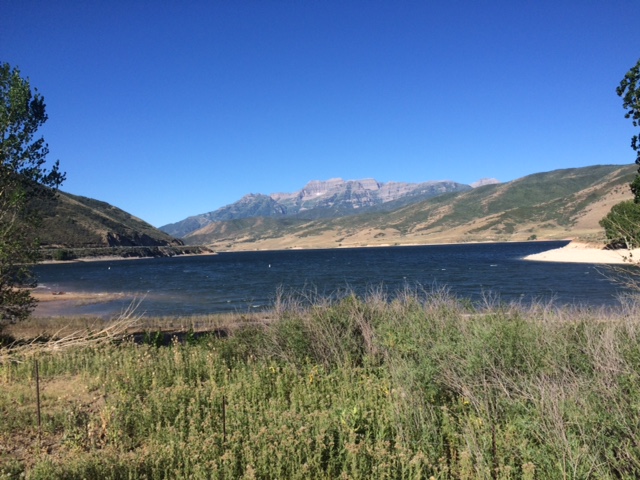
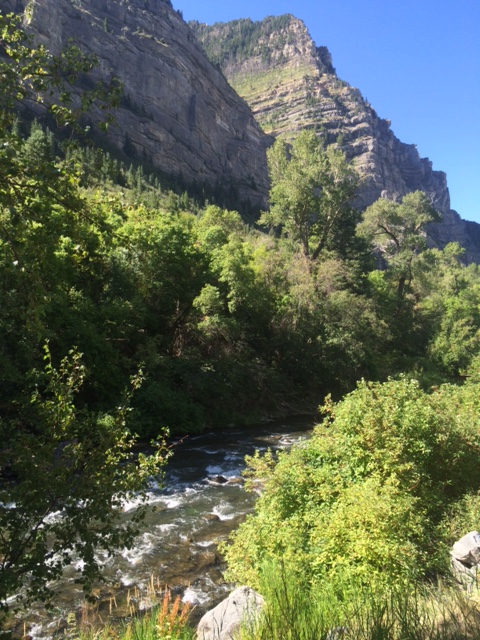
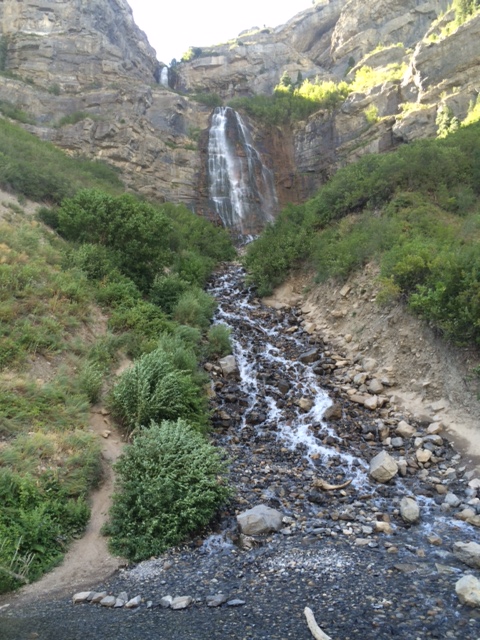
IMG_3139The ride from Midway through Provo Canyon is yet another gorgeous slice of Utah scenery. US. 189 is a wide and twisting road that hugs Deer Creek Reservoir at the base of Mount Timpanogos, the largest peak in this area. About halfway down a side turn leads to a bicycle path that runs right under the spectacular Bridal Veil Falls and then continues down to Provo. I rolled through Brigham Young University, had an odd interchange with a coed in a car who insisted she knew me, and cycled through downtown on my way to Fire Station No.5, where I met Chris Blinzinger, the Manager of Emergency Preparedness for the City of Provo. Chris took me out to lunch with four other people involved in medical, civil, and natural disaster preparation to talk about tomorrow.

IMG_3141 IMG_3147

Provo is similar to Madison, WI; State College, PA; and Boulder, CO in that it is a college town, but is unlike them in that BYU students, mostly Mormon, are quite different from many college students. There aren’t any bars, the campus is full of married student housing, off campus housing advertises itself as ‘men’ or ‘women’ only.

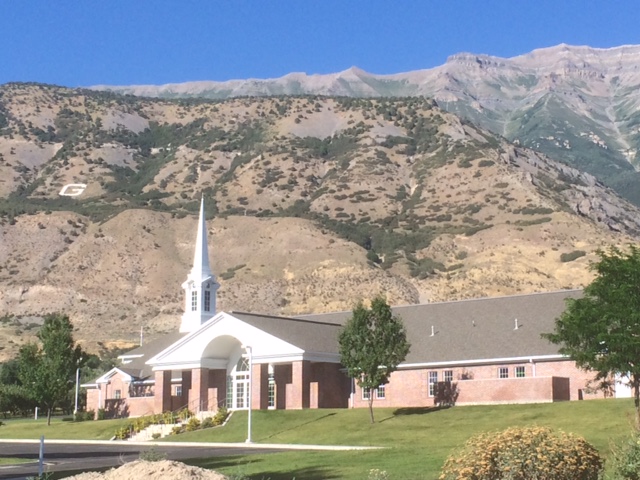
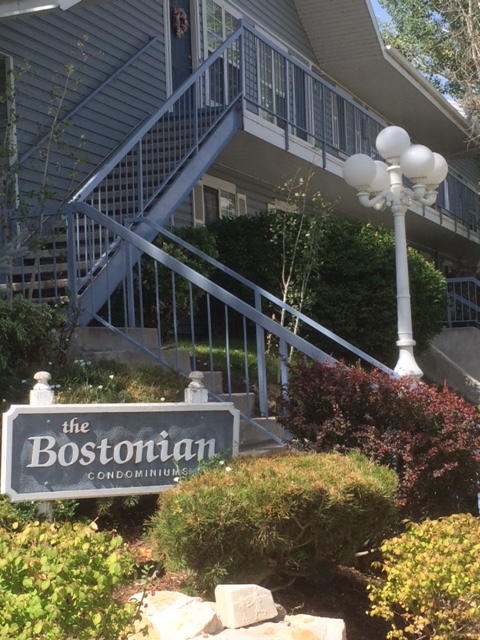
I was struck by Provo’s architecture, which doesn’t reflect the rugged West, as lodge style buildings do in Colorado. Rather, it harkens to colonial stability with brick, moldings and symmetry. The LDS churches, which occur within blocks of each other, are subtly different combinations of traditional elements. Even the condominiums complexes seek historical connections. I loved The Bostonian, Cape Cod forms in the shadow of giant mountains.

IMG_3161 IMG_3151IMG_3149

After lunch I took a writing break, then pedaled back toward Provo Canyon and over the Murdoch Creek Trail to Pleasant Grove, where I stayed with Chris and his family. Kendra and Chris and their eight children could be featured in a heart-warming reality program. They went to their high school prom together, drifted apart, married others, had children, divorced, and then reunited. We shared a terrific barbeque supper and then everyone pitched in to help Chris and his stepson Spenser prepare for a four-day backpack trip with 25 scouts. My two panniers with a credit card for emergencies are easier to manage.


Posted in Bicycle Trip Log | Tagged , , , , , | Leave a comment

Profile Response – Bill Gross of Farm Rescue Fargo, ND

HWWLT Logo on yellowFarm Rescue is nominally based in Fargo, ND, but like so many contemporary endeavors, is an affiliation of people and skills working out of multiple locations. I met up with founder and President Bill Gross via conference call when I was in Bowman, ND and he was in Alaska. Bill is a UPS pilot, and like many in the airline industry, his sense of space and time is a bit different from the rest of us. He’s based in Anchorage, has a house in Seattle, and owns a share in his family farm in Jamestown, ND.

“I was 22 when I got hired by Pan Am and worked for them until the day they closed; December 1, 1991. I’m the youngest of five. My grandfather homesteaded in North Dakota. My parents took over the farm. They had financial struggles in the 1980’s and sold off half their land. When I was growing up, we had 2,500 head of cattle, by the end of the 1980’s all but 100 cattle were sold.” Bill and a brother in Minneapolis own what remains. They farm part of it themselves and rent some out. “There’s excess capacity. We have sixty head of cattle; a neighbor has three hundred. The neighbor oversees daily operations of them all in exchange for using their land.”

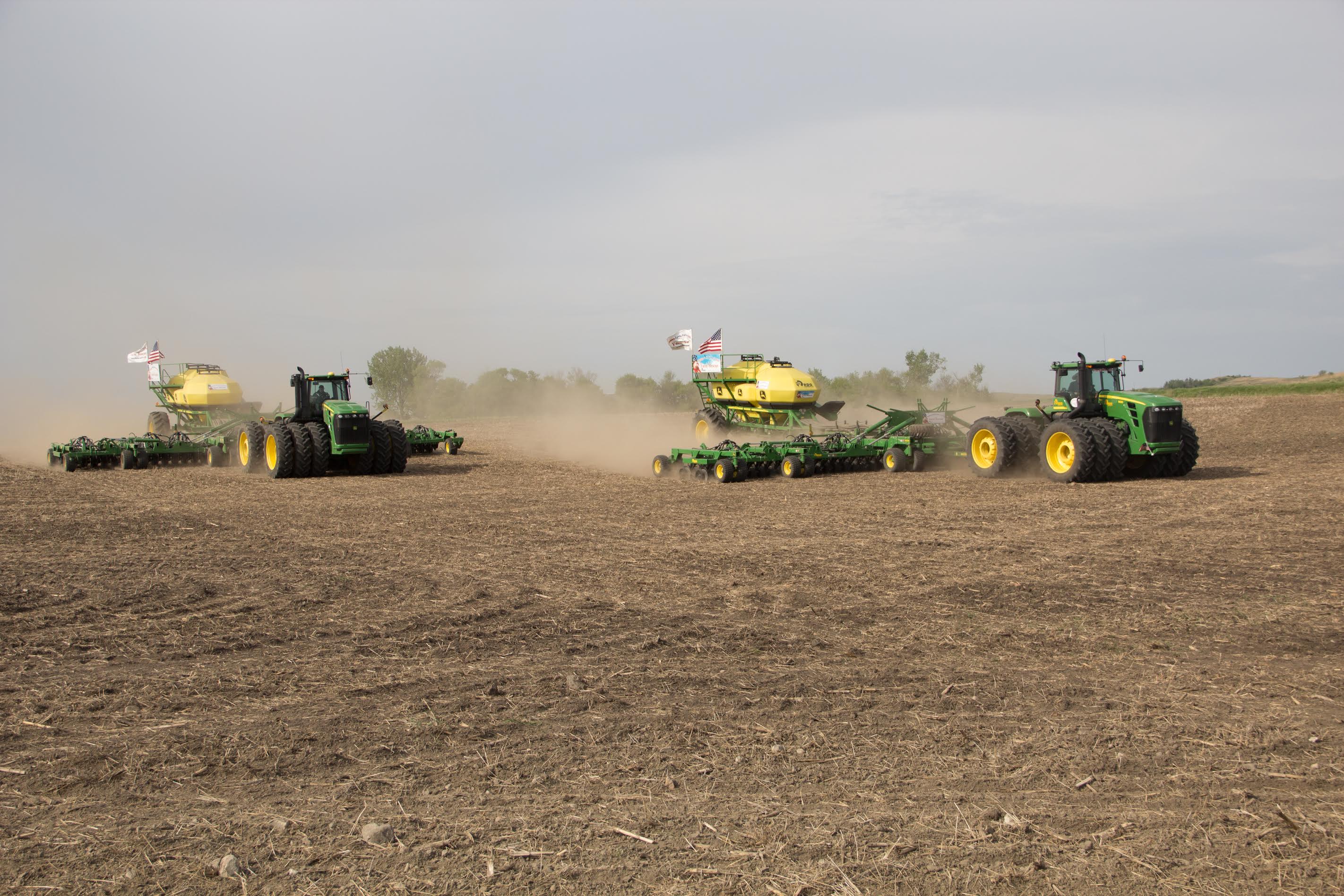
P1000934“I used to go on missions trips overseas through the church, in Croatia and other countries, but I wanted to do something at home. I got this idea of buying a big tractor when I retired and being a Good Samaritan by doing planting for others. My heart was always in farming; this was going to be my way of farming and helping other people.” I told a friend, Kevin Mateer, a chaplain in Army. He said, ‘Why wait until retirement? Do it now, you don’t know what tomorrow will bring. And why be a random Samaritan? Target people who are injured. Farming is the most dangerous occupation in the world.’”

Bill realized that Kevin was right on two counts. He should act now, and focus on helping farmers who are injured. “So I founded Farm Rescue ten years ago, bought a domain name, incorporated in North Dakota, had a $99 banner made, and started going to farm shows in the winter. I got free booth space from event holders and made up a brochure. I didn’t know what I was in for. Our slogan became ‘Helping farm families in crisis.’”

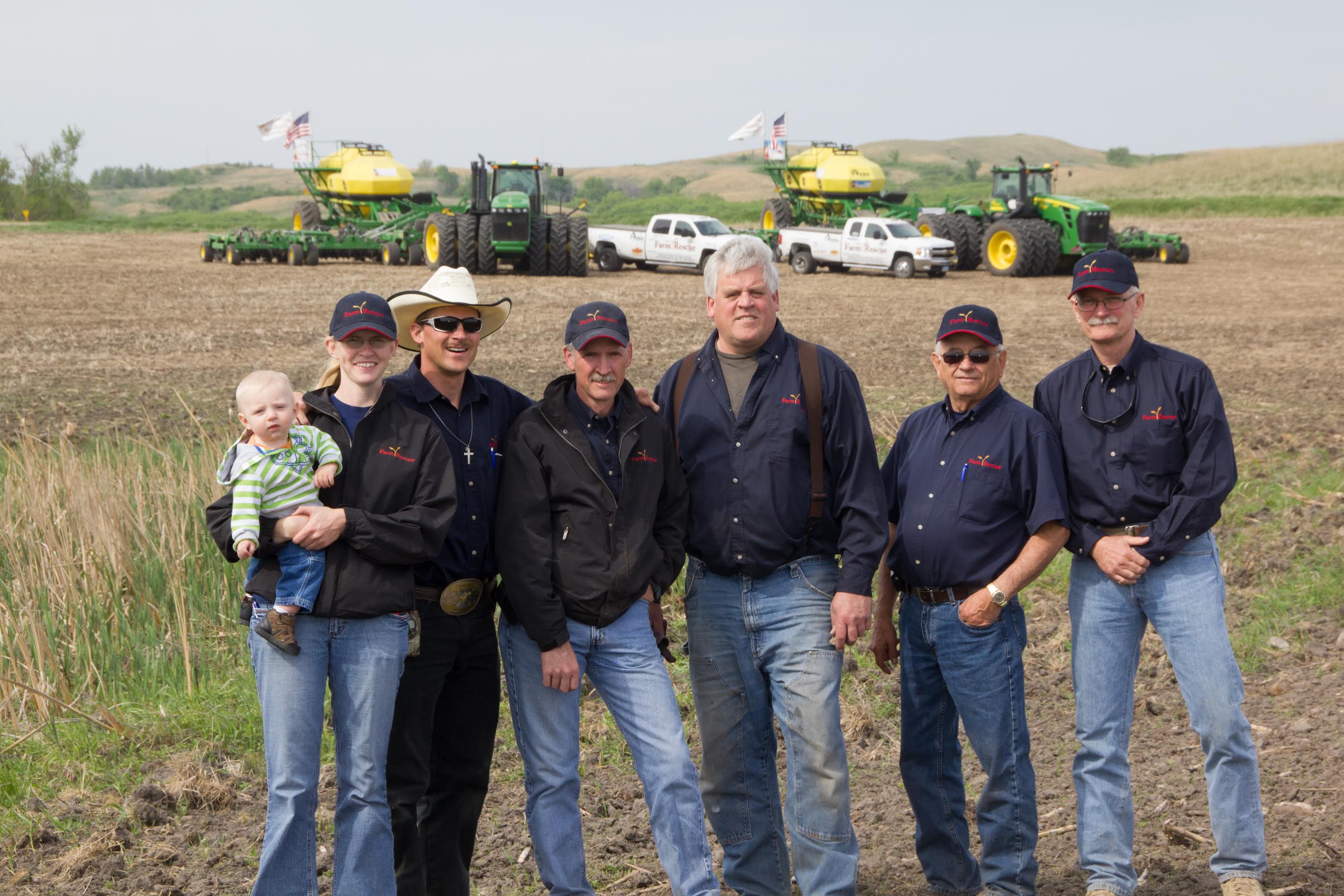
Farm Rescue 1Bill had three volunteers that first year. He got equipment sponsors, raised $40,000 to $50,000 and assisted ten families. Then the organization snowballed. Farm Rescue has aided 325 farm families to date in North Dakota, South Dakota, Iowa, Minnesota, and even Montana.

Farming is a time sensitive occupation. If a farmer gets hurt at planting or harvest, an entire year’s crop can be lost. “The first guy we helped was Matt Beale, just south of Dickinson. April 11, 2006. His right hand had gotten cut off and we finished his planting. We get applications from families who suffered fires, tornadoes, hurt children, and cancer; we get so many applications about cancer.”

Farm Rescue Volunteers“Now we have 1000 volunteers and so many applications we schedule months in advance. We have work from when spring comes through the fall. In any given season, we have volunteers from fifteen different states; multiple teams in multiple states. Some are retired; others use their vacation time. All sorts of people volunteer. Most come for at least ten days; it’s their vacation. They bring their campers and their families. Others are retired and stay up to three months.”

Bill is the head and heart of Farm Rescue; he has risen over 90% of their revenue in the past ten years. But he is assisted by three staff; one in Fargo, a coordinator in Sioux City, IA, and an Iraq war veteran in Colorado Springs who handles logistics.

unnamed (1)“We don’t give money to farmers. It’s not a hand out or a bailout of any crazy thing like that. It’s to help a farm family get the work done during a crisis. It helps them get back on their feet. Every small farm is important to every small town. My town of Cleveland ND closed the high school when I was a junior. I finished by correspondence. Now there is nothing but a PO in a trailer and one elevator. That’s what happens when farm families go out of business and the towns close up. I wouldn’t want to think we get to the point we only have large corporate farms. Our stated mission is just to help people but there’s so much more. It’s about supporting rural communities and rural America.”

How will we live tomorrow?

“I figured you would ask that. It’s not something I’ve given a lot of thought to, which is how you get your best answers.

“From my perspective, I believe that how we will live tomorrow is to help each other more. Our country does not have the resources to help everyone. You see where people start sharing cars in big cities. In Farm Rescue you have volunteers coming from all over to help people. Not just your neighbor. People are helping others, strangers. Some of it is Good Samaritan work. But some is just good sharing. Even farmers, if they ran things more like a coop, sharing equipment, they could be more efficient. As we are more efficient using our resources, whether money or land or material resources, people will share more.

imgres

“In America we need to create more Avenues of Goodness. It doesn’t matter if it’s in your family or through your employer or a non-profit; we have to find more creative ways to pool our resources.

I’m getting married next week. My fiancé is Filipino. The Philippines is a poor country. Her family farms four acres of land, plant by hand, plow with oxen, harvest by hand. They lack what we consider necessities, but they do have community. I believe in America people do have that spirit, but it has to be promoted more.”

Posted in Responses | Tagged , , | 2 Comments

Trip Log – Day 82 – Roosevelt, UT to Midway, UT

Roosevelt to MidwayJuly 26, 2015 – Sunny, 90 degrees

Miles Today: 101

Miles to Date: 4,657

States to Date: 19

Every time I feel flat or overwhelmed on this project, something happens to rejuvenate me. Today was a challenging day, but two high points made all the effort worthwhile.

I woke up early, filled with the anxiety that comes in facing a century through unknown terrain with over 4,000 feet of vertical climb. I rolled my packed Surly to the motel breakfast right at 6 a.m. to find hot coffee, bagels and fruit. More importantly, I found Alaina, the morning clerk who apologized for ‘not having my face on yet’ and then proceeded to brighten my day. I had not heard that expression since Oklahoma days, and sure enough, Alaina had just moved back to Roosevelt form Oklahoma. She was a sweet open person, and when I pedaled west on US 40, her hearty best wishes gave me more energy than the caffeine.

IMG_3124Roosevelt has grown long and ugly to the west, where the haphazard business of oil exploration has littered the valley with metal buildings, material stockpiles and a general disrespect for our earth’s surface. Since the latest oil boom’s tapered, structures less than five years old are already abandoned. The energy business is not conducive to thoughtful or stable development.

IMG_3127Duschesne is the third major town of the Uintah Basin, the smallest and the least affected by recent energy exploration. The Mormons who settled this area mastered water control. A system of canals enables the arid land to turn into lush green fields. The prosperous looking farmhouses reflect their success.


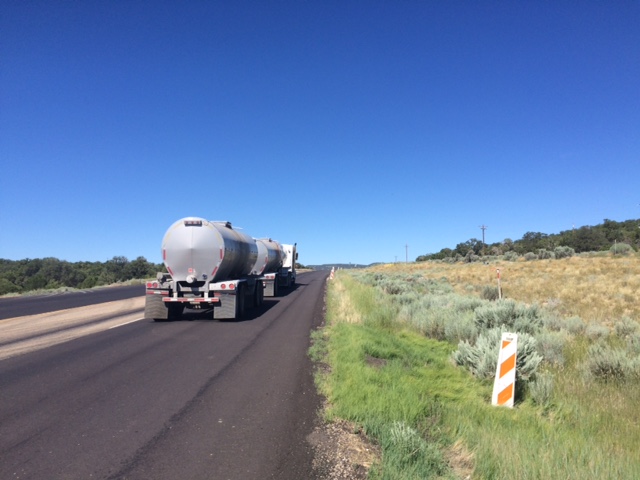
IMG_3128I enjoyed a fantastic breakfast at Cowen’s Cafe – perhaps the best sausage patty of my life – before heading into 60 miles without services. I climbed up a steady twelve miles to leave the Uintah Basin. Dozens of dual trailer oil trucks huffed past me. I descended into Fruitlands, a wide valley with more signs of land for sale than residents. I needed a noon break, but there wasn’t a scrap of shade, so I propped my bike on a guardrail and sat with my back to the glare. Then I climbed again, ten more miles at a steeper grade. More trucks passed me, along with all sorts of weekend warriors pulling trailers and boats. I saw a peak; it proved false. The next one was a rouse as well. When yet another rise showed itself I took another shadeless break to regenerate, then soldiered on.

IMG_3131At the top of the final rise was Strawberry Reservoir. On the East Coast the basic rules of gravity apply; water lies at low points. In the West, thanks to our prodigious damming, water is high up. Strawberry Reservoir is thousands of feet above its adjacent valleys.

My warmshowers host asked me to call a few hours out; he might ride out to meet me. It was 3:30 p.m. when I told Steve I was entering Uinta Forest, 28 miles from Midway. I had been averaging well under ten miles an hour, so projected I would get there around 7:30 p.m. The moment the words left my mouth I was depressed. Did I have energy to pedal four more hours of this hot sun and grueling climb?

IMG_3132The Entrance to Center Canyon seemed promising, but around a curve was a rise, than another, and more headwind. I was considering putting my thumb out for a sag ride but decided to persevere one other crest. Finally, I saw the summit sign – 8,020 feet – followed by the most satisfying downhill of my entire journey. Twelve miles at a nice 6% grade through a glorious canyon all the way into Heber City. I was at Steve’s door before 6:30 p.m., tired in body but energized in spirit.

Posted in Bicycle Trip Log | Tagged , , , , , , , , | 2 Comments

Profile Response – Blaine Hoffman, Whiting Oil and Gas Company Dickinson, ND

HWWLT Logo on yellowWhiting Oil and Gas is a public energy company that drills for oil and gas in many locations throughout the United States. The company extracts oil and gas to sell to others, and also has its own natural gas refining capabilities. I spoke with Superintendent Blaine Hoffman at their North Dakota headquarters in Dickinson, ND.


Blaine was born in Watford City, raised in North Dakota, and has worked in the North Dakota oil business for 39 years. He lives on 40 acres outside of Dickinson. “We’ve got a 2200 square foot house that my wife put together and I’ve got a 50’x80’ shop for me.” Blaine’s wife is in Arizona now. They bought property near Prescott and she is overseeing construction of another home where they plan to retire within a few years. “She can do whatever she wants, so long as I have another shop. It doesn’t have to be as big, maybe 40’x50’.”

IMG_2594Whiting first came to North Dakota in 1999, and drilled in Mission Canyon in 2002. In 2007 they began drilling the Bakken Formation, one of the largest oil and gas formations in North America. Fracking technology was just developing. “We did some ‘Hail Mary Fracking’ wells, dropped vertically and then went 10,000 feet horizontally and had some success. Now we can go up to 20,000 feet horizontally.”

I asked Blaine why fracking requires horizontal drilling. This led to a concise geology lesson. “The Bakken is a tight rock formation with horizontal fractures. The oil rich zone is between six and seventy feet thick. We use MWD (measurement while drilling) directional tools to drill straight down to that zone and then horizontally. We drill horizontally to tap into the transcendental fractures. Longitudinal drilling is easier, but vertical production in a place like the Bakken would be very little. The Middle Bakken is the target zone. We pump a mix of water and sand, six pounds of sand per gallon, into the well at 8,000 psi pressure. That deep in the ground, the hydrostatic pressure of the slurry is 14,000 psi or more. The water/sand mix infiltrates the fractures and releases the trapped oil.” The Bakken and Three Forks formations contain more than seven billion barrels of oil. Yet only 3%-10% is recoverable by current methods (source: Heritage Center of North Dakota).

Here’s how Blaine describes fracking:
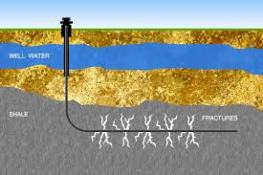
images– Start with 9-5/8” surface casing that we drill about 2500 feet deep, to get below any potable water. Fill that casing with cement to eliminate any leaks.

– Run an 8-5/8” bit filled with oil-based mud to keep the hole stable to a depth of 10,000 feet. (Blaine mentioned those two dimensions in the same breath, but I realized they are drilling with a slenderness ratio of 14,000:1. The vertical hole is proportionately thinner than an unspooled thread).

– Cement that hole in a 7” casing.

– Drill a 6” horizontal bit with a 4-1/2” liner up to 20,000 feet, nearly four miles.

– Insert a series of P-valves along the length of the horizontal bit. After the well is drilled, fracking begins from the end. Open the last P-valve, pump in the water/sand slurry, and open fractures. Stop the slurry flow and allow the released oil to flow up the well. Pull back to the next valve. Repeat.

I’m not savvy about geology or resource extraction. However, having spent my career designing healthcare facilities, I make the analogy between fracking and interventional procedures. Fracking is like performing an endoscopy on mother earth. Since endoscopy and other forms of minimally invasive surgery depend on cameras, I ask whether cameras determine their location in a well. “No, it is too muddy to get any camera image. The MWD tools show exactly where we are within a few feet.”

images-1Blaine makes fracking sound benign, so I ask why people are so worried about it. “When this started in Pennsylvania, there were no rules in place to protect groundwater. They didn’t always cement the surface and intermediate casings. Now, 99.7% of states have some rules. North Dakota leads in writing many of these rules.”

Then Blaine reveals that there are other substances, beyond water and sand, in the slurry mix. “We add a guar gum to the slurry to help the sand and water flow better. Guar gum is a plant material. All of the components of the fracking fluid are public record. We don’t have to list them by percent, but we have to list everything we put down the well.”

Fracking was developed by large companies and/or universities (Halliburton, Delco, Texas A&M) working alone or sometimes together. It continues to evolve. “Initially, we didn’t use the P-valves. We had sliding screens placed at intervals along horizontal well runs. We applied pressure to a location, the screen expanded and the slurry flowed out into the fractures, which allowed the released oil to come up the well.” Again, I am struck by the medical analogy, as Blaine describes what is essentially a stent. “Introducing P-valves and plugs is a more accurate way to control the fracking process and gives us better quality control.”

The North Dakota energy boom has tapered way back, but the industry is still robust. North Dakota remains the second largest oil and gas producing state, after Texas. “At the height of the most recent boom, there were 212 rigs operating in North Dakota, now there are 80. Whiting had twenty-one rigs at the peak and was producing 500,000 barrels a day. Now we operate seven and produce 175,000 barrels a day. The number will increase again, as the price will come back, but it is influenced by many factors: the Middle East, Wall Street and politics. Consumption doesn’t drive the prices all that much. Politicians know how to work the numbers to get prices to sway the way they want.”

imgresBlaine is proud to be affiliated with Whiting. He highlights that the company hasn’t had any layoffs despite the downtick. He points out Whiting’s high safety standards and the company’s leadership in community projects. “My message is; if it’s not good for North Dakota, it’s not good for Whiting. We want to maintain our quality of life. With all of the industry that’s come in here over the last few years, life has changed. If we leave the infrastructure in place, including pipelines, we can have everything in place to return to a high quality of life.”

I ask Blaine about changes in fracking. “The next thing is secondary recovery. We are getting between 5% and 25% of what’s there. When we run parallel well bores we can get maybe 25%. Parallel wells run between 300 feet and 700 feet apart, sometimes at different elevations to access different oil strata. There are certain efficiencies in drilling parallel bores, but at some point they reach diminishing returns. We are always looking for ways to capture more oil.”

“Whiting is a big family. I was the number 9 employee in North Dakota, now we have 515. It’s been a lot of work and a lot of fun, with a lot of rewards. Not many people have the opportunity to start something like the Bakken from zero. It’s been hard and really good, but I’m tired. What I’m most proud of in 39 years in the North Dakota oil business is our safety record and our environmental progress. These last seven years have been a godsend to North Dakota: oil, agriculture, cattle; all have been good. They are a bit down now, but they will be back.”

How will we live tomorrow?
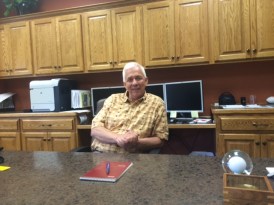
IMG_2593“We are going to live better. This is good for the entire state. Going forward, we want to stay involved with our community and our state. Being involved in our communities is the key to long-term success.”

Posted in Responses | Tagged , , , , | Leave a comment