Profile Response: Jensyn Hallett and Tracey Meyer Chesser, Heifer International, Little Rock AR

HWWLT Logo on yellow“Our mission is to end hunger and poverty while caring for the earth.” Those words, on the main display at the reception area in Heifer International’s Little Rock headquarters, might seem presumptuous if they weren’t so true. Since its founding in 1944, Heifer International has become one of the most respected philanthropic organizations in the world, grown out of the simple premise that if you provide someone the means for a productive life, they will become self-supporting.

imagesHeifer International has an appealing donation model: give a few dollars to buy chicks for a family in Ecuador, a bit more buys a pig in Swaziland, even more buys a cow in New Guinea. It’s a model that engages young children and families in philanthropy even on a modest pocketbook.

After Heifer establishes operations in a developing area, the organization provides animals only to families who seek them out. Families receiving farm animals are expected to ‘pay it forward’ by giving offspring to other neighbors.


imgres-1 images-1

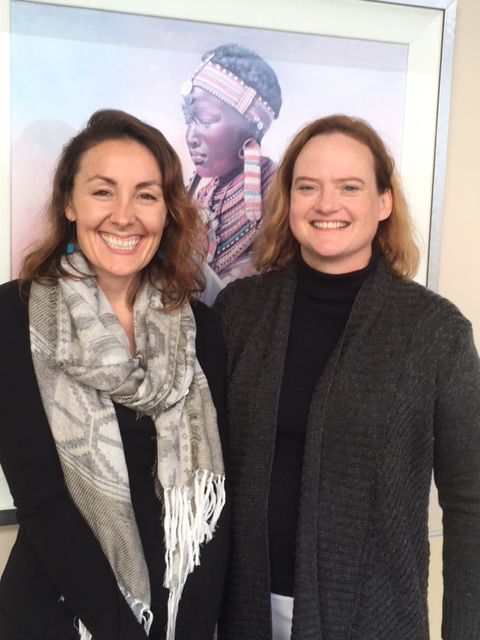
Tracey Meyer Chesser, Director of Heifer Village, toured me through the organization’s LEED Platinum headquarters building, adjacent education center, and 3.5 acre demonstration farm, all built on a brownfield site just east of downtown Little Rock. Heifer also operates two larger demonstration farms in the US. Tracey describes Heifer’s current focus on helping farm families be greater participants in the entire process of food production and distribution. “How can we develop the traditional model to be responsive to real market needs?” To that end, Heifer is reaching out to disseminate improved farming methods, form cooperatives, and include farmers in distribution networks.

imgres-2This is a leap from providing chicks to a needy family that requires a different level of funding. Jensyn Hallett, Foundation Officer, explains, “Over 95% of Heifer’s funding was from small donors. Now, we are working with organizations like the Gates Foundation on the East Africa Development project, working to create a complete value chain for dairy farmers.”

Heifer International’s impressive campus may seem too grand for a non-profit institution that addresses fundamental needs. Yet I came to see it as an integral part of their mission. True, they spent a lot of money. But they turned a polluted site into viable land, and they constructed something that will cost much less to operate over time. I could not help but compare Heifer to their giant corporate neighbor in Arkansas – Wal-Mart – a company whose relentless focus on low first cost doesn’t reckon with the environmental or resource implications of their actions as carefully as an organization rooted in distributing chicks.

How will we live tomorrow?
img_8534“With the experience of today and hope of a better tomorrow.” – Tracey

“I want to start a woman’s coaching business in work and life.

“I hope we will live more consciously in the future—whether it’s in consumerism, what we say, or how we treat others.” – Jensyn

 

Posted in Responses | Tagged , , | Leave a comment

Profile Response: Matt Cleveland, Little Rock AR


HWWLT Logo on yellowArkansas Governor Asa Hutchinson has described a crisis in the state’s foster care system. There are twice as many children in need of foster care as available placements. The governor is trying to increase the number of foster homes, particularly among faith-based communities. One established foster care setting is the Sherriff’s Youth Ranch, a compound of four eight-children houses that has the capability to double capacity. Matt Cleveland, Development Director, described the situation and some of the hurdles the foster system faces.

imgres“Our history is of sheriff’s finding children with no where to go.” Forty years ago, they banded together, purchased a ranch outside Batesville, and began Youth Ranch. The organization is sponsored by all 75 county sheriff departments in the state. Youth Ranch grew to three campuses, but the economics of operating multiple sites proved difficult, so the group is focusing on its original ranch and hopes to expand operations there.

Certain aspects of Youth Ranch are more generous than traditional foster care. Foster children age out of the system at 4 p.m. on their eighteenth birthday. At Youth Ranch a boy, or less often a girl, “can stay until they transition out as long as they follow the rules and work towards a goal, even up to age 21.” Youth Ranch residents also have educational goals and opportunity to work outdoors: the setting includes a 600 acres working cattle ranch.

images-1Creating a nurturing and stimulating environment for the children costs money. It takes $30,000 a year to support a child at Youth Ranch. “The state’s foster care allowance covers only 10% of our budget.” That’s a lot of money compared with raising a child in a family household, but only a fraction of what adults gone astray can cost society.

“There are about 5300 children in the foster care system at any time – over 8000 cases per year.” Matt attributes the spike in foster care need to high numbers of single parents and mandatory removal laws. “Fifty percent of these kids are in the system because of drugs. When drugs are found in the home, the children have to be removed. Some of these offenses are minor offenses. The children are not always well served.”

images

Matt believes that people want to help, but it can take up to six months to become an approved foster parent. “People who want to help get frustrated by the system.”

How will we live tomorrow?

img_8528

“I figure we’ve got to figure out ways to live together. We have more commonalities than we find on social media. More binds us than divides. We have to find more ways to open up to each other. It doesn’t have to be, but it might be, opening your home. Things aren’t going to get better until we do that.


“People put themselves on auto-pilot. We are going to have to be more intentional about that. I’d like to see the future communities and churches focus on service rather than sin.”


Posted in Responses | Tagged , | Leave a comment

Profile Response: Erica Swallow, Little Rock AR

HWWLT Logo on yellow“It all comes down to education and who you hang out with in school.” Erica Swallow acts as if there’s little remarkable about the daughter of a single mother who grew up in a trailer with intermittent electricity in northeast Arkansas graduating from NYU, working for The New York Times, writing for Forbes, starting her own business, and attending MIT’s Sloan School. “Education was the thing I needed to do to get where I wanted to go. My mom always said the things that motivated me, even though she never did them in her own life.”

search search

What seems to astonish Erica more is that, at age 28, she’s back in Arkansas. “I never thought about coming back to Arkansas. The only opportunities are factories or quick service.” Erica was invited to judge a high school Hack-a-thon sponsored by the non-profit Noble Impact at a Little Rock charter school. “I was so impressed the kids built something, which is not part of the K-12 system where you read, listen and take tests. They were doing in high school what I was doing at MIT.” Erica decided to work at Noble Impact to develop a business plan and scale their unique educational program. She worked to get the curriculum certified by the State of Arkansas, establish teacher training with continuing education requirements, and create a digital portfolio. After a year the state’s first public school adopted the program.

imgres imgres

These days Erica is focused on Southern Swallow, her digital content strategy firm and Entrepreneur Kids, a book series devoted to children who start businesses. She lives in downtown Little Rock and plans to stay here, at least for a few more years. Arkansas has proven to be a fertile place for her interest in the freelance economy and innovative education. “I want education to include wide exposure and individual exploration. I’m evaluating to what degree I can make an impact in this state.”

How will we live tomorrow?

img_8509“The key thing I focus on is, will we have to work for ourselves? Traditional jobs are automated. Tractors took over farm hands; machines took over manual labor; now even knowledge is getting automated. There is an automated news company that writes sports and business articles. Everything we do in our lives that’s repetitive will be done for us. If we want people to work, we’ll have to figure out what they’re going to do.

“Then, we are living longer, which expands the issue. If you combine AI (artificial intelligence) with nanotechnology, we will be able to address any technological or biological issue. 2048 is the year that Ray Kurtzweiler projects the singularity will occur, when AI surpasses human intelligence.

“One day people won’t die. If you line up the DNA indicators in the right way, you can live happy and healthy. So, we have people who don’t have jobs who live forever. How will we use our time? How are we going to accommodate living so long? Who will be able to access this? More people than you think. Look at the Genome sequence. Now it only costs about $1,000 to analyze your known genome. The cost will keep going down.

“Education will be the link that will make all of this happen.”


Posted in Responses | Tagged , , , , , , , | Leave a comment

Profile Response: Shawna Remy and family, Russellville AR

HWWLT Logo on yellow“My clients call me before they call their doctor because they know I will look for ways to get healthy rather than accommodate being ill.” Shawna Remy is a massage therapist who has a range of long-time clients and a variety of consulting arrangements with area physicians. She melds hands-on work with listening. “I don’t diagnose, I don’t prescribe, but I take the time to listen and can influence my clients’ care.”

Shawna’s fiancé, Johnnie Marlin LaCaze commutes several days a week to Little Rock as a founder of EEtility, a firm that helps electric coop customers obtain energy efficiency improvements, which is also Arkansas’ first B Corporation. Johnnie is a quiet man who tends to the domestic chores of raising eight children without reminder.

img_8479Wait a second – did I say eight children? Actually, Shawna and Marlin have twelve in total, but four live away right now. There’s Marlin’s oldest daughter, adopted from a first wife, Shawna’s four, Marlin’s three from a second marriage, the toddlers they adopted, the granddaughter they took in when her mother couldn’t provide, and another one whose connection was not clear, which clearly didn’t matter.

Their house is jovial chaos, at least when there’s an itinerant cyclist about for diversion. There are chore charts and blessing quotes on the walls. Meals are buffet style and portions are huge. For breakfast Shawna scrambled 18 eggs; Marlin cooked two pounds of bacon and griddled twenty hot cakes like seasoned short order cooks. Everyone seemed pretty happy to be there. I sure was.

screen-shot-2016-12-21-at-8-31-13-pm

How will we live tomorrow?

screen-shot-2016-12-21-at-8-28-36-pm“There are a few things that come to mind, a combination of philosophical and spiritual. We live tomorrow how we live today, and how we live today will determine how we live tomorrow.

“I try to be earth friendly, to leave a lighter footprint on the earth. I had a huge garden in the back of our old house. That first summer I canned and had enough produce for our family and many others. Those cans lasted two years. We scaled back, yet still fed ourselves.

“I want to participate in my own life.”

Posted in Responses | Tagged , , , | Leave a comment

Profile Response: Starla Gresham Conway AR

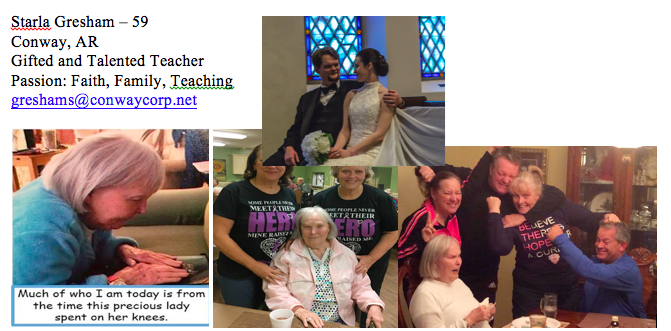
HWWLT Logo on yellowStarla Gresham attended the Conway public schools, became a teacher, taught first grade for ten years, and then had the opportunity to join the Gifted and Talented (GT) team. As the ‘thinking teacher’ at a Conway elementary school, Starla spends one period every week with each K-4 class, and 2-1/2 hours per week with selected third and fourth graders in the Pinnacle program. Her class work includes projects like building something from a bag of trash and writing about it, or an extended version of twenty questions to untangle riddles like: ‘The baseball champions scored 12 runs but not a single man crossed home plate.’ (I guessed it was a woman’s team; in Starla’s riddle all the players were married). Starla has written a book on Creative Problem Solving and loves writing curriculum to help other teachers.

screen-shot-2016-12-21-at-8-37-49-pmAfter visiting so many teachers who are disenchanted with our educational system it was a joy to spend time with a devoted teacher who still loves her work. Though she did say, “I’m glad not to have a regular classroom anymore. The restrictions on classroom teachers are so great these days.”

Consistent with her rigor, Starla investigated my website and prepared a response to my question as suggested by one of my earliest posts. Interestingly, even a GT teacher who specializes in riddles rephrased my question to the first person singular. That word ‘we’ is an uncomfortable one for most everyone.

How will we live tomorrow?


screen-shot-2016-12-21-at-8-41-22-pm

How will I live tomorrow? Should I make this personal? I’m very much a “Pollyanna Positive” I see the glass completely full as opposed to ½ empty J

At this time my heart is very heavy as I watch my mommy disappear a little at a time each day. Alzheimer’s is such a cruel disease. This amazing woman did everything right, exercised every day, ate only healthy food, participated and taught bible studies on almost a college level, raised 4 wonderfully exceptional children almost single handily. (Dad was a traveling salesman) And now she’s forgotten how to brush her teeth. Every day when I go see here there is still that little sparkle in her eye when I walk in. My prayer is that the God she was so faithful too her entire life will take her by the hand “HOME” before that spark is completely gone. I live tomorrow with that hope and enjoy every second I have with her. Blessed!

I LOVE my job – I could stay home and make just as much money – but it’s not about money in the least! I LOVE my job! After 35 years I can’t see stopping. I will live tomorrow blessed to touch the lives of SO MANY innocent children (some stinkers) but where else can you work and feel like a super star when you walk in a room – kids waving arms, smiling, yelling Mrs. Gresham, Mrs. Gresham. Blessed!

Precious Baby Son – 500 words just aren’t enough! What an amazing son I’ve been blessed with to be a part of my life. I will live tomorrow watching him work so seriously on his Pharmacy degree. He takes the responsibility of helping so many people with such dedication, I will live with ride in my heart that I can call him Precious Baby Son!

How will I live tomorrow – hopefully making a difference in the people I come in contact with every day? My family knows I would do anything for them. My students know I’m always there for them. We have SO MUCH FUN – they don’t always realize they are learning. Blessed to have the freedom to freely worship my Heavenly Father. Just trying to be the best person I can be.


Posted in Responses | Tagged , | Leave a comment

Profile Response: Elysse Newman and Michael Repovich, Fayetteville AR


HWWLT Logo on yellow“Architecture students are very good at applied problem solving and custom fabrication. There’s a certain degree of empathy that architecture students have.”

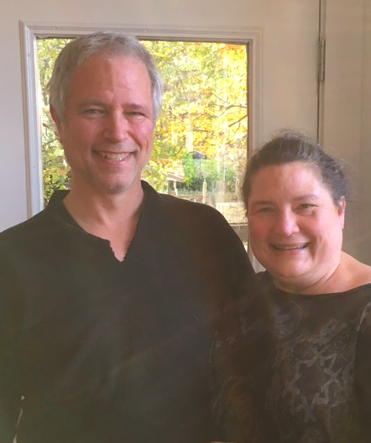
Elysse Newman and Michael Repovich exemplify the range of pursuits that can be launched from architectural training. The couple met in Washington DC, when they both worked for the large design firm, HOK. Elysse turned toward an academic and research path, focusing on the relationship between neurosciences and architecture at Harvard’s Graduate School of Design. She taught at Florida International University, and recently became Head of the Department of Architecture at University of Arkansas. Michael kept his hand in direct practice, but recently switched to become the owners representative for the new children’s hospital under construction in Rogers.

imgres screen-shot-2016-12-21-at-7-45-56-pm

The U of A School of Architecture is renowned for its namesake, E. Fay Jones, whose finely conceived and crafted buildings gave Ozark regionalism international acclaim. Selecting Elysee, a research-driven architect, to head the department demonstrates a broader view of the school’s purpose. “U of A is changing as a whole. It’s promoting the public presence of higher education. What does an architect need to know in 2030? Look at the 99%: how can our students lead that conversation?

imagesElysse teaches a course in medical devices, an unusual offering in architecture. “We identify a user, observe, develop, and make prototypes.” As an example, Elysse described a group of students who recently developed an infill cushion that fit between the back and headrest of a standard wheelchair for a woman whose C5 injury was unsupported by that gap. “This is not the 1% design we see in magazines. It is not what the studio system promotes, but it makes a difference in people’s lives.”

How will we live tomorrow?

screen-shot-2016-12-21-at-7-38-27-pm“I think, despite appearances, we’re moving toward a more unified experience. Nationality is dying. We will continue to have regional differences; we will come to see the differences as good. We will come to understand ourselves as stewards of the earth. This is fifty to one hundred years out.

“We are not in a very good space right now. In the 1700’s you would see this dichotomy, ‘the best of times, the worst of times.’ We started to standardize time and measure. That was the beginning of physical globalization. Now we need to make the spiritual leap.

“This will have many ramifications. It will affect our view of women and men, race, money. The computer doesn’t care who you are. We have not caught up with how that changes us. This will affect every institution we have. Look at our politics. What we‘ve seen is because of social media, which is based on a computer.” – Elysse

“Depends on what tomorrow you’re talking about. Monday will be much like Sunday. We are coaxed into change, we don’t volunteer for it.

“In terms of the future I’m a doomsdayist. I think it’s going to be really challenging. We are damaging our capacity for human habitation. Our only saving grace is the balance between culture, technology, and resources. How we balance them will shape our tomorrow.” – Michael

Posted in Responses | Tagged , , | Leave a comment

Profile Response: Kyla and Kurt Templeton Bentonville AR

HWWLT Logo on yellowEveryone in Bentonville has a Walton’s story, but Kurt Templeton’s is pretty good. His sister was Steuart Walton’s (third generation Wal-Mart heir) first girlfriend. True fact. One night when Kurt was eighteen, he and his sister went by the Walton’s house. “We were hanging out and I realized I had the nicest car of the bunch. These guys, richest on the planet, had old cars.” The Wal-Mart ethos of modest frugality runs deep, at least in the Ozarks. “So much of the company is predicated on people who haven’t had a break. The Walton’s have hunting ranches and vacation houses all around the world, but not in Northwest Arkansas.”

screen-shot-2016-12-21-at-7-21-42-pmFifteen years or so later, Kurt’s worked for Wal-Mart ever since graduating from OSU, using his journalism degree and artistic talent indirectly. His wife Kyla also worked at Wal-Mart before stepping down when their two boys were born. The family lives downtown, within walking distance of the square, a block or two from some of the Walton grandchildren.


img_8402Kyla is a bicycle disciple and triathlete who competes in short competitions. “I don’t have the time to do an Ironman. I can’t leave Kurt with the boys while I ride a hundred mile or run a marathon. I like to swim, bike and run but I sprint them all.” Kyla heads the Arkansas Interscholastic Cycling League, which operates all over the state but is very strong in Bentonville, where Walton grandson Tom is one of many Walton’s with a keen interest in cycling and The Walton Family Foundation’s funds many cycling initiatives. “Every school in Bentonville has thirty bicycles. Every third grader learns bicycle safety and rides for PE.”

screen-shot-2016-12-21-at-7-21-20-pmAfter the three and four year olds are in bed our conversation meanders into deep streams. In this town with such a singular corporate identity, people see benefit to corporations taking on roles traditionally allocated to government. As Kurt sees it, “Wal-Mart serves 160 million customers. Forty million could stop shopping there next week and have other options. All of Amazon’s customers can walk. Can you imagine having a four to six year contract with your grocery? That’s what we have with our politicians. Businesses are much more responsive.”

screen-shot-2016-12-21-at-7-20-22-pmThen Kyla warns, “But what about Halliburton? They have a huge business but not in consumer products. What influence do we have over what they do?”


How will we live tomorrow?

img_8409“I haven’t really thought it beyond tomorrow. We’re corralling the Dirt Divas, the girl’s mountain bike group, to ride out to Blowing Springs. I’m looking forward to being in the woods and being with other girls. We’ll also have some good wine and cheese.

“How about the other way to take that? I think a whole lot of people are going to revolt against social media.” – Kyla

“Oh, good luck with that.” –Kurt, without looking up from his smartphone.

“That’s why I’m going mountain biking with my fiends tomorrow.” – Kyla

“That’s why I’m tweeting a bunch of people I don’t know. Social media is extroversion for introverts.” – Kurt

________

“It’s a really hard question. I think tomorrow is a fork in the road. Politically, in the US and UK, it comes down to whether we want to isolate ourselves from people different than you or connect with them. It’s counterintuitive that we know so much about health but are so unhealthy. It doesn’t help that technology defines everyone by the worst one percent.

“As yogi bear says, ‘When you get to the fork in the road, take it.’” – Kurt


Posted in Responses | Tagged , , , , | Leave a comment

Profile Response: Hamza Farooq, Bentonville AR

HWWLT Logo on yellowBegin life in Karachi Pakistan for youth and undergraduate degree, move to Malaysia for MBA, shift west to Dubai for consulting, rocket to Minnesota for Masters in Data Science and severe climate shift, on to New York City and land in Bentonville all before age thirty. “I have been here a year and a half, the longest I’ve been anywhere in a long time.”

When Hamza Farooq solved a data set problem posted on Kaggle.com, Wal-Mart came courting. “I had a job in a company in New York. Wal-Mart flew me here, took me in a room with a super computer bigger and faster than any I’d ever seen. They said, ‘you can play with it’ and left me alone for an hour. When they returned they said, ‘welcome to your new office.’”

imgresHamza lives in a minimally furnished one-bedroom apartment littered with The New York Times and The Economist. He’s reading Ted Chiang’s Stories of Your Life. He builds his own small computers and makes his own work hours. “My role is to determine the right mix of products to have on the shelf in any store.” To most of us, all Wal-Marts appear the same. I know where to find the bicycle tubes and Power Bars in any city. But the products and quantities in each store vary in ways a typical customer will not perceive. Hamza tweaks each store’s inventory, enabling Wal-Mart to sell twice the volume per square foot compared to most retailers. “There are 4600 Wal-Mart stores in the US offering over one million products to one hundred million households. I determine what goes on the shelf in Plano Texas.”

imagesThat determination involves huge quantities of data but also a dose of human interaction. “I spend a lot of time in stores and talk to people. It’s all about customer satisfaction,” which is related to employee attitude and efficiency. Hamza is expert and pinpointing the underlying problem of underperformance. “I use a normal curve for everything in life. There is no correlation or causation either way. If the customers are satisfied and the staff is happy, that is the key. If not, look at the externals, like the back room or the competition or whether the access road is under construction.” Those are the factors we like to blame, but they are almost always the outliers.

“I excel at behavioral economics. Pure economics assumes everyone has complete knowledge, but no one has full data, and we all make habitual and irrational decisions.” Hamza ordered entree #20 at Thai Basil without consulting the menu. “I have been here enough to know what I like. I don’t need to explore anymore. I order that dish every time.”

images-1Hamza has couchsurfed all over the world, but I was his first guest in the United States. “I don’t understand people here. They have such fear. In Berlin or Vienna people invited me in, we got to know each other. In Dubai every Wednesday was a volleyball match sponsored by couchsurfers. The unwritten rule was, ‘everybody plays.’ In this country, to get three people together is an achievement.”

What are we so afraid of? “People here say, ‘we need guns.’ In my country I live in a house with a wall and barbed wire and two full time guards. Still, I have been held up twice at gunpoint. This country’s politics run on fear, but there is so little to fear here.”

So why does Hamza, who could live and work almost anywhere, choose to be in the United States? “It’s Maslow’s Hierarchy. The problems here are real, but of a higher order than in the developing world.”

How will we live tomorrow?

screen-shot-2016-12-21-at-7-02-17-pm“In fear.”

Hamza must have seen my face drop at such a brutal response from such a nuanced individual. After a long pause, he added, “Fighting stereotypes and fighting fear.”


Posted in Responses | Tagged , , , | 2 Comments

Profile Response: Chris Cochran, Bentonville AR


HWWLT Logo on yellow“Wal-Mart can be a force for good.” Chris Cochran is a Senior Manager in Sustainability at Wal-Mart’s corporate headquarters in Bentonville AR. “The biggest effect is that we save the average family $2,000 to $3,000 per year – whether you shop at Wal-Mart or not.” Chris is a steady spokesman for his company. “Wal-Mart can influence the entire industry. When Wal-Mart established a minimum $10 per hour wage, that will become the defacto minimum wage.” The thirty-year-old runner studied International Development and Finance at Johns Hopkins and ran a coffee plantation in Honduras. “Wal-Mart has three sustainability goads: 100% renewable power, zero waste, and sustainability produced products.” His earnest enthusiasm is contagious. “Wal-Mart already uses 25% renewable energy and we are on target to reducing waste by 50%.”

screen-shot-2016-11-23-at-7-41-11-amWal-Mart entered the sustainability space, as techno-geeks like to say, in 2006. The decision was prompted by PR needs in response to bed press and lawsuits about their business and human resource practices. The company realized that it wasn’t just good press, it was good business. Last year Wal-Mart saved over $2 million through their recycling initiatives. Chris’ sustainability group is involved in the full spectrum of Wal-Mart decisions, from production to transportation to bricks and mortar stores to online growth.

screen-shot-2016-11-23-at-7-42-01-amChris is particularly interested in agriculture. “Agriculture is the root of economic development. Economic development is the root of all international relationships.” A recent project centered around erecting tents over grape fields in the Sonoran desert. Producers increased their yield and reduced water.

Chris grew up in Searcy AR, son of a theology professor. He pulled away from his original church. “Like most religions it was too much about what not to do rather than what to do.” He has a penchant for action and believes in the power of big solutions. He believes that government, as well as big business, can be positive. “FDR’s first 100 days illustrate how the federal government can be a force for good. It counters the prevalent notion that government is bad. I feel that this election, we have torn at the fabric of our society. If everyone had the opportunity to visit the FDR library, it would affect their perspective. It might not change their minds, but it could.”

screen-shot-2016-11-23-at-7-39-37-amDie-hard environmentalists scoff at Wal-Marts sustainability initiative – people in Arkansas shouldn’t be eating Mexican grapes not matter how efficiently grown – and climate change deniers reject it from the other end of the spectrum. But if we are going to sustain seven or nine billion people on this planet, we’re not going to do it without large centralized organizations. In this country, that means big business. Wal-Mart is the biggest of the big businesses. Being more sustainable may not be enough to stem the tide of environmental degradation, but it’s the right direction.\

How will we live tomorrow?

screen-shot-2016-11-23-at-7-37-42-am“We will live in an even more unequal society but the inequality will be post-human. Bill Gates will have an implant that gives him capacities that will not be available to everyone.”

“I work in sustainability. How will we feed nine billion people in 2050? We are already using 1.5 times the earth’s resources. And now people aren’t content with grain, they want milk and meat. Today, there are 800 million people who are undernourished. The inequality will create even more undernourished people.

“I like the movie, HER. There is a scene where everyone puts down their device and rediscovers each other. We will get to the point where we break through the noise of technology. We will seek contentment. We will decide that media is not free and pay to cut through the noise.”

Posted in Responses | Tagged , , , | Leave a comment

Profile Response: Denise Bell and Chris Sykes, Hulbert OK


HWWLT Logo on yellowChris Dykes’ father was a high school teacher on Tulsa’s south side – the white part of town – when 1970’s era desegregation prompted the school system to shuffle their student mix or face a court-imposed system. A high school in the poor, black, north side of town was turned into a magnet school. Chris’s dad switched to Booker T and spent the rest of his career teaching philosophy and advanced English to students willing to travel the extra miles for a rich education.

img_8355About the same time he purchased an acreage on a creek outside of Hulbert. Chris spent weekends and summers up in the woods and streams. His father retired to a small cottage on the property with a central wood stove, encircled with books.

Meanwhile Chris became a librarian at the Tulsa Public Library reference desk. One day, Peggy Herbert, a semi-star of the 1950’s and glamorous Tulsa native approached the reference desk. After she left, a homeless man asked Chris to use a railroad atlas. Unbeknownst to Chris, his dad watched both interactions. Afterward. the philosophy teacher told his son, ‘You treated them both just the same.’ img_8351

“Our libraries are the most important institution we have; more important than the church.” But Chris kept getting nudged up. “As a male I got a career path, but I only wanted to answer questions.” So he left the library, travelled Europe and worked a variety of literary and sports-car related jobs. Then he returned to Tulsa and discovered Denise Bell in a bookstore.

screen-shot-2016-11-23-at-7-34-37-am

The couple spent more and more time at the farm. They started a business growing lavender and built their own house beyond Chris’ dad. “Lavender is romantic, but hard work. It’s all done by hand.”

img_8353Denise Bell is a reserved woman, self-contained in presentation and movement who enjoys working with her hands. Eleven years ago she discovered knitting. “Knitting is math; it’s all about the pattern you build and counting.” Denise knits fine lace with thin thread; nothing like our conception of knitted sweaters. She is a master who teaches specialty classes all over the country. The couple abandoned lavender for Lost City Knits, an online business of exotic yarn. Their recent book, Ultima Thule, is a delightful mash-up of Shetland lace pattern, stories of the Highlands, and coffee table photos of the breathtaking Scottish landscape. Chris rose from the table to fetch the lace Denise is working on at present. Suddenly Denise is standing, bobbing, pointing out the delicate pattern. She catches herself. “I ought to stop talking.” Her excitement for knitting is palpable, contagious. “I am besot by it.” I marvel and applaud her enthusiasm.

screen-shot-2016-11-23-at-7-36-04-am

How will we live tomorrow?

img_8357“Have the answers gone south in the past week? I have a prepared answer and its negative. How will we live tomorrow? With more information and less wisdom; more isolation and less connection.

“But we have a bicycle tourist who opens himself to anything and that flies in the face of my answer.” – Chris

“As a woman I am more worried about the future. This has deteriorated in the past ten days. Because we live remote, our encounters are limited, so we can control them. I do hope that we swing back to acceptance, not tolerance, of others in our society.” – Denise


Posted in Responses | Tagged , , , , | Leave a comment