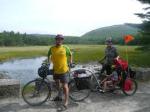
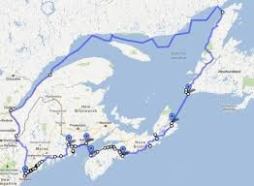
Profile Response: Rose Swan Pot Luck in Union, ME

HWWLT Logo on yellowRose Swan is a family constellations counselor and workshop facilitator. Her partner, Jeremy Clough teaches at a Waldorf School. When Rose invited me to stay with them, I looked up Union, ME on the map, explained that it would be a haul to get there, but I’d aim for 7:00 p.m. on a Friday night. That proved challenging. When I finally arrived, after eight o’clock, Rose had assembled thirteen people to talk about tomorrow. They included teachers, farmers, therapists, and dancers. Some were born in rural Maine, others relocated there. They shared a conscious decision to live a simple, remote life. Here is a recapitulation of our conversation.

Human beings have energy zones that are independent of our muscular and kinesthetic energy, yet are related to them. Our movement informs our mental state. Much of contemporary life – computers, TV, movies – agitate our staccato energy. Staccato energy is exciting, but it needs balance in order to avoid tripping into anxiety. There is no legato. Our energy is no longer balanced.

Our electronics provide one level of connection but they mask other elements of connection. We rely too much on visual and written messages. We lose subtlety and body language.

imagesAnd yet we get contradictory messages. The stimuli coming at us are exciting, but children are expected to sit still in school. The normal activity of the child is to move, not sit at a desk. So we put them on Ritalin to curb their natural impulses.

Is tomorrow utopian or dystopian? There are conflicting forces at work. Technology is the wedge that drives us apart, yet it also allows us to advance in phenomenal ways. We can’t go back on it, yet we must acknowledge that it is not only changing the way we view the world, it is actually altering our fundamental being. Just like the printing press made reading widely available. It changed the way we understood the world and simultaneously changed the way our brains developed. In the extreme, we could evolve into two completely separate species: the technical and the non-technological.

When I think about resources, I believe they are finite. At some point they are going to have to be rationed if we are to survive. How can they be allocated in ways that enhance human connection rather than technological disparity? Moving forward, solving problems is not going to work the way it always has; we’ve never accepted the limits of our earth. I worry about having the imagination to address ever more complex problems.
images-1Enough of this! Every generation has their Achilles heel. Ours is technology. We have to learn how to grapple with it and make it serve us, but I’m sure that we will. Every other generation has addressed its challenges. I have hope.

I agree. Framing tomorrow in terms of technology is a very narrow frame of reference, especially when compared to the totality of human history.

But we’ve never encountered anything quite like it. Facebook is like eating Little Debbie snack cakes – no one admits to it but everyone eats them. Technology, especially in the form of social media, is like mental candy – a constant rush of sugary stimulus.

imgresHuman development mirrors societal development. In the Waldorf School approach, we mirror the curriculum and expectations to human development. We want to teach children age-appropriate skills and values that they can take into the future. Our work revolves around myths and fairy tales in second grade, when children’s imaginations are prominent. We teach the Greeks in fifth grade when Idealism is ripe. We teach modern history and war to seventh and eighth graders, when they are developmentally rebellious.

History shows that adaptability and change are the only constants. When you realize that you can ask a question, that your voice can influence and affect, that’s when the world changes.

imagesRose explains why she values studying constellation modalities in relation to this question: “People have forgotten where we have been. History helps us understand our place in the fabric of existence. If we have a context, today, of where we are from, we will be prepared for tomorrow. We shape tomorrow by standing in truth today. We need to acknowledge our place. People are experiencing a lot of anxiety because we have lost context. Myths and stories give us context. They root our place in this world.”

We have so much stuff. We can’t keep having so much stuff. I grew up in a village. We looked after each other. When there was a physical village people didn’t move. Now, we can stay in touch so easily, the village is the globe. The resources available are much better, but something is lost.

We’ve lost that sense of community. How do we find a sense of community?

There is a schism between people and the land. People leave the land. They move to the city. They get jobs to buy food grown by others and live in houses built by others. They lose their sense of control.

The earth dimgres-1oes support us. But our society doesn’t support us.
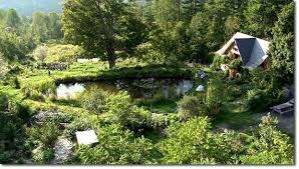
You can live off the land, but you can’t make a living off the land. We have become used to higher standards than our forebears enjoyed. We ‘need’ a toilet; we ‘need’ the Internet. The land can’t give us that.

So now we have to create community consciously because it doesn’t happen organically. The mutual support that was required in an agricultural community – everyone helped everyone else during haying or disease – is gone. We don’t all go to LaGrange balls and Sunday church suppers. Our community can be the entire world, and that makes it more difficult.

Technology gives us unlimited connection, and yet it limits actual connections. In the old days you picked up the phone when it rang and said, “Hello.” Who does that anymore? Now we screen our calls, talk only to those we know and like. Nothing is random or unexpected.

The start of community has to be us all here, sitting and talking.

Posted in Responses | Tagged , , , , | Leave a comment

Trip Log – Day 14 – New Hartford, NY to Cazenovia, NY

Screen Shot 2015-05-20 at 12.29.53 PMMiles Today: 43

Miles to Date: 846

May 19, 2015 – Sun, clouds and thunderstorms, 75 degrees


Linda Turner, my warmshowers host, fried up hash browns, steak and eggs. Over breakfast she shared her explorations in genealogy – up to ten generations back through some branches of her family. She has connected relatives that didn’t know each other existed, bridged gaps that occurred when so many died in the 1918 influenza, held a reunion for more than 200 people from the ‘Murphy’ branch, and traced her ‘Adams’ connection back to our founding father. Linda demonstrated the amazing array of historical resources she uses on line and contributes her own findings with sites documenting her family roots.

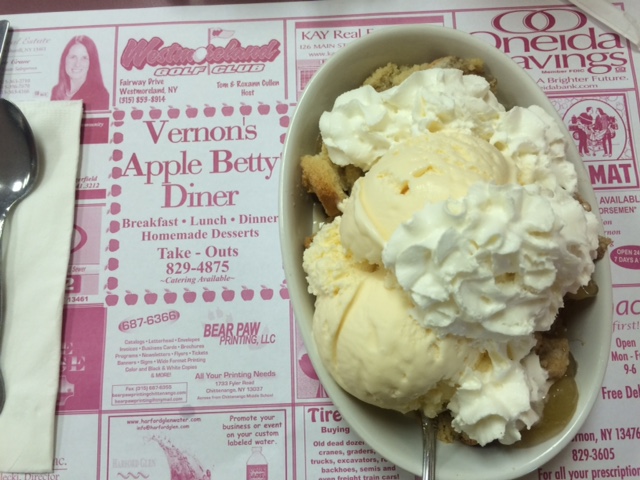
IMG_1898The day started muggy. I encountered a cooling light rain as I headed west. When I stopped at Apple Betty’s for lunch, the waitress told me I had just missed a huge downpour. Good thing I made a late start; also good that I ordered Apple Betty’s namesake dessert, which was terrific.


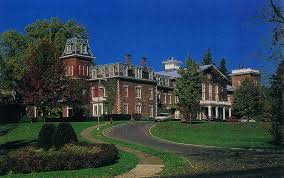
imgresI spent the afternoon at the Oneida Community Mansion and had a fascinating discussion with Executive Director Patricia Hoffman about the impact of the Oneida Community on the nineteenth century utopian movement and what their legacy means for tomorrow.

IMG_1885By the time I began my late afternoon ride, the storms had passed, the air was crisp, the farms lush, the birdsong delightful. I meandered on country roads in a south and west direction, clinging to river valleys except for one questionable turn that took me up a wicked step hill. Eventually I returned to U.S. 20, which I had left yesterday, and pedaled the long rolling hills into Cazenovia.

IMG_1903John Cawley, my warmshowers host, lives in an incredible Civil War era building called Stone Cottage that sits at the very end of Main Street, overlooking Lake Cazenovia. We visited in his living room, which has the most incredible crown molding – made of wood – I’ve ever seen. Then he cooked spaghettis with meatballs, offered me Yuengling, then ice cream. We took his dog Teddy for a walk along the lake at sunset, and when I climbed into my period four-poster bed, I fell into solid sleep.


Posted in Bicycle Trip Log | Tagged , , , , , , | Leave a comment

Trip Log – Day 13 – Cobleskill, NY to New Hartford, NY

Screen Shot 2015-05-18 at 10.09.53 PMMiles Today: 72

Miles to Date: 803

May 18, 2015 – Sunny, 80 degrees


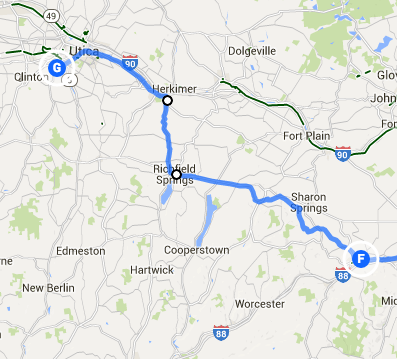
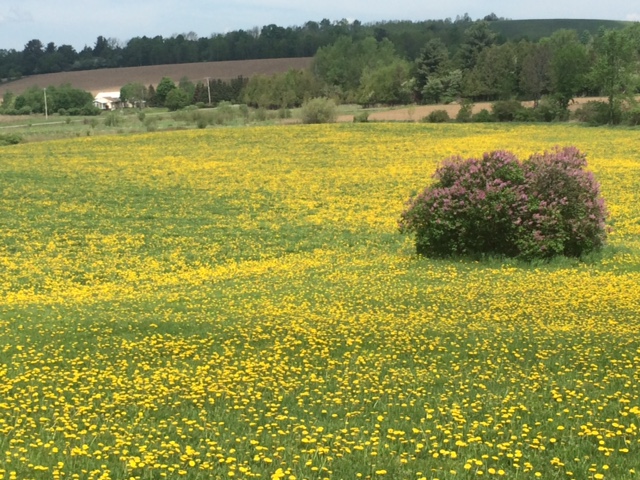
I made several trips to my hotel breakfast bar and floated out of Cobleskill on a beautiful Catskills morning. Thunderstorms were in the forecast for afternoon, but I had detailed directions and plenty of time to log the 67 miles to New Hartford. I rode through glorious farm country, past graceful churches, Mennonites in buggies, past millions of dandelions, and odd roadside attractions.

IMG_1887IMG_1896IMG_1897IMG_1894

IMG_1892Route 20 is a huge road with wide shoulders and absolutely no traffic. I was making good time.

At Richfield Springs I turned off U.S 20 to NY 28 then County Road 150. The turns didn’t lay quite right, but I was confident of my sense of direction and kept on. It was one o’clock now, the sun was straight overhead, and I lost my cardinal sense. When I came upon an intersection that included roads I had already left, I stopped to study my GPS. A couple sitting on their porch offered guidance. I took off on a new tack.

Less than a mile along an empty road my chain skipped on my rear sprocket three, four times and then – snap – my chain broke and strung out behind me. I’ve never had a broken chain, or ever knew anyone who did. I took out my cycling tools and inspected the break. I couldn’t repair it. So, I took a deep breath, devoured a Power Bar and an apple, and repacked my stuff. I laughed that is was my thirteenth day out, so bad luck should have been expected. I figured I’d walk uphill and roll down until I got to the highway three or four miles away, and then hitch a ride to a town.

Just as I was about to move, a car drove up, the couple from the corner. They stopped. We figured out how to take my bike apart to fit in their car.

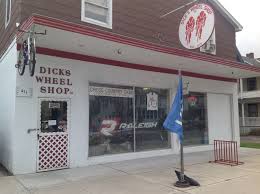
imgresThey drove me to Dick’s Wheel Shop in Herkimer, stayed with me until Dick found the right part, and wouldn’t take a dime for their trouble. I lingered at the bike shop for an hour or so while they replaced the chain, checked everything else, and directed me to a beautiful road that ran along the Mohawk River all the way to Utica.

The afternoon rains came. Not as dark thunderstorms, but as gentle showers that took the stinging heat out of the air. I rode along, thankful for the cool wet breeze, the generosity of humans, and the strange coincidences of my day. The couple that picked me up were named Frank and Lou, same as my grandparents. They delivered me to Herkimer, where my parents spent their first Honeymoon night. And Dick, the bike guy, was definitely my own father’s soul brother. Speculating upon the mysteries of life while pedaling through a soft rain is satisfying, but ultimately life delivers wonders that we must simply accept.

I didn’t arrive in New Hartford until six. My warmshowers hosts, Linda and Mike, fed me salad and grilled steak, baked potatoes and foil-warped onions swaddled in bacon. So good after a long day of riding and no lunch. Yet we still finished in time to watch The Voice.


Posted in Bicycle Trip Log | Tagged , , , | 2 Comments

How will we live tomorrow?- Responses 4

How will we live tomorrow?

“We’ll shut down the war machine and help everyone in this country. We’ll make everyone in this country strong – the poor, the elderly, the immigrants, everyone. And then we’ll help others. I’m not saying get rid of the military completely. Just keep enough to defend this lad. That will leave plenty of money to make all of us truly strong.”

Dick Gloo, Dick’s Wheel Shop Inc. Herkimer, NY

____________

How will we live tomorrow?

“We are planning a garage sale for Memorial Day weekend. Last year we made $1,000. Whatever doesn’t sell we give away to Catholic Charities. Nothing goes back in the house.

“I want to go to Old Orchard Beach, to see the ocean. I was there when I was three, but I don’t remember it. I don’t like to travel more than two or three days, then I like to be home. But I would like to see the ocean.”

Judy Lawyer, retired homemaker, Duanesberg, NY

____________

How will we live tomorrow?

“That’s a good question. People are people. There is too much arguing and too many labels. We’re all just people.” 

Jack D. Jolie, Vocalist and guitarist, bluegrass_guitar@hotmail.com, Ricky’s Diner in Bridgton, ME

_____________

How will we live tomorrow?

“My dad is on the two-year plan. He is 103 years old. He is the oldest living member of Theta Chi fraternity. Every two years the oldest member closes the national conference. He spoke at Orlando, then Phoenix, then Minneapolis. Every time he ends his speech with, “See you in two years.” So far, he has been good to his word.””

Dan Freeham, Jr. Retired veteran and railroad enthusiast, Canaan, NH

_____________

How will we live tomorrow?

“The thing that bothers me are the people who complain but don’t do anything; they don’t vote, they don’t participate. Here in Maine, what we have to do over hte next three years is get rid of our governor.”

Kim LeClair, Jobs Counselor, Bridgton, ME

_____________

How will we live tomorrow?

“Hopefully, just as good as today.” 

Tammy of Mike and Tammy’s Main Street Market and Deli in Londonderry, VT

_____________

How will we live tomorrow?

“Hopefully trying to make tomorrow better than today. Live tomorrow in the moment.”

Fiona Bachtel, Seventh grade scientist, Norwich, VT

_____________

How will we live tomorrow?

“Why is everyone worried about losing their identity in a country where we’ve already lost ours?”

Dave Bachtel, IT Executive and bass player, Norwich, VT

_____________

How will we live tomorrow?

“That’s exactly the question. Our expenses far exceed our income. We are getting older, fewer, and have too few active nuns. The math is obvious. Every year 15 to 20 of us die, and no one takes their place. We need a tremendous renovation, but it takes a lot of money to make money. We have invited other communities to use our space. 2025 will look very different from today, and I am challenged to have the vision”

Sister Frances Eustace, 93-year-old Sister of Saint Joseph of Carondelet, discussing the status of their Provincial House in Latham, NY

_____________

How will we live tomorrow?

“If I could pull it off, I’d like to go to the moon. That’s my thing – we need to DO more.”

Sister Gordon, retired science teacher, Saint Joseph Provincial House, Latham, NY

_____________

How will we live tomorrow?

“Have fun and do what you can. You never know what will happen.”

Myrna, laborer on her uncle’s farm near Duanesberg, NY

_____________

How will we live tomorrow?

“My plan is to stay in it for five years and then retire at 62.”

Mike Whitmore, Shipping Manager, New Hartford, NY

____________

How will we live tomorrow?

“The future is here. We can have great local agriculture in this area.”

Jim LaValla, Owner of The Locavore, Frankfort, NY

____________

How will we live tomorrow?

“Railroads has to be part of the package.”

Dan Freeham, Jr., Veteran and railroad enthusiast, Canaan, NH


Posted in Responses | Tagged , , , | Leave a comment

Profile Response – SMRT of Portland, ME

HWWLT Logo on yellowI enjoyed working with architects, engineers, and landscape designers from SMRT several years ago when designing the MaineGeneral Medical Center in Augusta, ME. They invited me to visit their offices for a freeform discussion of ‘How will we live tomorrow’. The group included Ellen Belknap, Graham Vickers, Mark Johnson, Paul Lewandowski, Andrew Bradley, and Justin Grove. Specific attributions are only indicated on comments that swerved from the main thrust of the conversation.

imgres-1We started talking about healthy food, despite the fact that Ellen tempted the gathering with a box of Portland’s famous potato donuts from The Holy Donut. Local farming is finding resurgence in the area. Small farms are reviving in Scarborough (a Portland suburb). The Portland Food Coop opened four months ago and has four times as many members as they anticipated. Community gardens are being developed in Portland. There’s an urban trend for local agriculture, but it will have to work its way out to less urban areas to have an impact. St. Mary’s Hospital in Lewiston has a farmer’s market in their parking lot, which is both a symbol to the community that healthy food is good health, and allows their staff easy access to better quality food. MaineGeneral Medical Center has am ambitious local food program, but they’re finding the 18 to 24 year old demographic is the most resistant to new foods – if you consider heirloom vegetables ‘new’. At Henry Ford Hospital (Bloomington, MI) they had to create special training and appreciation programs to introduce food service staff to traditional foods and how to prepare them. The food spectrum has changed so much in the last ten years.

“This is all true, and the green movement is great for the affluent. But it’s not reaching to the poor. Not everyone can live on the Peninsula.” Ellen Belknap (The Peninsula refers to the City of Portland’s core, which is both affluent and funky).

images-1The green movement has to mature, and then it can expand. Andrew described how he installed a solar array on his house, but when he needed a replacement tube, the part was not readily available. Standardized parts, so prevalent in the automotive industry, are not yet part of the solar industry.

The practice of architecture will change. Collaboration was not inherent to architecture in the past. There are still some folks who work alone and present a design to be built. But younger people are much more collaborative, and it permeates everything. Working in open spaces is now the norm, which promotes open communication. As a joint architecture / engineering practice, this collaboration is SMRT’s strength.

With regards to the process of work, each of the participants talked about their children. Some have children in grade schools with combined curriculums, for example; physics, geography and cartography are taught together. Middle schoolers experience a lot of team projects, and the results are mixed. Sometimes the group dynamic is great, other times team members can skim through a collaborative process. Others have college-age children who are pursing cross-discipline degrees. Dual emphases coexist: people need to have necessary specific skills, and they need to have the general skills to collaborate with others. Accreditation requirements lag; they are focused only on specific skillsets. Look at the maker movement. You don’t need a deep understanding of everything you make, and because you’re not “expert” you bring a new perspective to the problem. We’re trying to create Renaissance people everywhere. Perhaps a new major is required, “Team Building” that combines psychology and business.

“Your personal experience becomes the lens for everything.” (Andrew Bradley).

images-2“Yes, but collaboration cannot usurp the need for focused knowledge. The best collaboration is people with deep knowledge, each approaching the problem from their perspective.” (Ellen Belknap).

The discussion of collaboration honed in on the college experience. Getting into college has become every young person’s first marketing endeavor. It’s difficult enough for kids with families and support; it’s too difficult for those who don’t have that. Not everyone needs the training that college delivers, but the experience of personal and social growth that college delivers would be useful to everyone. How do we deliver the college experience to all, regardless of the actual work they will do in live? Especially in an era when so many people have reduced expectations. The growth of community colleges is one step.

images-6Our school system prompts every kid to go to college, even though the process of actually going to college is so difficult. Perhaps the evolution of the ‘maker space’ can change the face of Vo/Tech so that is an acceptable track for more high school students.

Graham had several friends in high school that went on the mechanics track, worked in auto repair, and later became mechanical engineers. They brought a completely different perspective to the work.

images-5We are torn between an educational system that provides growth experiences and one that produces the work force we need. All labor is becoming more knowledge-based. Even Asia will lose its manufacturing edge once robots become cheaper than off-shore labor. We have to create a system that allows us to design / build / use in one environment. Look at fashion. It takes a year for couture to conceive and produce a custom garment. Yet fashion trends change every six weeks. The Gap was innovative in getting the process down to three mouths. Then Zahara sliced that down to 14 days – concept to store. It’s a creative model, but still dependent on cheap labor. Automation can address that downside. We want to make the connection between the user and the maker to be as short as possible. That’s what the local movement is all about. It is still fledgling, but it’s a good direction.

images-3The demand for everything is faster. Things sped up when we went from mail to fax, now with email the expectations of response are even faster. “We have all become commodities.” (Justin Grove), “Our profession is heading into tough straits. People think what we do is a technical task that can be reduced to production.” (Ellen Belknap). As technology evolves, we will have to move away form tracking our hours to tracking our deliverables. That is beginning to happen already, and it will change the way we do business.

imgres-2Look at Kaplan & Thompson. They are a full service design firm, but what’s really taking off is their Bright Built Barn. It’s net zero and modular. At $225 per square foot it puts net zero construction a more affordable range. It can be assembled in days rather than months, but it changes the role of the architect.


In many ways, it is a more appropriate role for architects. We are trained to design the landmarks but actually have very little influence in most construction. There are architectural parallels to fashion. We have starchitects who are the couturiers, then custom designs, which are like high designers, then the knockoffs, which wind up being most of construction. At imagesthis time, the most innovative design is happening in the most dynamic places on earth, the Middle East and Asia. Design in the United States is staid by comparison, which reflects our more mature society. We are no longer cutting edge.
What is the appropriate way to accommodate and embrace change? “The computer was supposed to save us time and lead to the 20 or 30 hour work week. Instead, we amped up productivity. At what point will we reap that change? Will we get to the point that we produce less? Can we make what we need rather than what we can? At some point there will be a crash, where production capacity eclipses demand.” (Andrew Bradley)


Posted in Responses | Tagged , , , | Leave a comment

Trip Log – Day 12 –Slingerlands, NY to Cobleskill, NY

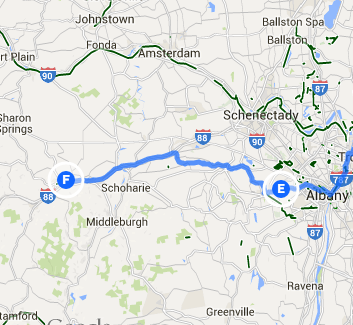
Screen Shot 2015-05-17 at 8.12.29 PMMiles Today: 37

Miles to Date: 731

May 17, 2015 – Sunny, 80 degrees


A cycling fact: fifty miles before noon is easier than thirty miles after noon. I got off to a late start, on purpose, because I went to church with Dave Gibson and his family. It was a worthwhile experience, but put my on the road after noon. I planned a short day, but was lethargic all afternoon. Perhaps it was the eighty-degree weather and the saturated sun. Perhaps it was the fragrant abundance of lilacs. Perhaps it was the cotton candy clouds. Perhaps it was the long swales of blacktop that lulled me into reverie. Perhaps it was the cultural rhythm of Sunday as a day of rest. All of that combined to wedge the song “Lazy Afternoon” in my head.

IMG_1875Though I lacked energy, I also had ample excuses to stop. The entire world was out on this gorgeous day. Fellow cyclists passed me, which didn’t bother me since I’m about distance over speed. I stopped along the road to talk with people out walking. Bob and Pat from Altamont explained the virtues of tacking Alaska on to my trip. Myrna stopped working her hay farm to chat. Judy Lawyer hailed me from her seat in the shade of her open garage door and offered me cold water. She and her husband Bill have lived in the same house along New York Route 7 since they were married, on property her parents gave them next to the house where Judy grew up. Now, with three grown sons of their own, they spend a good amount of time watching the road and reporting tales of travellers. One couple’s RV broke down in front of their house; they stayed in Judy’s yard for two week while it was repaired. I gave them a card, but Judy and Bill aren’t Internet people. I imagine the next vagabond that comes their way will hear about the cyclist with the question mark on his chest.

IMG_1871I stopped at Stewart’s for lunch. Not because it’s good, but because I have an unreasonable devotion to the Albany-area convenience chain. There was nothing remarkable about my roast beef sub, Stewart’s cola, or dish of salted mochachinno ice cream, except that I loved observing the disorder of Stewart’s home-made signs, paper cups of condiments, and zig-zaggy counters. Every aspect of the place screams out for orderly, but therein lays the charm.

IMG_1878Somehow, I got a room at a too-good hotel, which means no door directly to the outside. It’s awkward to roll a bicycle through a hotel corridor. Also, there is no desk. Why do all basic hotel rooms have desks, while the next level up have upholstered chairs and too high tables?

While I’m ruminating on minutiae, here’s a chilling reality. When we get directions from A to B on Google, it gives us the predicted travel time. Pretty easy in a car, where almost everyone drives the speed limit when they can. They do the same thing for bicycle routes. Bicyclists ride at a much wider range of speeds, yet the ride times that Google gives me a spot on to my usual speed. Are Google’s ride timScreen Shot 2015-05-17 at 9.17.20 PMes customized to my own riding habits? Does my computer somehow know how fast (or slow) I cycle? This is where I stop humming “Lazy Afternoon” and start to whistle “The Twilight Zone”.
 

Posted in Bicycle Trip Log | Tagged , , | 1 Comment

Trip Log – Day 11 – Manchester, VT to Slingerlands, NY

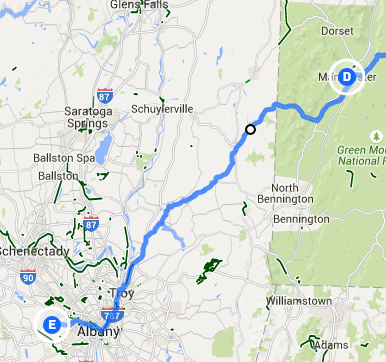
Screen Shot 2015-05-17 at 8.11.38 PMMiles Today: 72

Miles to Date: 694

May 17, 2015 – Cloudy, 60 degrees


IMG_1856Nature is breaking me into her fury in a most gentle way. After encountering no rain for ten days, this morning’s forecast called for a few hours of showers. Reality turned out to be a gentle mist and steamy fog rising off of Mount Equinox as I pedaled south from Manchester.

Rolling through Arlington brought forth memories of many good times there with my housemate Paul, who had a house there for years. I rode past his old house, the park where we walked his dog, Silas, and the covered bridge over the Battenkill where we taught Silas how to swim. Since he got used to the water, that dog dives into any pool or puddle he can find.

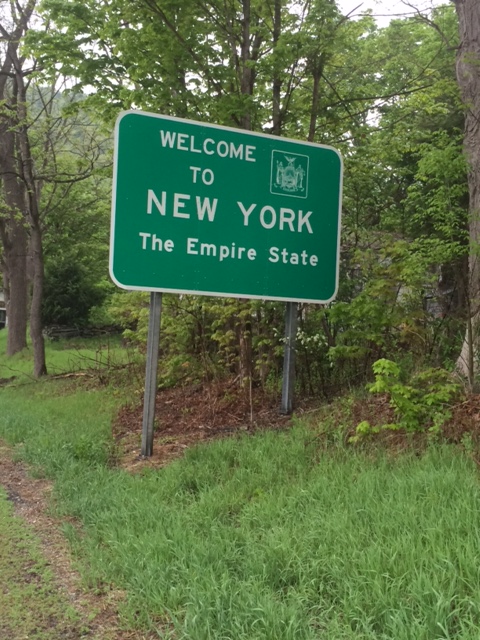
IMG_1860The metaphor of the Empire State in decline was too obvious to ignore as I passed the state line and the solid road, pristine gentlemen farms, and well proportioned white houses of Vermont yielded to cracked blacktop and farms past luster. Still, New York’s countryside is beautiful and the expanses of planted fields already further along than those I saw north and east only a few days ago.

I plan to be in New York State about a week, cutting a swath through the center of the state. I traversed the Erie Canal, Mohawk Valley, and Western New York on my last bike trip, and will spend time in the Big Apple on my return. There is a lot to see in New York.

IMG_1863I stopped for breakfast at the Country Gal’s Cafe in Cambridge. There’s nothing like it in Cambridge, MA for sure. That gave me plenty of energy to push through to Saint Joseph’s Provincial House in Latham for lunch, where I met with my aunt, a 93-year-old nun, and her fellow sisters to talk about tomorrow.


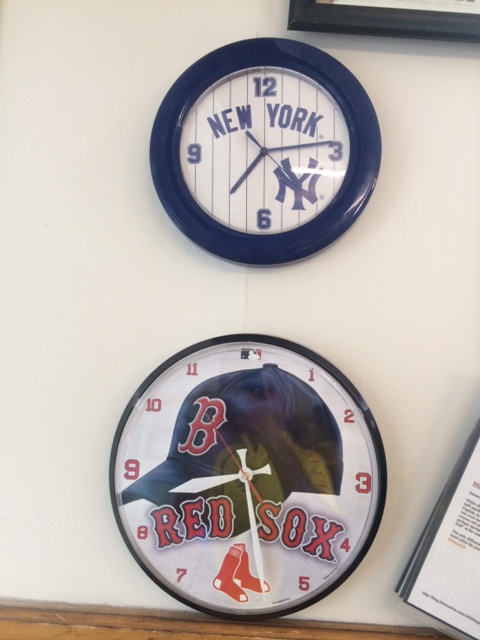
IMG_1864I also realized that I was passing out of Red Sox Nation and entering Yankee territory, though the Country Gal’s Cafe hedged their bets.

IMG_1861Am I the only one who thinks this is funny?


I took an easy ride to the other side of Albany to stay with my friend Dave Gibson, his wife Chris, and the three children they still have at home. They have ten children in total and several grandchildren to boot. We made flatbread pizzas on the grille and ate on the deck overlooking their wooded yard. As old friends do, we talked until nearly midnight – very late for this cyclist, but a great time to catch up.


Posted in Bicycle Trip Log | Tagged , , , , , , , , | Leave a comment

Trip Log – Day 10 – Norwich, VT to Manchester, VT

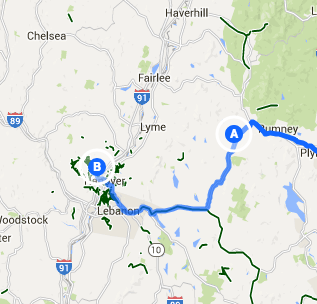
Screen Shot 2015-05-15 at 6.31.15 PMMiles Today: 82

Miles to Date: 622

May 15, 2015 – Sunny, 60 degrees


I had a big task today: 82 miles plus over 4,000 feet in elevation change. So, I abandoned my custom of a long afternoon break and took short but frequent stops instead. I got a bag of GORP, which I ate every ten miles or so. That, along with a breakfast bagel sandwich, sausage and pepper sub, 2 diet cokes, a quart of Powerade and a big cookie, were all consumed by the time I got to my destination shortly after 4 p.m. This proved a better strategy for long distance days than arriving after five or six.

IMG_1841-1The first third of my route was a beautiful ride along US Route 5 through the Connecticut River Valley. I passed large farms, rocky waterfalls, and travelled through many lovely towns. Windsor is particularly charming, and was the place where Vermont’s Constitution was signed. I never knew that Vermont was an independent country from 1777 until it joined the union as the fourteenth state in 1791.

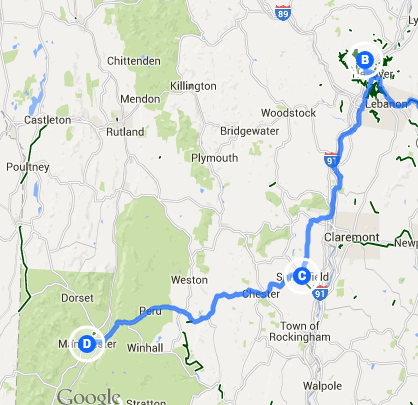
IMG_1850Then came a series of rises through Springfield, Chester and Londonderry. The greens were amazing, the yard sculptures odd, and the forest so dense the wind was never a factor.

The last section took me over Bromley Mountain and back down into Manchester. The climb was fine though long. The decent – over three miles of 8% grade – was all the thrill ride I ever need.

My housemate Paul is from this part of Vermont, so I know it well. I stopped at his usual grocery, got take-out for dinner, and was happy to be in my motel room on the far side of town for a relaxing evening.


IMG_1843IMG_1853

Posted in Bicycle Trip Log | Tagged , , | Leave a comment

Trip Log – Day 9 – Dorchester, NH to Norwich, VT

Screen Shot 2015-05-14 at 6.14.41 PMMiles Today: 37

Miles to Date: 540

May 14, 2015 – Sunny, 70 degrees (eventually)


IMG_1828Like most optimists, I look at the high temperature forecast for the day and figure, oh, that’s good. I need to start looking at the morning temperature as well. It was beautiful today – sunny skies and crisp, but it was only 29 degrees when I went speeding away from D Acres at 6:30 a.m. By the time that I realized my hands were freezing, despite Goretex gloves, I was almost halfway to breakfast and decided against stopping to fish out the hand warmers in the deepest pouch of my ‘wet’ pannier. By the time I pulled up at the diner in Canaan, my fingers were numb. Lesson learned – check the morning temp and keep my hand warmers near the top of my stuff.

IMG_1834The next twenty miles through Enfield and Lebanon were much more pleasant. I arrived at Dartmouth-Hitchcock Medical Center by 10:30 a.m. to meet with folks from facilities and their arts program. After a great lunch that included fresh local fiddleheads and wheat berries on my salad, I spent most of the afternoon catching up on writing at a window with a great view of the inpatient pavilion I designed over twenty-five years ago. The pod form is dated, but the building still looks great.


IMG_1835Late afternoon I pedaled through Hanover, where the undergraduates were enjoying the day on the lawns, and crossed the bridge into Vermont.


IMG_1838I stopped at the Appalachian Trail maker to acknowledge that five years ago my son Andy walked across this bridge in the opposite direction on his way from Georgia to Maine. Now I am traveling west on two wheels. That trip shaped much of Andy’s life, and inspired me to be ore adventurous myself. I owe many thanks to Andy.

I spent the night at the home of Marianne and Dave Barthel, and their daughters Fiona and Ophelia. We enjoyed wonderful turkey burritos from Paul Prudhomme’s Fork in the Road Cookbook – low fat versions of his dishes that taste anything but.


Posted in Bicycle Trip Log | Tagged , , , , , , , , , | Leave a comment

Profile Response – Sarah Cushman, Rob Levin, and Cedar

HWWLT Logo on yellowSarah Cushman, Rob Levin and their 8-year-old daughter Cedar live on Munjoy Hill in Portland ME. Sarah is an alternative transportation consultant for non-profit organizations, Rob is a land conservation attorney and Cedar is a budding artist, with a gallery of work for sale throughout their home. I met Sarah and Rob through www.warmshowers.org, a website that links ling distance cyclists with overnight hosts. A few years ago they took a four-month bicycle loop through Canada. I am sworn to secrecy about when and where their next cycling trip will be, but I can attest that it will be huge. Sarah and Rob were my first warmshowers hosts, and they set a high bar with their gracious hospitality.

How will we live tomorrow?

Cedar’s response is quick: “Tomorrow is going to be an awful Friday because we have gym. After that, I will live in this same house as long as my guinea pigs are alive.”

imgres-1 As a Quaker, Sarah felt adrift after the 2001 terror attacks. “The response to 2001 was so extreme.” When Sarah and Bob married, in 2002, they chose to mark this new phase of life in several ways. They moved from their previous home, Baltimore, to Maine, and Rob opened his own practice. To commemorate these changes, they walked from Baltimore to Maine, a two-month journey that included parts of the Appalachian Trail and stretches of local roads. “Walking helped me love my country, the individuals are so wonderful.”

They settled into a five-room condominium in old house on Portland’s east side. The small, affordable home helps shape a basic lifestyle. “We have voluntary simplicity living in this condo. There is a good group of Quakers in Portland. We have 100 chairs in our meeting, and most Sundays 75 are filled. That is nothing compared to other faiths, but we have a strong community.”

imgresRob recently went on the Pipeline Pilgrimage in MA from the Berkshires to Dracut to protest the proposed Kinder-Morgan methane pipeline. He described it as a retreat in motion. “My struggle is that I am generally optimistic. As Martin Luther King Jr. said, ‘The arc of the moral universe is long, but it bends towards justice.’

“Then there is the other side. I am very concerned about climate change, and it’s hard to be an optimist about climate change. I listen, I read, and sometimes I’m scared. How do we not be overwhelmed to paralysis? I’ve been reading The Climate Casino by William Norhaus. That leaves me less scared about the next fifty years, but more worried longer term. I relate climate change to human generations. I can’t look Cedar in the eyes in 40 years and tell her it was too hard for me to do anything. It’s easier to put this in the context of my own family.

imgres-33 imgres-4

“I’m a political person. I’ve gone door-to-door for Presidential campaigns and gay marriage. I want to work in the system. But I can’t see how the system will address climate change.

imgres-2“I am trying to rein in the two largest carbon footprints in my life. First, I have stopped eating beef. Second, I am trying to stop flying. I don’t want to judge others, I just want to do what I think is right. I am giving a presentation at a Land Conservation conference in Sacramento in a few months. I don’t want to fly there, and it would take a lot of time got there by bus. So, I asked the organizers, whom I know, if I could give my presentation via videoconference and they agreed. If we want to live on a planet that does not want to burn out, we have to stop crisscrossing the planet.

“Personal behavior has to change if we are going to change our climate. I believe in Emmanuel Kant’s categorical imperative. Act as you want the rest of the world to act.”


Posted in Responses | Tagged , , , , , , , | Leave a comment