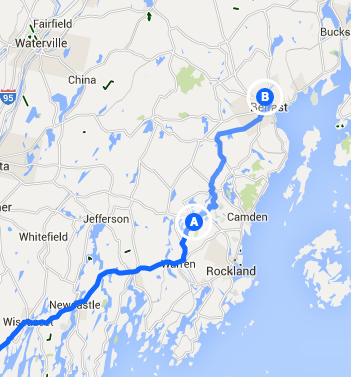
Trip Log – Day 8 – Conway, NH to Dorchester, NH

Screen Shot 2015-05-14 at 2.35.18 PMMiles Today: 69

Miles to Date: 503

May 13, 2015 – Partly cloudy, 65 degrees


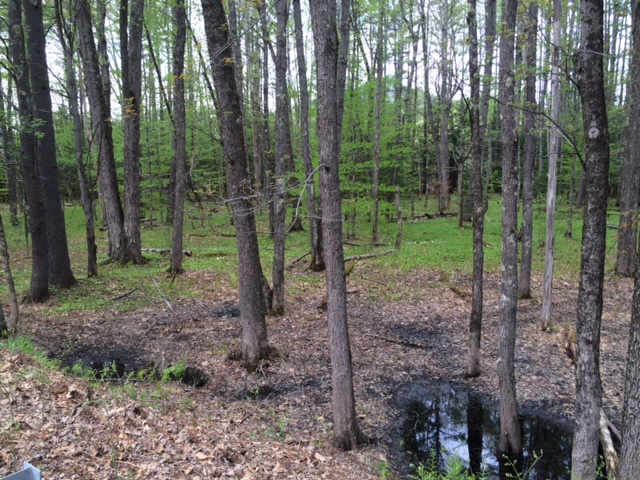
IMG_1813Nature’s first green is gold

Her hardest hue to hold.

Alas, Robert Frost’s words proved true overnight. The budding trees that stood along the side of the road in Maine are flush with leaves; still small, yet soft green and distinctly shaped. Spring is on the move, the earth pulses with energy.

I started the day as a fly on the wall in a local convenience store, devouring an egg and bacon sandwich and coffee cake muffin while locals filtered in, bought their coffee and cigarettes and shot the breeze with the two proprietors, who knew everyone by name and their order preferences without asking. One guy bought three packs and said he was heading for New York. “Be careful not to sell any singles there. They shoot people there for that.” Like all good jokes, the reference to Eric Garner got s laugh, even as it stung. A few miles down the road I passed a Dunkin’ Donuts with a line of cars in the drive-through. The price of getting our coffee without getting out of our vehicle is human distance.

IMG_1807A morning mist turned into passing clouds and then sun, Brilliant rays streamed through the forest as I headed west on a series of lightly travelled roads. Outside Ossipee I stopped by a covered bridge under construction and got a lesson in timber frame restoration. Sandwich is a picturesque village where every building is classic white. The lakes were pristine; a few fishermen braved the cold water.

IMG_1820


After lunch at a sandwich shop along Squam Lake, I headed north, through the cool college town of Plymouth. I had reservations to stay at D Acres, an organic demonstration farm and hostel in Dorchester, the next town over. Turning west on the Tenney Mountain Highway the entire scale of my day went skew. Suddenly, I was on a busy road with wide shoulders and the usual assortment of big box stores. Since there were no major towns behind me, and none ahead, I was baffled where all these people and cars came from. But we are bees to honey when it comes to shopping, and for a few miles I was on a shopping strip as busy as any despite being in rural New Hampshire.

IMG_1824Eventually the stores ended, but the road kept on, and on, and on. My GPS directions were off and the headwind was not my friend. After much longer than I anticipated, I took Route 118 south and climbed to D Acres, a fascinating hybrid of counter-culture agriculture and funky retreat. The main house is full of gorgeously detailed rooms and fine crafted furnishings. The double-headed shower room with integral seat and glass blocks is opulent as any spa. Balance that with the composting toilets and hand painted agricultural and political slogans on the walls. Joshua Trought, the titular owner and main farmer, wrote a book about the place, The Community-Scale Permaculture Farm.

D Acres can accommodate up to 10IMG_18270 guests, but was pretty empty this early in spring. A dozen or so staff and visitors shared dinner, an incredible buffet of beef ragout, diced potatoes, parsnips, greens with tahini, and rice with mushrooms and nettles. All I could eat for $12.

Its turkey-hunting season in New Hampshire, and wild turkeys are as rampant around D Acres as they have become in Cambridge. Josh and his crew shot four in and around the property today. After dinner they defeathered, scalded, and gutted the birds prior to freezing. Anything that a half dozen people do together can turn into fun, and I got a very hands-on look at life on a community farm, though I did not stick my mitts in the mix.


Posted in Bicycle Trip Log | Tagged , , , , , , , | 2 Comments

Featured Response – Jay Philomena

HWWLT Logo on yellowJay Philomena is a retired designer from Boston, MA. In his sixties, Jay realized that he always wanted to be a singer. He took voice lessons, joined the Boston Gay Men’s Chorus, and now performs throughout New England. This summer he will join the chorus on their international tour to the Middle East – the first gay chorus to tour that region of the world.


How will we live tomorrow?

imgres-1This question prompts me to consider how we as a society think about age.

Many celebrities have dedicated significant time, their celebrity, and parts of their fortune to helping the disadvantaged here and aboard. Few, however, have endeavored to change the way we think about ourselves and reevaluate values of a society that has evolved from being ethic’s based to personality based, from a respect for age and its knowledge, to a worship of youth and its promise.

Recently, I saw Lady Gaga & Tony Bennett perform in concert. I went with my sister, who had just lost her husband. We joked about the diversity of the audience.  Yet, watching those two talented individuals perform together gave me hope how generations can view and respond to each other.

Lady Gaga and Tony Bennett are doing something that can change the way we think about youth and age. She is a “pop” icon in her late 20’s; he is 89-year-old icon from another generation – actually four removed.

Two or three years ago, most 25 year olds did not know who Tony Bennett is; now they do!   Most people over 60 did not know who Lady Gaga is, or if they did, didn’t care. Today, Tony and Lady are a performing phenomena!   Young and old alike know them both, and watching them together overcomes the stigma of age.

imagesLady Gaga’s action by performing with Tony Bennett, and he with her, may help change how we think about aging, and in so doing, how we live tomorrow.  Perhaps our age-based and youth-worshipping society will think differently about the value of age / maturity and proficiency.

Watching the two of them, the way they respect each other, the playfulness, and obvious love they share for each other, the music and the act of performing together, is amazing. Lady Gaga has broken a new frontier as a “pop” star by partnering with a man old enough to be her great-grandfather.

So much so, that I may consider dating an 89 year old, or at least playing around with one. 🙂

Posted in Responses | Tagged , , , | Leave a comment

Featured Response – Cleo Gorman

HWWLT Logo on yellowI had the good fortune to work with Cleo Gorman for several years through the Birmingham, AL office of TRO JB. She is a joy in every respect, and that spirit shines through in this thoughtful response to the question:

How Will We Live Tomorrow?


imgresIn my humble opinion, our tomorrow will be determined, in large part, by how well we teach our children to embrace other races, cultures, and even each other in our own backyards.


Cocina IVIn our recent experience, my daughter, Ellie, had worked hard to make the volleyball team for the next school year. For months, Ellie labored, perfecting her overhand serve and spike. She played in a couple of recreation leagues, took clinics, and had a couple of private lessons. She has diverse interests, but volleyball has been her favorite and most competitive sport.

On the first day of a three-day “look” by the coaches, she was ready. We were early and she felt good about her chances. After the workout, she came bounding out to the car, nervous, but excited. We were to check the school’s website for the list at 6 p.m. If a girl’s name was not there, she didn’t make the first cut and was not invited back for Day 2.

2013 volleyb w EKYou guessed it: Ellie didn’t make the team. This was the first real disappointment my sweet, hard-working, optimistic daughter had ever experienced. And, with my second and third pouring over the list, on which her name was not listed, my own heart sank. That night, we cried a little and talked more. Ellie confided that she would hate her friends’ questions at school the next day and having to reveal her failure to make the team. She would hate not playing on the team next year but even more, would be embarrassed and would have a hard time concentrating on her school work for the long school day. All seemed bleak.

But my story is not as much about this experience and what Ellie has done with it, as much as the story beyond the story. What happened next was refreshing and inspiring. After that dreaded day at school, we went on our evening walk with the dog. She reported that several friends had sympathized with her and she did feel a little better. She was still stung by the coaches’ rejection, having known that she had done her best, but knew she’d need to get over it.

We stopped to open the mailbox, and what we found there was not just the mail, and not just one treat from a friend for Ellie, but three! Friends from different walks of their activities together had thought to console her in a tangible way through her 12-year-old heartbrokenness and disappointment. These were friends who had, days earlier, just made cheerleading or the dance squad for the 7th grade year, girls who could otherwise have been celebrating their own successes rather than attending to one of their own who’d not tasted their same success.

FOT40CF
This experience revealed more to me about the future than all the stock market reports and political stories regarding our future! Real caring is being taught and is being demonstrated by the next generation. That’s something about which to feel really good and something about which to look forward to for tomorrow!

It doesn’t make up for the school team camaraderie and gamesmanship Ellie will miss next season, but it does something else: it shows her that she’s part of a caring community and she is valued there.

Ellie and I will pay it forward at every chance, from now on!


Posted in Responses | Tagged , , , | Leave a comment

Trip Log – Day 7 – Auburn, ME to Conway, NH

Screen Shot 2015-05-12 at 5.19.57 PMMiles Today: 59

Miles to Date: 434

May 12, 2015 – Partly cloudy, 65 degrees


I woke up hungry on the edge of town, unsure where I might find any food heading west. Fortunately I came upon a fresh farm stand where I got a couple of bananas, tangerines, a hunk of cheese and a container of GORP. That put me in good shape to tackle 30 miles of rolling countryside through Maine’s Lake Country.

IMG_1774My fascination with ‘stuff’ in Maine struck a new high today. All along the road from Auburn through Minot people had set giant piles of brush, lumber, old furniture, car parts and mildewed clothing by the curb. At one point I came upon a convoy of four orange dump trucks and a shovel truck. A team of sanitation workers in jump suits put whatever people had piled into the trucks. I am sure that this was not a typical trash day, but it was amazing to see how much stuff was headed to its final resting place buried in a landfill.

IMG_1775The narrow roads of back woods Maine are more like Appalachia than any other area of the East Coast I’ve ever seen. Houses with plastic covered windows and rusted trailer homes are littered with all kinds of yard stuff. Dogs bark loud, but fortunately, they’re tied tight. Towns and lakes with a tourist bent are pristine, but the back roads are cluttered with stuff past use, churches with an evangelical bent, country music references, and American flag motifs.


IMG_1792I stopped at Ricky’s Diner in Bridgton for lunch; patty melt with fries and a brownie sundae dessert. The waitress worked the room like a professional entertainer, brought extra napkins and exclaimed, “If it’s not messy, it’s not good.” Most of the patrons were older than me, and a good deal heftier. But it didn’t take long for folks to talk across tables, and soon I was passing out my card and asking people about tomorrow. Exactly how I imagined engaging people from a different perspective when I planned this trip. One guy with a deep, percussive voice turned out to be a bluegrass guitarist and singer. Jack D. Jolie has a great YouTube rendition of Bill Monroe’s Old, Old House.

IMG_1800The road to Fryeburg is perfect – a wide shoulder and fresh blacktop through a forest of gorgeous golden buds on black-trunked trees. The rise into Conway, NH is gradual. As I left Maine behind I realized what good luck I’ve had in traveling safe, meeting great people, and enjoying good cycling weather. It will be tough for other states to be as accommodating as Maine.

imagesWhen I pedaled up to the White Mountain Hostel I realized I’d been here before – 40 years ago on a college ski trip. Then, the place buzzed with winter activity. Now, I am between seasons and it’s very quiet. Still, it’s clean and friendlier than a motel. They gave me a prime room. The view out my window shows the sharp silhouette of the mountains. Tomorrow I am going to live in low gear.

Posted in Bicycle Trip Log | Tagged , , | 1 Comment

Trip Log – Day 6 – Waterville, ME to Auburn, ME

Screen Shot 2015-05-11 at 5.23.23 PMMiles Today: 60

Miles to Date: 375

May 10, 2015 – Overcast, 55 degrees


If the early bird gets the worm, I have a belly full of ‘em. My alarm went off – too loud – at 4:30 a.m. I was on the Surly in the early dawn, rolling through Waterville to get to MaineGeneral Medical Center for a 7:00 a.m. tour by CEO Chuck Hays. Most of the route was along a ridge road named Middle Street, which gave the gray morning a Zen quality.

The bulk of my career was in healthcare design, and I was fortunate to be involved in three greenfield hospital projects. Completely new hospitals are uncommon, and for an architect to have a hand in three is rare. During my journey I plan to visit them all: MaineGeneral (Augusta, ME, 2013), Dartmouth-Hitchcock Medical Center (Lebanon, NH 1991) and Bronson Healthcare (Kalamazoo, MI 1999). Each were state-of-the-art when designed and built, so visiting three facilities spaced about a decade apart should give some sense of how healthcare design has evolved.

imgresimagesimages-1

Chuck showed me the high points of the completed facility, but what struck me most about his tour was that Chuck greeted every employee we met by name. He spent extra attention describing the staff communication systems and the focus on quality food. When we finished, I rushed back to the cafeteria and devoured two bowls of steel cut oats with fresh fruit and brown sugar. After being up more than three hours and riding over twenty miles, I was hungry.

IMG_1763The ride to Lewiston was uneventful. The weather was nippy, Dense trees in every shade of green stood tight to the road, from golden buds to deep evergreens, but the diffuse light softened their variety.


IMG_1771Lewiston is a former mill town. Although Bates College has a beautiful campus and the Basilica of Saints Peter and Paul is remarkable downtown is struggling. I met with Muhidin Libah, Executive Director of SBCMALA (Somali Bantu Community of Lewiston, ME) in the two-room suite on an upper floor of a grimy, aging edifice.

It was after three when I rode to a motel in the direction of tomorrow’s ride. This was my first night in a motel, and my first night staying with proprietor Patel! On my last long trip, I discovered that Indian’s rule the locally owned motel world, and many of them are named Patel. At least in Maine, that has not changed. I was too beat to venture out for dinner, but my steel cut oats were still stuck to my belly.

Posted in Bicycle Trip Log | Tagged , , , , | Leave a comment

Profile Response – Taylor Whitworth and Tylor Hess

HWWLT Logo on yellowTaylor Whitworth is a Research Associate at Evidera, a consulting firm that provides health economics, outcomes research, market access, data analytics and epidemiology services to large pharmaceutical companies. Taylor studied International Relations at James Madison University and has a Masters in Healthcare Administration from Georgetown. Tylor Hess is a PhD. candidate in Mechanical Engineering at MIT. Tylor and I met in yoga teacher training during spring 2014, while he was taking a year away from his studies. He is one of the most integrated thinkers I’ve met, of any age. We share analytical bents, yoga, and meditation practices. We also shared brunch at Cambridge Brewing Company in Cambridge, MA on Taylor’s 27th birthday.

How will we live tomorrow?

Tylor and TaylorTH – I don’t have much to say about this, though I’ve given it some thought. My ideas run in different directions, but I have no one great guess. The future is hard to predict. Consider the quote attributed to Henry Ford, “If I had asked my customers what they wanted, they would have said faster horses.” We don’t have a paradigm of how to analyze forward.

The places I go mentally are not positive. There’s this surge of dystopian books and movies among my generation. I attribute it back to that image of the earth that was taken from space in 1969; this blue green ball in a sea of black. It defined us as finite. Before then, every image was from the top of a mountain or even an airplane. Regardless, the earth stretched as far as we could see. That image from space showed our limits. It triggered the environmental movement.

imagesOur relationship to the planet is all wrong. We treat resources as commodities. We talk about ‘producing’ oil, not depleting oil.

In my lifetime we will encounter shortages so severe they may trigger wars. Over issues like clean water. Probably not in California, although whose idea was it to build a city in the desert. More likely we’ll see violence in Bangladesh or another developing location.

imgresThe scientific consensus is that MIT’s campus will be underwater within 100 years. Who could have predicted that when the campus was built 100 years ago? We only find out this things after the fact, when it is often difficult, expensive, or impossible to address. Like these dead zones we’ve discovered in the oceans, masses of water so devoid of oxygen they cannot support life. Will these expand or come to the surface? What will this mean for our water systems?

Or take animal extinction. Species are becoming extinct at a rate 1,000 times faster than historical models.

Just so you know, I am going pessimistic here, then I’ll go optimistic. Bum you out then build you up.

The past is not an indicator of the future, especially if you base your predictions on scientific fact. The industrial revolution led to the technological revolution. This has resulted in an underdevelopment of how we get along. This disconnect between our technical ability and social organization plays out daily on both a massive and small scale.

Start-up companies create an innovative culture at a small scale, but there are no precedents at larger scale – the scale of government or countries. We have no precedent for the cooperation we will need to address global warming. There has never been a problem that affected every corner of the world and required such coordinated action.

images-1Why did we evolve from bonobo’s? They are aggressive, mean, and kill other monkeys. Why didn’t we evolve from orangutans? They are more peaceful and cooperative. Our worst traits are related to bonobos, our best traits to orangutans. Yet we are more closely evolved from bonobos.

TW – Human behavior is fungible. We can twist and bend but only to a point.

TH – Have you seen Gattaca? It’s a 1990’s sci-fi thriller that deals with DNA modification. Now, DNA modification is possible but the ethical issues have not caught up with the science. Do we want to control the intervention of gene lines? We think we can make improvements, but what if don’t improve? What if we create ill side effects? What if getting a disease switches from something that comes from God to something derived from human error?

imgres-1The United States is not going to lead in this, given our Christian foundation, but others will take this on. We will miss out leading the exploration of humans with greater speed and strength, or the creation of a servant, zombie class.

TW – The focus should be on improving the quality of our lives, not design optimization. When something is random, it’s no one’s choice. Once we are ‘designed’ we lose our ability to make choice. Our lives are predetermined by our formulation.

Our plates have been empty for some time. The waiter comes by with the check. Tylor motions for him to lay it on the table, and says, “We are going to be here awhile.” Taylor and I exchange looks and laugh. “Remember, he began with, ‘I don’t have much to say about this.’”

TH – That was a tangent, genetics. Let’s go back to tomorrow. Speed is an important consideration. Mohr’s law posits that the speed of computing doubles every two years. Related laws in other disciplines also indicate a huge acceleration in the rate of change of many systems on earth. But from a systems dynamic perspective, every system follows an S-curve. Whatever the system is, it grows increasingly fast until it runs up against an inhibitor. Then it flattens. Mohr’s law will not hold forever. Computing speed will hit an inhibitor, at the atomic level, and it will not continue to increase as rapidly as it does today. That will happen with other systems as well – population, production, climate. Right now we are at a point where many systems are accelerating, and we don’t even know what the inhibitors are.

The undertone of rational thought about tomorrow is pessimistic. The undertone of mindfulness about tomorrow is optimistic.

images-2We might be on the cusp of enlightenment, to move from a focus on extending life to a focus on improving life. Look at therapy. Since the 1980’s every form of therapy has included more focus on mindfulness. Religion is at an odd place. The growth is strongest at each extreme – fundamentalism and atheism. What if a religion based on a less defined sense of God actually took off? The legacy of existing culture argues against this happening, but humans have precedent for religions based within us, it’s possible.

In software development we hack / edit/ augment a program up to a point to tweak it to address new problems. But at some point the code does not address our needs and we refactor. That’s what humans need to do – refactor. We need a non-violent revolution. We may be able to use the tools within our existing government to radically change it. But if not, we need to refactor.

Thomas Jefferson anticipated that the United States might have a revolution every 20 years. We are long overdue.

It’s possible to refactor incrementally. We could change the government bit by bit – first make the post office relevant, than another sector, then a third. The challenge is that when you refactor incrementally, each revised system still has to interface with existing, antiquated systems. Still, it can be done.

The cool thing about our generation is that we’re fickle. And we’ve bought into American values, i.e. money. Not exactly a recipe for revolution. But, if you want to make heaven of hell and hell of heaven, you just have to reassess values. Fickleness can actually help us here. Want to learn patience? Reassess your values. Reframe sitting in traffic as mediation and it won’t bother you anymore.

images-3TW – Context is everything. The world of yoga has one set of values; corporate America has another. A wonderful person can become an executioner in the right context.

TH – Look at Nazi Germany.

Humans can hold within us completely contrasting ideas. These mental dissonances can lead to psychological stress and disruptive actions. We have the ability to be divisive, even within ourselves. Yet we also have the capacity, and can work toward, coherence.

Look at politics. If the Republicans want less government, why do they put such emphasis on creating social restrictions? The Democrats are equally inconsistent.

TW – The Republican dissonance is more extreme right now. They may wind up splitting in two. The extremes are tearing against the center. Look at Mitt Romney. He’s not such a bad guy, but he got pulled all over the place.

TH – We are bonobos and we are orangutans, and the question is, can we program the orangutan out of ourselves?

TW – Can we create an environment that fosters our orangutan side?

TH – Look at alligators, so angry all the time. They have this huge Abdulla mandala. It’s a biological explanation. Did you hear about the nice guy who turned sexual predator? This is not a joke. They discovered he had a tumor that caused his behavior. They took out the tumor, and he stopped. Then he started again and you know what, the tumor had reappeared.

images-4TW – There are no good or bad people. We are functions of our environment.

TH – We have to understand that better. We have to stop thinking that that we are 100% in control. 95% of what we do is on autopilot; maybe 5% is actual creative activity. If we can reorient our 95% autopilot actions in a more positive direction, we can change. For me, meditation is reprogramming my autopilot self to react with positive responses.

After two hours of discussion that touched on evolution, revolution, psychology, technology, extinction and extraction, we ended within our own core. This brought us full circle to Tylor’s first comment of the afternoon, when he talked about graduate student life.

TH – I am loving life so much more since I stepped away from so many activities. I was involved in all of these activities that were existentially what I wanted, but classes, research, and meditation all suffered. Since I started focusing on those basics, my day to day is better. It’s like the oxygen mask that drops down in the plane in an emergency; you have to put your mask on first before assisting others. I wasn’t living as I wanted at MIT. I was doing stuff I wanted to do, but not being the person I want to be.

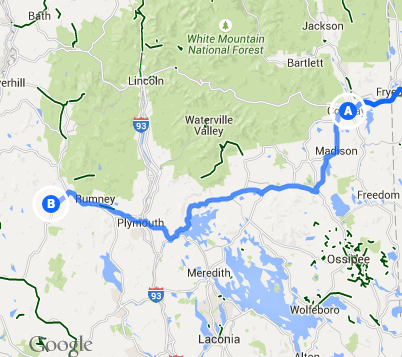


Posted in Responses | Tagged , , , , , , , , , , | Leave a comment

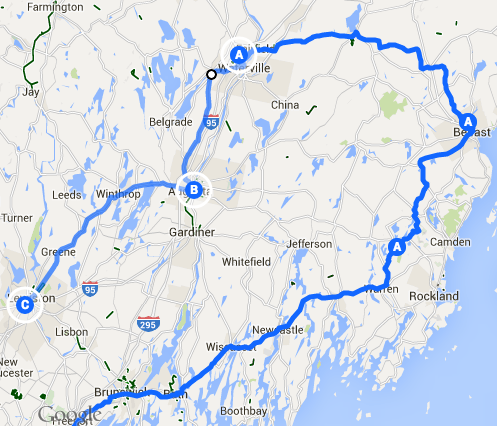
Trip Log – Day 5 – Belfast, ME to Waterville, ME

Screen Shot 2015-05-11 at 5.09.12 PMMiles Today: 43

Miles to Date: 315

May 10, 2015 – Sunny, 65 degrees


IMG_1740Today I turned the first big corner of my trip. Coastal Maine dawned foggy, but by the time Jim Merkel, Susan, and I enjoyed a vegetable omelet, hash browns, oranges, and toast with strawberry jam, the sun was peeking out. Jim rode the first ten miles with me, climbing away from the sea on Route 137 West. After he turned back at the hilltop overlooking Knox Center, the countryside widened out, the swales became more generous. The farms expanded as well – big Holstein operations eclipsed smaller, more locally focused farms. The landscape felt Midwestern, as did the optimistic village names – Freedom, Hope, Union, and Unity.

Maine has a wonderful web of small highways and drivers are very respectful of cyclists. Route 220 from Knox Corner to Unity is a glorious stretch on a perfect road. I stopped at the Unity General Depot for lunch; a hybrid general store, restaurant, and gas station with Subway and Dunkin’ Donut franchises. So far removed from the organic sustainability I just left. What General Depot lacked in charm and nutritional value it made up for in activity – the place was packed on Mother’s Day noon. This was my first of what will likely be many Subway meals. Subway is the most ubiquitous franchise in the United States, and in many small towns like Unity, it is the only lunch option. As fast food goes, it is better than most; you can pile your sandwich with veggies.

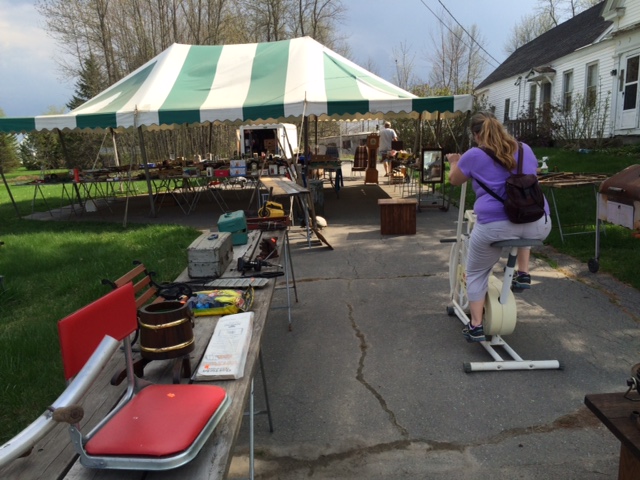
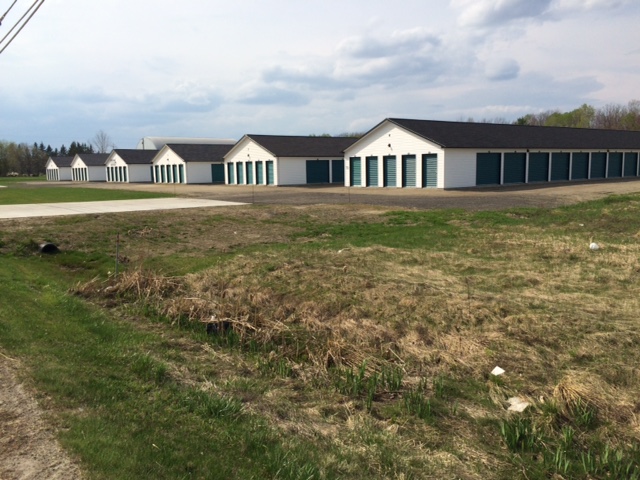
The ride from Unity to Waterville was easy. The day grew hot and blackflies swarmed me along marshy stretches. Why do they always fly in your mouth? Coming into Benton I noticed yard sales, many of them on this lovely Sunday afternoon. Then I noticed storage facilities. Larger yard sales, and even more storage facilities. On our morning ride, Jim revealed how difficult it was to keep stuff in check. Since writing Radical Simplicity he had moved in with Susan, combined two households, fathered a child, bought forty acres, built a house, a greenhouse, purchased a car, and a boat. “I don’t know where to put it all, and I wrote a book about it.” Cycling past yards full of junk, stuff for sale, cars, trucks, and rows of storage buildings, the number of objects along this small sliver of Maine boggled my mind.

IMG_1752IMG_1753

I stopped at one of the better organized sales. Chuck Norris, or so he called himself, and his wife have run a yard sale every Friday, Saturday and Sunday for over twenty years. They have a big tent with tables full of paraphernalia, and larger items spread on the driveway on this nice day. It’s their hobby and business. They pick up stuff from auctions and wholesales, and then sit in their driveway during the long summer days passing it on to others. I was drawn to an antique metal Shop Rite truck, but of course I didn’t buy anything. I am traveling light.

I rolled into Waterville to visit my friend Gail just after four, and just before afternoon thunderstorms descended. She and her housemate Ruth gave me a wonderful dinner and we speculated on how we will live tomorrow.

Posted in Bicycle Trip Log | Tagged , , , , , , | Leave a comment

How will we live tomorrow? – Responses 3

How will we live tomorrow?

“The same as we do today. 

Chuck Norris, Weekend Flea Marketer for over 20 years, Benton, ME

_____________

How will we live tomorrow? 

A biology teacher’s words in college drove home to me, a very elementary point: “To survive, one must exist.” So the way we will live tomorrow may well depend on how successful we are at existing today. It’s just too easy to concentrate on all the wrongs and injustices in our existence and wonder how we and our children can ever hope to get by tomorrow. This quandary is not new — our fathers and our grandparents before them, likely asked the same question. So I think the answer must lie in our resolve to persevere and do what is right, no matter how challenging the obstacles must be. And often times that’s a lonely place to be. In the end, generations from now, I can only speculate what the answer might be, if in fact it is able to be captured by words. Maybe it’ll be some combination of love, learning from the past, empathy, forgiveness, humility, and constructive intelligence.

Harry Mears, Oceanographer, Seabrook, NH

____________

How will we live tomorrow?

“Let me ask my three kids. They’ll have ideas.”

Maryse Newton, Painter, York, ME

_____________

How will we live tomorrow?

My vision of the future (at least my future) is probably some version of the Golden Girls that involves guys (at least my guy), a strong sense of community, involvement in activities and causes that I love (ESL tutoring, The Women’s Lunch Place), a dog, lots of walking & periods of living abroad for a few months at a time.  I believe our generation will live more communally and pool resources to address issues of aging and to maintain independence, choice and adventure in our lives. 

Ellen Slater, Wellesley College Class of 1978, Needham, MA

_____________

How will we live tomorrow?

“Well I have lots of plans tomorrow, because it’s Mother’s Day. I’m going out to breakfast with my three year old, and then to my mom’s and then to my husband’s mom.”

Mary Shaw, Shopkeeper, Hope, ME

_____________

How will we live tomorrow?

The ability to connect through the Internet will turn connections into concrete action. We will be able to tell stories of hope that can be harnessed to level the playing field slightly. Our hemp spinners do not even have cell phones or electricity, let alone Internet or the language skills required to use it, but their children will. What the spinners do have is incredible survival skills, for which we owe them deep respect. 

Docey Lewis, 3 Form, Materials with a mission in Nepal, New Harmony, IN

____________

How will we live tomorrow?

“I like what I’m doing here, but if I have to, I can escape to Northern Maine. It’s sustainable up there; with a few solar panels, you have everything you need.

“I should be out of debt within a year. Getting a divorce, moving twice, starting the business, making some big mistakes right off the bat – they all took their toll. I’m thinking of getting a mobile unit with Wi-Fi. I could work from the road, travel to meet new clients, and expense it all.

“Tomorrow I want to travel more. Get a condo in Florida for the winter, play golf.”

Chris Marston, Graphic Designer & small business owner, Portland, ME

_____________

How will we live tomorrow?

I have been struggling with this question since you posed it more than six weeks ago.    I don’t have positive outlooks for our future.   I see more fighting over territory, beliefs and biases.  Our country is like a very large family.  Not everyone comes out quite right, not everyone heeds to the guidelines and rules; lots of competitive fighting for control and voice.  There will always be the bully, the quiet one, the one with the brains, and the one that just wants us all to get along. Who got more, who has less, who is bigger…….  Why can’t I ……..?

So, outside of the family, how will we live?   Probably more alone than ever before.  Our tech devises will substitute for humans.   We will continue to find comfort in consumption.  Except real food will be unaffordable, or unattainable for some.   Our health and health care will continue to change, grow and develop. New diseases, new fights for cures  – in all aspects, mental and physical.    And the source of life – water – will be sparse.

Agriculture will be science projects.  Fruits and vegetables will change.  Animal farms won’t be recognizable.

There is another side….  We will be a cautious society.  We will work with the frailty of our earth and water.   We will begin to educate in other ways and forms that is not a blueprint for all learners.

As our planet ages, and family of inhabitants – we shall become much wiser and have the tools to not repeat mistakes.  Let’s hope. 

I hope to live tomorrow believing in what we can achieve, if we work for it.  And ridding of extraneous biases.   Also, I want to live by the ocean and grow my own veggies 🙂

Adela Taylor, retired RN, Newark, DE

____________


Posted in Responses | Tagged , , , , , , , | Leave a comment

Trip Log – Day 4 –Union, ME to Belfast, ME

Screen Shot 2015-05-10 at 1.29.12 PMMiles Today: 30

Miles to Date: 272

May 9, 2015 – Cloudy, 55 degrees


IMG_1723I opened my eyes and greeted the domed skylight in the center of the yurt’s roof above me. Dozens of rafters splayed out of create this giant circle. The wind outside made the canvas roof pucker. I was cozy in my sleeping bag. My imagination spun at the thrill of adventure. I simultaneously felt far from home.

There is a consciousness to yurt living, Rose and Jeremy style. Jeremy set a fire in the wood stove. Rose chopped piles of fresh vegetables for a frittata. I took a bath in their deep tub. The long bath was luxurious, but like so much of conscious living, it would be time consuming on a daily basis. The yurt sits on a square concrete walkout basement, which creates odd foundation geometries were round meets square. Rose and Jeremy plan to move the yurt to another plot and construct a more conventional house; divided into rooms, including a bathroom with a shower.

IMG_1718 Being round, the yurt invites interaction, which is well suited to Rose’s work. Two days ago she called me on the road. “Can I do a workshop Saturday morning based on your question?” I was planning a short travel day, so decided linger in Union and participate. Ten people gathered beneath the yurt’s dome and Rose led us through a series of explorations that touched on the individual and community, where we are today, where we’d like to be tomorrow, and how to get there. I must confess being a bit skeptic of group process exercises, but the morning was insightful and emotionally powerful.

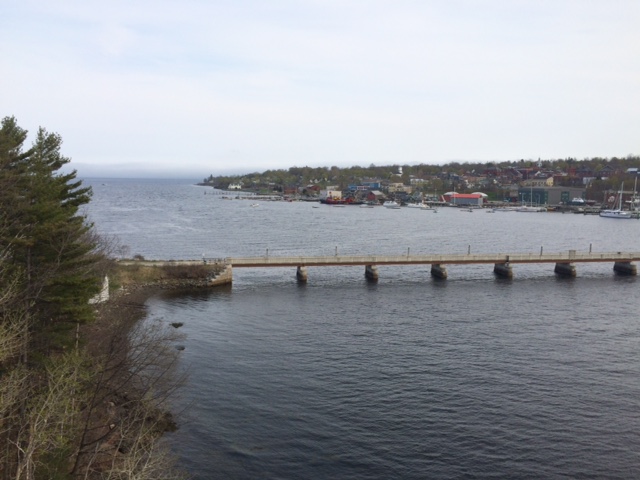
IMG_1728When I rode away about one o’clock, I needed a few hours of solitude to process the intensity. The ride from Union to Belfast goes through beautiful countryside, forests and farms. The topography is hill after hill after hill. Long, low gear climbs followed by fast, all to quick, descents. I spent my mid-afternoon break at the Hope General Store with a Diet Coke and Whoopie Pie, a ridiculously sweet Maine staple.


IMG_1731The side of the rod was littered with fiddlehead ferns. I rolled into Belfast about 5 p.m. Belfast is a picturesque coastal town that has transitioned out of manufacturing with great spirit. I crossed the Passagasawakeag River on the high bridge on Route 1. Then I turned off the Atlantic Highway for one final time, and climbed the hill on opposite rise to spend the night with Jim Merkel, long-distance cyclist, environmental education, and author of Radical Simplicity, and his family.

IMG_1736

Posted in Bicycle Trip Log | Tagged , , , , , , | Leave a comment

Profile Response – Kathy Spirer, Executive Director of Cambridge at Home

HWWLT Logo on yellowKathy Spirer is Executive Director of Cambridge at Home, a non-profit group that helps elderly people stay in their own homes. Cambridge at Home provides a desirable, economical, option to assisted living and other institutional care. Aging in place is important among the continuum of options that allow us to grow old with grace, dignity, and safety. We spoke at her office in Cambridge, MA.

Cambridge at Home started eight years ago. We are the second oldest ‘village for aging’ in community in the United States. The first was founded on Beacon Hill, in Boston. Now there are 160 groups within the village-to-village network across the United States. All operate with same goal: to enable people to live at home with independence and safety. We connect memberimagess to services, from home health to handymen, to meals. We also sponsor a range of exercise and social activities, including a book group, scrabble, bridge, a discussion group, and even an exercise group that meets three times a week. About three-fourths of our members are mobile, so sociability is a big part of what we provide.

We currently have just over 200 households and have been steady in that number for many years. Anyone over the age of 50 can join. Current members range between 58 and the late 90’s, though most are over 80.

I asked Kathy if research about villages for aging provided data to support their efficacy.

The Village-to-Village network works with researchers at UC Berkeley to get data and quantify the benefits of these programs, to see how aging in place affects length and quality of life. Since we’ve been around for such a short time and the variables are great, it is difficult to quantify at this time. However, we are going to need data to get insurers or other third party payers to decide these programs are worthwhile. Our demographic are people with too many assets to get public assistance but not so wealthy they can easily pay all the costs of staying in their homes.

People join for many reasons. For some, this is a friendly charity; others join as insurance against a catastrophe. Some join from their hospital bed – the catastrophe has already happened. Still others join for the social aspect and come to use the other services in time. Adult children often try to enroll their parents, but we prefer the parents to enroll. We want parents to want our services. Adult children can be enemy #1, pressing parents for more services or moving them before parents are ready. Children want peace of mind that their parents are safe, parents want to hold on to what is familiar and gives them independence. imgres-2

When assisted living developments began, people flocked to them. Then, around 2008, many people realized they couldn’t afford them. Assisted living has a run rate from $4000 to $10,000 per month. Plus the extras. The least expensive option for most seniors, until they require 24-hour care, is to stay in their home.

Home modifications can be an obstacle to aging in place, but they are a one-time cost. The biggest challenge for most people is actually transportation. People want independence, and that is difficult without a car. Public transportation is a real challenge for people with mobility issues, shared van services are affordable, but inconvenient, while taxis and ride services are expensive.

I asked how buddy systems, where seniors check in on each other every day, contribute to people staying in their own homes.

Buddy systems are popular and effective in many parts of the country, but we’ve had little luck instituting them in Cambridge. People in Cambridge are very independent. They bristle at the idea that someone ought to check in on them. The reason we don’t have 300 households in Cambridge at Home is because too many people don’t think they need our services, until it is too late, and then they need even more services.

I asked Kathy, how will we live tomorrow?

images-5In order to live in the future, we are going to need to learn how to ask for help and receive help in a respectful manner. I know an 82-year-old man who every day drives to Newton to care for his 100-year-old mother. She never counted on living so long; he never counted on giving her care when he is so old. We are living longer, our frail years are extending, but it is difficult for us to ask for and receive help.

Posted in Responses | Tagged , , , | Leave a comment