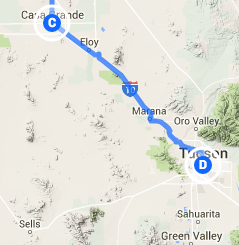
Trip Log – Day 201 – Casa Grande, AZ to Tucson, AZ

Screen Shot 2016-01-14 at 8.56.09 PMJanuary 15, 2016 – Cloudy, 60 degrees

Miles Today: 62

Miles to Date: 10,351

States to Date: 26
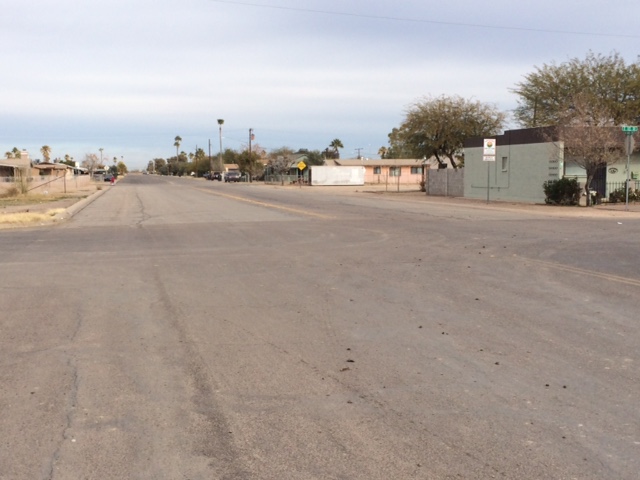
IMG_5415A chilly, grey morning lingered into a chilly grey day. Twelve miles on I came to Eloy, a desolate place with a near-empty Main Street. All the action was at Food Town, where bakers and stockers and cashiers all chatted with the customers. Despite having a full breakfast, I tanked up on mango yogurt, a banana and a pair of Mexican Sweetbreads. I could add a bumper sticker to my bike: I stop for Panaderia.

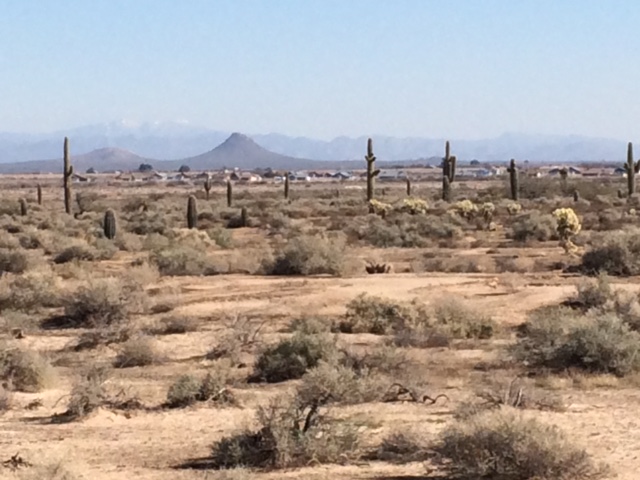
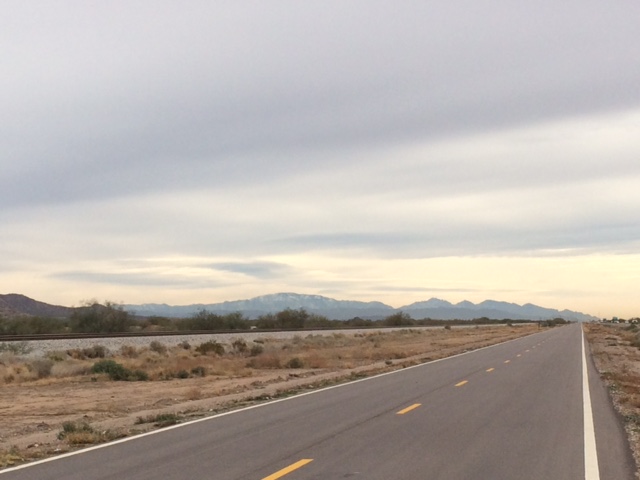
Outside of town I connected with the I-10 frontage road. Despite traffic whizzing past 100 yards away, the road was my solitary space, a straight and steady rise with the wind in my face for 32 miles. This situation connects me with the Zen, the yoga of cycling. For the first few miles I push against the reality that for the next few hours I have nothing to do but pedal. I shift in my saddle and check my odometer’s every click. My mind calculates and recalculates. How far have I gone? When will I get to the Exit 244? I invent games to pass the time.
IMG_5419 IMG_5420

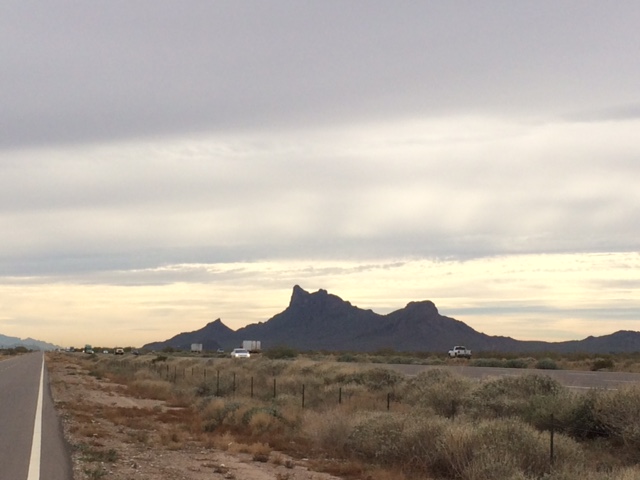
At some point the mental gymnastics dissipate. I resign myself to pedaling. Nothing changes. The mountain in the distance remains fixed and unattainable. The landscape is too big to register my slow progress. The wind is too steady for me to feel its variation. The grade is too slight to discern any rise or fall.

Finally, out of that space where nothing changes, I stop thinking about time or progress. Everything becomes hyper alive; the smallest wind shift, the shallowest pavement dip. The immovable distance I must cross vanishes. The struggle of time passing evaporates. I simply breathe where I am.
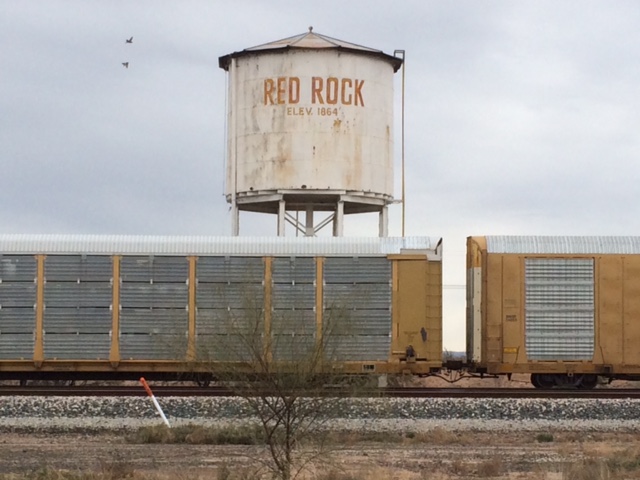
IMG_5422Long stretches are perfect for singing. My repertoire is triggered by whatever passes; a car, a sign, a bird. I come to Red Rock, which is nothing more than a stretch of railroad and rudimentary interchange. Immediately I recall Song for Martin by Judy Collins. It begins, “In Red Rock Arizona he lived for many years alone…” It’s been twenty years or more since I sang the fragile poem of a not-quite friend’s suicide. But lyrics stick to memory like oatmeal to our gut; I remembered every line. The song resonates even more haunting rolling across this blank expanse where so many years ago someone Judy wished she knew better took his final breath.

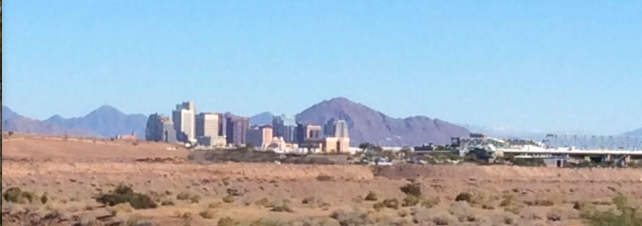
imgresThe wind, the slope, the landscape, and my mood all turn around in Marana, Tucson’s northwestern exurb. My steady climb becomes a gentle decline. The wind shifts from my head to my tail. The frontage road is littered with offbeat stores and construction yards. My spirits lighten as I approach my destination. At Twin Peaks Road I shift to the The Loop, Tucson’s extensive bicycle ring path. I’m released from the Interstate’s throb. I ride a wide paved path lined with Ironweed and Mesquite, scrub cactus and sharp rock until I reach my destination.



Posted in Bicycle Trip Log | Tagged , , , , , , , , | 1 Comment

Responses: How will we live tomorrow?

HWWLT Logo on yellowHow will we live tomorrow?

“My first thought is, as a species we’re going to go away in evolutionary terms. I don’t know what we’ll become; maybe a computer. It’s okay, its part of the evolutionary chain. I like 2001, the three parts: the ape, the humans, and Hal starting to think for himself. It is not an extraordinary extrapolation.”

Jason Malinowski, Restoration Hardware Executive, Novato, CA

How will we live tomorrow?

“You don’t have to do anything to make people have fewer children other than make them rich.”

Michael Sojko, data base specialists, Mt. Shasta, CA

How will we live tomorrow?

“When you ask that question, the key is the question. Out of necessity we will have to learn cooperation. Things will change and shift, but we need to balance our inner and outer lives.”

Shomosa, dancer, Cave Junction, OR

How will we live tomorrow?

“If we live tomorrow. If I am here.”

Prado, passive solar homebuilder, Cave Junction, OR

How will we live tomorrow?

“I visited La Mondragon Cooperative in Spain. They haven’t laid anyone off since 1945. When a business fails, they transfer workers to other businesses. Fifteen-percent of the Spanish workforce is in cooperatives. We need more of that. The name ‘cooperative’ doesn’t say as much as how to do it. People can be organized to do it ten different ways.”

Bob Quiltich, progressive, Reno, NV

How will we live tomorrow?

“I am reminded of the Abraham Lincoln quote, ‘We are about as happy as we allow ourselves to be’.”

Roberta, Unitarian Universalist, Reno, NV

How will we live tomorrow?

“We need corporations to create forms of business larger than mom and pops. Now, corporations’ limited liability has gotten so broad. When corporations are bigger than governments, it is not healthy. It is good that Tesla came to Reno, but not at the terms they got to set. That was not positive.”

Elliot Parker, Economics Professor at University of Nevada, Reno, Reno, NV

How will we live tomorrow?

“Live every day as if it’s your last.”

Medical Interns, Indian restaurant, Reno, NV

How will we live tomorrow?

“RV living. We will have RV parks all over the country.”

Skip, retired wanderer, Livingston, TX

How will we live tomorrow?

“The same way we do today.”

Stuart Jones, former Peace Corps volunteer, Fresno, CA

How will we live tomorrow?

“Closer together.”

Mark Jones, Lab Scientist, Fresno, CA

How will we live tomorrow?

“Kinder and more gently.”

Eric Murray, wine wholesaler, Napa, CA

How will we live tomorrow?

“The brands of the future will have more purpose. I believe in the triple bottom line – people purpose, and profit. In the future, businesses will have a social purpose.”

Ben Koenig, Heritage Eats, Napa, CA

How will we live tomorrow?

“Everything is going to go faster and faster. Distances will matter less. I see things getting more fragmented and bureaucratic. Different forms and players will each have their own systems.”

Sophie Feldstein, high school senior, San Francisco, CA

How will we live tomorrow?

“We’ll eat the last free swimming salmon within five years.”

Gary Schaefer, retired Air Force, San Anselmo, CA

How will we live tomorrow?

“In Marin County, the property taxes were rising about $10 million per year. Last year they went up $90 million. This is not sustainable.”

Kathy Schaefer, retired engineer, Marin County, CA

How will we live tomorrow?

“The same way we do today.”

Heidi Siegenthaler, bicycle commuter, San Francisco, CA

How will we live tomorrow?

“The world will have fewer people because they are not necessary. It’s not going to be pretty, but we’ll find a way. Maybe you convince people to have fewer children; maybe you control them.

“You can’t keep the trajectory we’re on and keep living as we do. We thought the Arab Spring was going to be the greatest thing, and look at how it turned out.”

Martin Siegenthaler, political junkie, San Francisco, CA


Posted in Responses | Leave a comment

Trip Log – Day 200 – Tempe, AZ to Casa Grande, AZ

Screen Shot 2016-01-14 at 8.55.46 PMJanuary 14, 2016 – Sun, 60 degrees

Miles Today: 71

Miles to Date: 10,289

States to Date: 26

One look in the mirror this morning told me the ten pounds I’d gained over the holidays were already slipping away. A cyclist’s problem for which the world offers no empathy: I needed to ramp up my food intake.

IMG_5400Phoenix’s sprawl enveloped me for twenty miles and stopped along a sharp line when I reached Highway 87 and entered the Gila Indian Reservation. I took a break at the first wash I came upon to breathe in the desert and carb up. Then I pedaled twenty-five miles through stunning landscape to visit Casa Grande Ruins, our nations first archeological preservation monument. The remains of the four-story adobe structure and its surrounding plaza, circa 1350, represent the apex of an agrarian culture that existed for a thousand years, supported by an elaborate irrigation system fed by the Gila River. The society collapsed shortly after Casa Grande was built. The reasons are unknown, but there is evidence that increased population encountered a period of heavy flooding that washed out the canals, forcing the people to relocate and decentralize.

IMG_5403This explanation resonates with scenarios people often articulate in my travels: that our population has increased so much and our resources are stretched so thin, a disruptive phenomenon (climate change, tsunami, plague, food contamination, take your pick) will decimate us and refocus how we live. Casa Grande Ruin is a sobering place.

I cheered right up with my first Sonoran enchiladas, better-fried tamales, at Tag’s Cafe in Coolidge. They fueled me the last 25 miles to the Motel Six outside the present-day town of Casa Grande.

IMG_5404 imgres

IMG_5411When I passed Love’s Country Store, where gas is $1.75 a gallon, I wondered if it’s even feasible to turn this giant spinning globe of seven billion people in a different direction. Floods in the desert undid our ancestors. Will pulling gas and oil from our earth and burning it through the atmosphere do us in as well? Or will it be something else completely? Something we could never predict. Like a flood in the desert.

IMG_5412

Posted in Bicycle Trip Log | Tagged , , , , , | 1 Comment

Profile Response: Joe Colesium, Los Angeles, CA

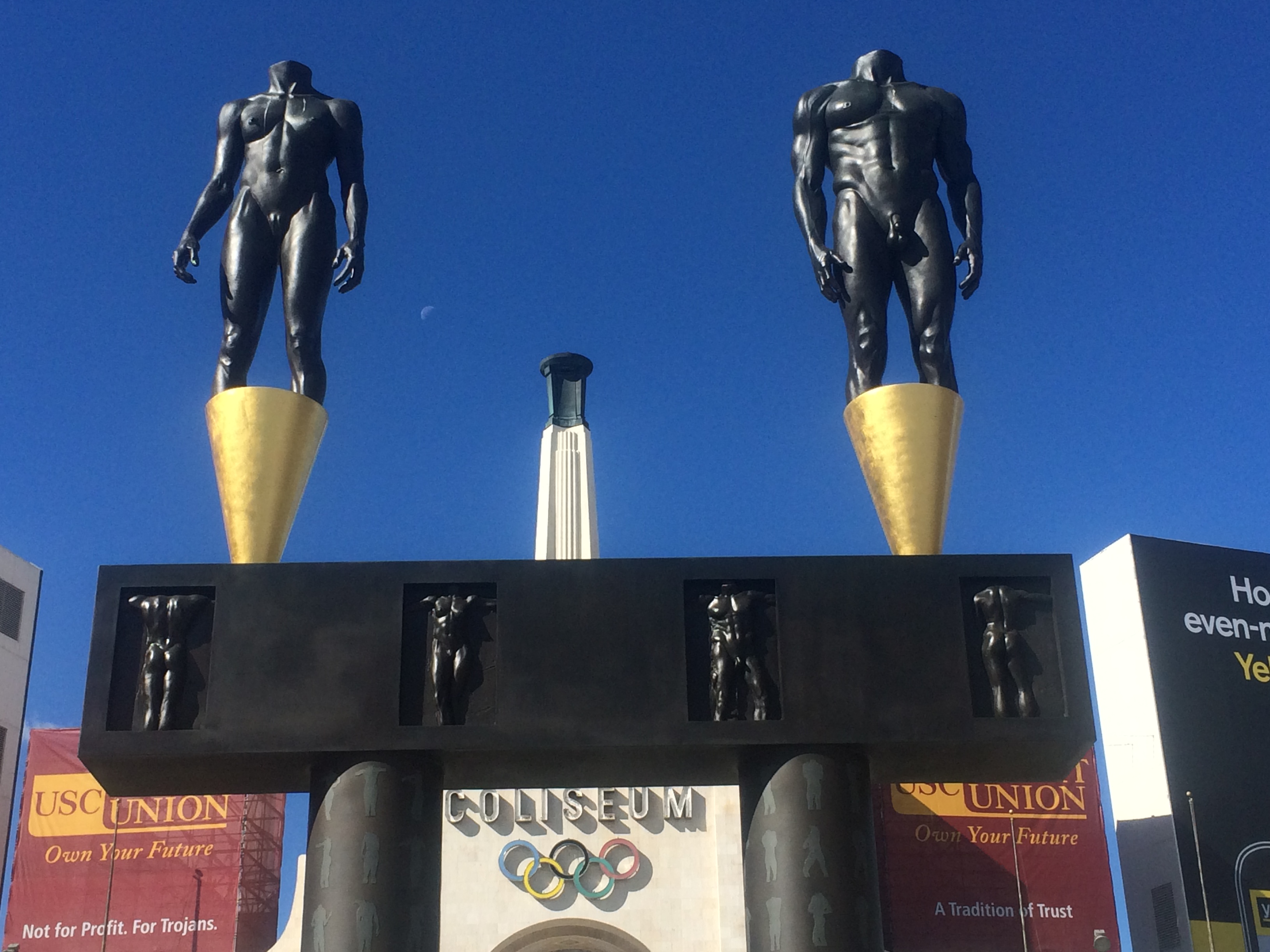
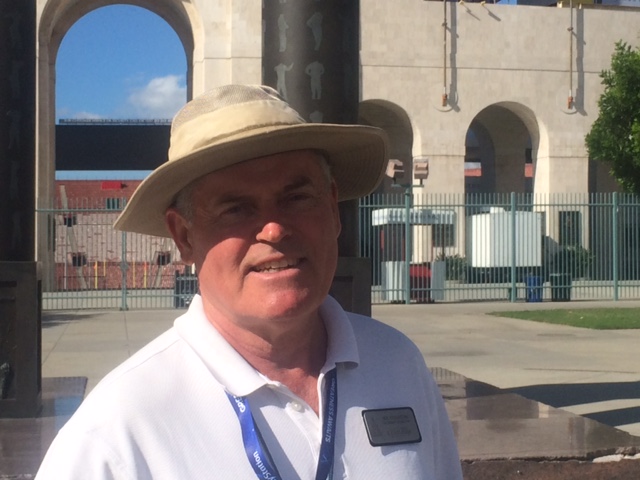
HWWLT Logo on yellowI acknowledge pretty much everyone I encounter on my bike. When I receive a gesture in reply, I sometimes stop and strike a conversation. Riding through USC, college students scuttling to class ignored my nods. South of campus, in front of the Coliseum, I could tell the middle aged guy with a big grin wanted to chat. Joe Coliseum (that’s what his nametag read) is the tour guide at this 1932 and 1984 Olympic landmark. He boasts having a history degree, with honors, from Berkeley and an MBA. His stated interest is Eastern and Western history and philosophy. His real skill is talking.

IMG_5053 IMG_5056

“I meditate three hours a day with the Centering Prayer. Open heart equals open mind. The Centering Prayer works on the difference between moving and sitting. In Christianity you have to keep moving to keep Satan out. That’s where the phrase ‘Protestant work ethic’ comes from. But look at the Asian work ethic – Protestants don’t own work. The Centering Prayer allows quiet sit. Refer to Thomas Merton and Thomas Kearns on this.

Screen Shot 2015-12-25 at 11.40.54 AM“Compare them to Paramahansa Yogamanda, Autobiography of a Yogi. To what degree do you know god as revelation? The structure of faith comes after revelation, which comes after meditation. When the mantra goes away, the prayer begins. When everything that makes us human: action, feeling, thought, goes away, when the single meditation word goes away, only then can the empty vessel that is the human reach up and accept god’s grace descending upon us.

“The links between Hebrew and Sanskrit, Judaism, Buddhism, Hinduism and Christianity are under appreciated. We stress the differences, but the similarities are immense. The Centering Prayer allows me to have one foot in the Christian world and one foot in the mystical world. In the Gnostic Gospels Jesus says to make thy eye single and the body will be fused with light. That’s an Eastern idea.

imgres-1“The Biblical terminology about the second coming is not accurate. The world doesn’t end; it is complete. The phrase should be, ‘When Jesus reappears the world will be complete.’”

Half-hour into this monologue I began to gesture that I needed to move on. The more I tried to pull away, the faster, and more insistently Joe talked.

“The Heisenberg Uncertainty Principle is essentially a Buddhist concept. For thousands of years they have acknowledged experiences beyond rational, 3-D existence. Add time, add mysticism. The Dao of Physics is the rational side versus the spiritual side of life. Newton and Descartes looked at the world from a new perspective. That perspective had to precede the restructuring of human consciousness.

imgres-2When I finally extricated myself, after forty-five minutes, I deduced a theory of personal interaction. When someone shares his passion with you for fifteen minutes, it’s exciting. When he’s goes on for half an hour, it’s detailed. Beyond that it’s tedious. Worse than that, it becomes suspect. By the time I rode away from Joe I didn’t trust that any of what he said was true. It was simultaneously too polished and too scattered. As if he were some twisted tour guide of the soul.

How will we live tomorrow?

IMG_5055And, to make matters worse, he never answered my question.

Posted in Responses | Tagged , , , , | Leave a comment

Trip Log – Day 199 – Goodyear, AZ to Tempe, AZ

Screen Shot 2016-01-14 at 8.55.21 PMJanuary 13, 2016 – Sun, 60 degrees

Miles Today: 38

Miles to Date: 10,218

States to Date: 26

Today was the ultimate demonstration of my route’s inefficiency. I spun a complete U-turn and ended up exactly where I began yesterday. Fourth graders west of Phoenix wanted to talk with me on Tuesday. College professors at Arizona State invited me on Wednesday. I pedal where my question takes me.

imgresArizonans do not reset their clocks. The state is on Pacific Standard Time in the summer and Mountain Standard Time in the winter. That means January mornings are dark. Given the desert, they’re also cold. I headed out of Goodyear at first light, which is not until 7:00 a.m. Frost glistened on car windshields. I coffeed up at Circle K; they are ubiquitous here. I rolled toward the sun, warmer with every breath.

IMG_5389The affluent cities surrounding Phoenix have wide, straight roads lined with eight foot high masonry walls that hide tawny stucco houses with red tile roofs spun along curlicue streets. The main arteries are monotonous. I prefer Phoenix proper, which includes most of the distance from Goodyear to Tempe. Poorer neighborhoods are more interesting. Houses are less precious, tchotchke’s hang all over them. More dogs chase me in barrios, but most are small. Little Napoleons run after me for half a block, though they can’t even reach my heel.

I travelled through the city’s bowels. On Lower Buckeye Road, the county prison is across from the dump, which is next to the wastewater treatment plant, an industrial area, scrap yards, and the bus terminus, where the striking drivers were picketing in force. A pungent no-man’s land.

imgresI knew Arizona State University as the nation’s foremost online college educator. Along my journey, several people suggested it’s in the forefront of other educational innovations, so I was pleased when several ASU faculty and staff agreed to talk with me about tomorrow. A university with a School of Sustainability, a School of Public Service and Community Solutions, and a School of the Future of Innovation in Society has got tomorrow on its mind.

IMG_5392I had fascinating discussions with a variety of folks there (profiles to come!) but was so dazed after my last interview, I camped out in the Student Union to organize my notes. Luck led me the Changemaker Central, a student run lounge dedicated to service opportunities: Teach for America, Peace Corps, and the like; a welcome complement to the Armed Services Recruitment Centers on many campuses.

Screen Shot 2016-01-15 at 10.30.35 AM

I stayed with a cool group of undergraduates in a splashy student apartment: four-bedrooms, two baths, sunset views and a pool. No matter that I was three times their age, we did what college students everywhere do: stayed up too late talking about everything.

Posted in Bicycle Trip Log | Tagged , , , , , , , | Leave a comment

Profile Response: Lisa Arangua, Los Angeles Department of Public Health, Los Angeles, CA

HWWLT Logo on yellow“I go through tangents once in a while, so stay with me.” Lisa Arangua tossed that comment my way while I was scribbling and grasping for coherent threads in our conversation at her downtown LA office. Lisa speaks in quick, short sentences and switches topics at random; from her daughter’s cancer to childhood obesity rates to mentoring a wealthy murderer’s sons, to implementation science, to the virtues of hiring immigrants. I floundered during our first fifteen minutes together. Then, over the course of a meandering hour and a half conversation, her statements began to connect. Lisa’s life, her work, her family, her philosophy, and her rapid-fire energy are tightly woven. Each informs and supports the other. What appears random as a Surrealist art film becomes as finely crafted as Alejandro González Iñárritu’s movie Babel.

imgres“2013 was a bad year. I got laid off from UCLA. I had a car accident. My daughter Olivia, who was ten at the time, was diagnosed with endocrine cancer.” The doctors at UCLA recommended a treatment strategy that didn’t feel right. Lisa consulted pediatric oncologists from CHOP, Sloan Kettering and MD Anderson. Together, they developed a treatment protocol and radiation dosage levels. Coordination at this level is often stymied by research and funding restrictions, though Olivia’s case eventually landed in the literature. “The four docs wanted to share information and collaborate. Time wasn’t an issue – oncology docs give more time and attention than they have. They have extraordinary concern for their patients.”

imagesWhen Lisa lost her position as an implementation scientist at UCLA, a former colleague encouraged her to move to the LA Department of Public Health, where she works on programs to stem childhood obesity and raise nutrition awareness. Lisa applies the intense coordination that helped bring Olivia into remission to her work. “If we’re going to solve the world’s problems, coordination is how it’s going to happen. We want to transform the food environment. We use tobacco as a model. We take a micro-approach: individual efforts, and a macro approach: mass marketing. Smoking is no longer socially acceptable. We are trying to apply these ideas to food.” Lisa confronts obstructions, fiefdoms and special interests in every direction. She focuses on getting the constituents together and rowing in the same direction. “Coordination is the future. Grantors are beginning to require that. That is good.”

images-1Changing the eating habits of an affluent nation is an ambitious undertaking. Programs have to be staged to address what we can control. “LA County has ten million people. It’s as large as many countries. We’re starting in the schools – something we control. We started in our two poorest areas, South LA and Antelope Valley. We met with families. We solicited their input. 93% of the parents in Antelope Valley consider childhood obesity a problem. But they don’t want a nanny state. Inform our choices but don’t take our choice away.” The public health department developed a green/yellow/red light food display system. They added nutritional content to menus. They passed a procurement policy to guide school offerings. Now they’re working on portion size, so preschoolers and sixth graders don’t get the same amount. “We work in the schools now. The retailers will come later.”

IMG_5005Lisa hopes these small steps will lead to small successes, which will lead to larger steps. She always keeps the big picture in mind. “We need to spread this beyond schools. We need community gardens. People have to be in touch with their food. We have to stop subsidizing meat and start subsidizing fruits and vegetables. Why are we subsidizing milk? We are the only mammal that drinks milk beyond infancy; the only mammal that drinks milk from another mammal.”

Those big steps won’t happen because of policy, they will only happen when there is a champion. “In order for implementation to really happen, you have to have a champion. Someone with fire in their belly.” Someone like Lisa.

How will we live tomorrow?

“It’s all about community. Bringing the right people, the smart people, the people on fire, together. I hope we teach kids the value of community and empathy. I hope we start creating more leaders.

“We need to give our kids more survival skills. We protect our children too much. My daughter has had an epic test of her strength. We have bonded over that. We took our older kids on a 300-mile paddle trip. We hit a thunderstorm and paddled for life. We’re better for having that test.

“Our Western way of living is dismal and deadly. I hope, this is a hope rather than a how, I hope we stop doing national health experiments. The cell phone is our next public health crisis. The evidence is amassing that these are going to cause all kinds of health problems. Neurosurgeons are finding more tumors. Cell towers are being built next to schools and in parks. They are toxic accumulations.”


Posted in Responses | Tagged , , , | 3 Comments

Trip Log – Day 198 – Tempe, AZ to Goodyear, AZ

Screen Shot 2016-01-14 at 8.54.38 PMJanuary 12, 2016 – Sun, 55 degrees

Miles Today: 38

Miles to Date: 10,180

States to Date: 26

Back on the road again…

Getting back on my bike required a slew of transportation modes. Seems like I used everything except automobiles. During the eight weeks I was home visiting family, doing construction projects, and gaining ten pounds eating my housemate’s incredible cooking, Landry’s Cycles in Tempe refurbished Surly. When they called to confirm the repairs they explained the kind lady from the airport did, indeed, deliver the bike lock that TSA rejected when I flew home in November. Therefore, first thing I did upon landing at Sky Harbor Airport was to check information. Sure enough, Glenda was working. I had the pleasure of thanking her in person and feeling that my trip’s good mojo was intact after my hiatus.

imgres-1Glenda explained that the Metro Valley bus drivers were on strike. Light rail was running as usual and managers were operating buses on half schedule. My motel was near the trolley, but I rose early the next morning (jet lag and all) so had plenty of time to make slow bus connections. There was no sight of the Sixteenth Street bus and I am too impatient to sit on a cold bench in the dark (sun rise is very late in Phoenix this time of year). I decided to walk between stops and keep an eye out for the bus.

IMG_5371 imgres

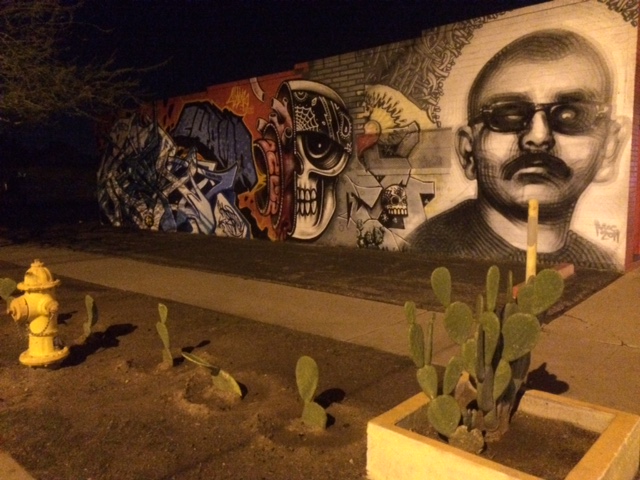
The neighborhood proved fascinating, full of cool murals. My walk became a hike. No buses ever came. Ultimately I walked full eight miles to Southern Blvd. But the morning was crisp and bright. I had all kinds of time, and just one pannier on my shoulder. Still, I was glad the eIMG_5375astbound 61 came along Southern Blvd and transported me ten miles to Landry’s. Distances in Phoenix are crazy long. Eighteen miles in Boston would get me near the I-495 outer loop. In Phoenix, eighteen mile is just a portion of the seemingly endless gird of wide roads.

Surly! It was so great to be reunited with my bike. She’s practically new: new wheels, tires, bearings, derailleur, chain, sprocket, you name it. Thank goodness bike repairs run about 10% of car repairs. We didn’t have time to dawdle because I had a 2:00 p.m. presentation at a charter school in Goodyear – a mere 34 miles.

Screen Shot 2016-01-14 at 9.08.44 PM

Beside being immense, Phoenix is also pancake flat and easy to navigate. The sprits gave me a tailwind. I was so pleased to be back on the bike I covered the distance without a break. I arrived at BASIS Goodyear in time for a tour before a raucous hour talking about my trip and my question to some of the most engaging ten year olds I’ve ever met. I answered every lingering question (my favorite: Do you carry soap?) and talked with faculty. By the time I realized I forgot to eat lunch, it was already four.

downloadNo problem. I took my short ride to my hosts, Becca and Mike Beaulieu. I’m pretty good at logistics, but their coordination skills dazzled me. Mike is the Operations Manager at the brand new BASIS Goodyear, Becca teaches kindergarten there. Daughter Elena attends BASIS. Son, Nolan, is just three months old, in his second day of home day care since Becca returned to work. And, they just moved to a new house. Nonplussed by anything, they invited me to stay with them. Becca made a delicious dinner, while supporting baby Nolan on her hip. Afterwards Mike and I played with Candy Land with Elena. It seemed appropriate that I came in last. After all, I am colorblind.

Posted in Bicycle Trip Log | Tagged , , , , , , , , | 1 Comment

Profile Response: Caroline Bringenberg, Silver Lake, CA

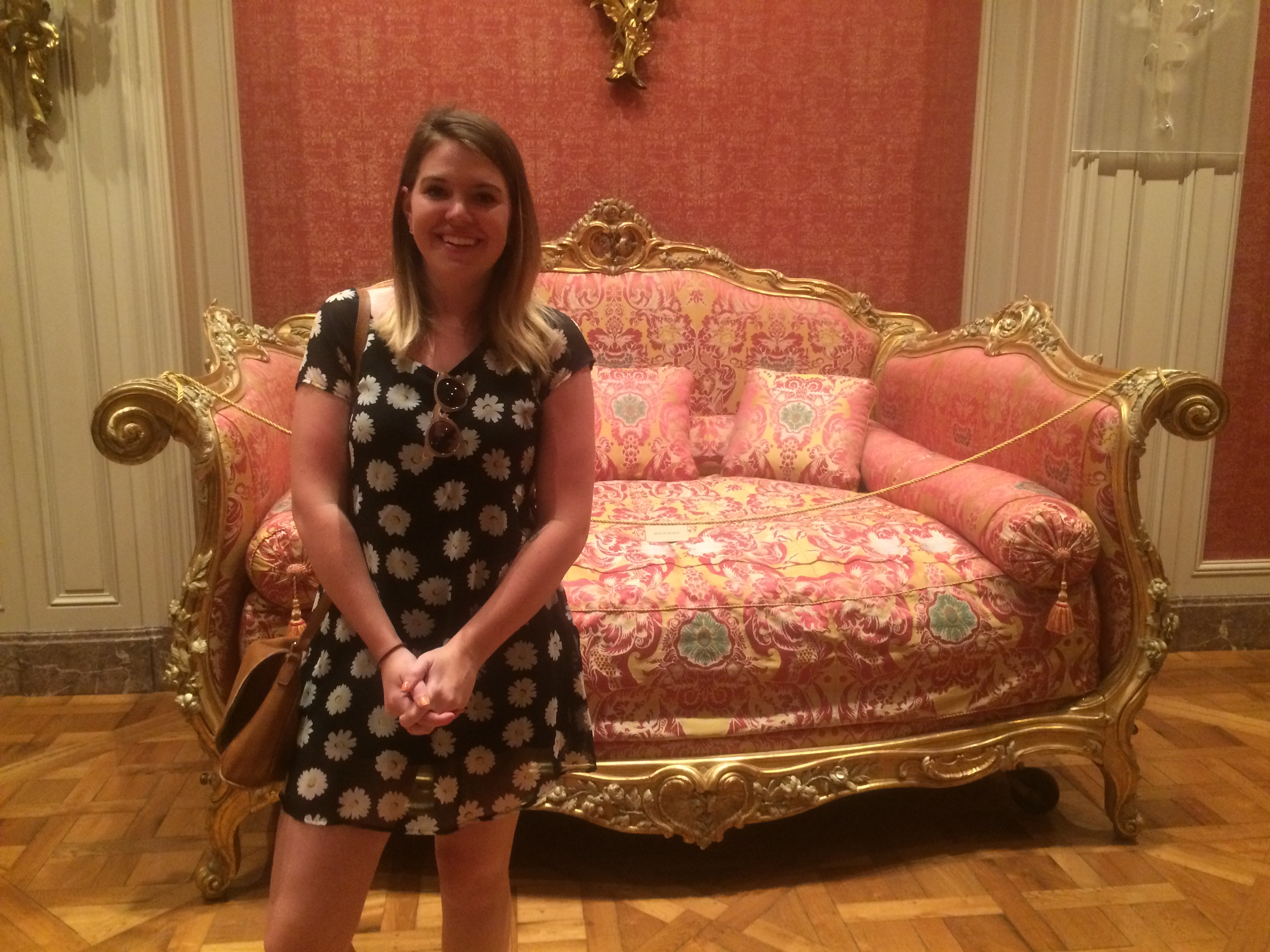
HWWLT Logo on yellowCaroline Bringenberg and her boyfriend Sean met as students at Occidental College. They are in what Caroline calls, ‘the sophomore year of life’, two years removed from undergraduate life. The couple shares a one-bedroom apartment in a small complex of bland stucco buildings a few miles from Oxy’s idyllic campus. Any grass or shrubs has been paved to accommodate the maximum number of cars; the pool was drained long ago. But there’s a friendly banter of Spanish and English among the dozen or so residents, most of whom have brown skin and calloused hands. Although everyone in this community of proximity has about the same income, Caroline and Sean’s youth, education, and life prospects are different from their neighbors. They may live here for several years, probably not for life.

cbkSean works as a wholesale insurance broker. Caroline is the administrative assistant at The Unusual Suspects, a non-profit theater group that works with incarcerated youth. They adopted a pug from the pound. Sean plays keyboard in two bands. They started a book group and enjoy game nights with college friends. The couple lives modestly. They’re paying back their student loans ahead of schedule. Life is good.

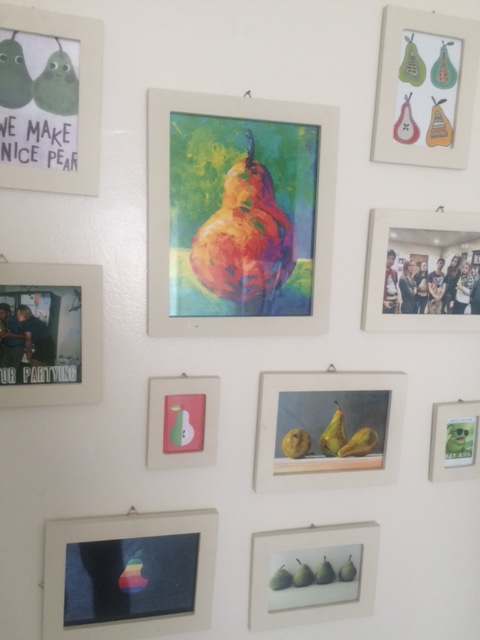
“If we got married it would be social suicide. We’re already the only couple we know who are dating. I’m amused when Caroline says she’s ‘dating’ Sean, a more casual term than the reality of their situation. Couples who are dating don’t live together without an escape pad to which at least one can retreat. They don’t own a dog together. The dIMG_5036on’t hang pears images on their walls. They don’t keep a quarter jar for the laundry.

If you press Caroline, she’ll admit that Sean is the real deal; that they’re together for the long haul; that they might even get married some day. But in a society where marriage is on the decline and preserving options it more important than staking commitments, that’s not something a hip Occidental grad in the sophomore year of life can declare up front and out loud.

How will we live tomorrow?

IMG_5033“I have two answers. What I hope for and what I actually think.

“I hope we redesign our cities so they are less focused on cars and more focused on people.

“I hope we end mass incarceration and rehabilitate people rather than put people in cages.

“I hope women will be paid the same as men.

“I hope we stop destroying the earth.

“What I think will happen is we will keep doing what we’re doing until something catastrophic happens. Donald Trump gets elected. California falls into the ocean. The East Coast floods.”


Posted in Responses | Tagged , , , , | Leave a comment

Profile Response: Insurance Brokers, Eagle Rock, CA

HWWLT Logo on yellowWhen I think of insurance I think of middle-aged white guys in off-the-rack suits that have consumed too many Rotary luncheons. Their necks bulge over the collars of their crisp white shirts. Their wrists puff out from beneath their cuffs.

Toss that image away. Twenty-first century insurance men for Neitclem, a wholesale broker that offers insurance services online, aren’t middle-aged, don’t wear suits, or eat Rotary lunches. They’re not necessarily even men. I met Betty, Jose, Sean, and Gary for lunch at Dave’s Chillin’n’Grillin sandwich shop in Eagle Rock. They all shoimageswed up in Neitclem polos (company policy allows you can wear jeans if you sport the company logo) and ordered bodacious sandwiches all around.


The 20- and 30-somethings assured me that traditional salespeople, who sell policies to individuals, still dress conservatively. But underwriters, people who assess risk and determine rates, don’t need to be so formal. These folks enjoyed the laid-back banter and casualness often associated with start-ups. Though in this case there’s nothing new about the product line. Insurance has been part of our economic landscape for hundreds of years.

imgresThere is no one path to being an insurance broker. Jose came to the US from Mexico in 1991 and became legal a few years later. He’s been at Neitclem over ten years and worked his way up through several positions. Gary wanted to be an actuary but the registration and testing process was too cumbersome. Sean did a part-time telemarketing stint for an insurance company, which led him to Neitclem. Betty worked at Starbucks. “It’s rare to find anyone who studies this in school; brokers come from all paths of life.” Most underwriters have college degrees, though it’s not required. Gary added, “You just need people skills.”

Liability in commercial insurance is spread among the client base. A kitchen fire in a restaurant may trigger a big claim, but it’s unlikely that there will be multiple kitchen fires. Damage insurance for floods or earthquakes is an entirely different matter. There will be no claims at all, until there are many at the same time.

imgres-1 imgres-2 imgres-4

Successful insurance brokers set rates that a client can afford, but high enough to cover damages made by claims. There are rate guides, frequently updated. Sean described a new rate for food trucks. “It’s less liability than a restaurant, but more than a concession stand.”

imagesStill, there are quirky conditions that require underwriters to finesse book rates. Betty had to figure a rate to insure goats that ate grass on Malibu hillsides. Sean had to determine how to insure a new product, eavesdrop, that retracted holiday lights through the warm weather so people didn’t have to restring their Christmas lights every year.

Commercial insurance is commodity. People are always looking for the lowest premium, in amounts that are often required by their mortgagor or a regulatory agency. There are some creative aspects to setting policies, and lots of nerdy number crunching. But mostly, these four like the job because they’re working with such a good group of people – each other.

How will we live tomorrow?

IMG_5041“The question makes me think of climate change. The future is going to be very hot. This is the hottest year ever. The second hottest was last year. There’s a trend.” – Sean

“Living here in LA, housing keeps getting worse. Santa Monica has some form of rent control. We are going to need to expand that idea. The only places people can own have terrible commutes.” – Jose

“People know much more now. Everything is out there; it’s all available. We know more about conditions abroad. Our youth are more aware of conditions elsewhere. This will help bring us together.” – Betsy

“I am interested in the $15 minimum wage in LA Country by 2020. How will that affect other wages and jobs? Will it raise salaries of other jobs as well? It might decrease incentives to get higher education. On the other hand, a higher minimum wage will allow folks to go to school and make more money. But there will be more outsourcing and more automated transactions.


“Underwriting will remain, at least in terms of what we do. It has already disappeared from car insurance, which is now fully automated.” – Gary

Posted in Responses | Tagged , , , , | Leave a comment

Profile Response: Meisha Rainman, Development Director, The Unusual Suspects, Los Angeles, CA

HWWLT Logo on yellowI get the impression there are only two kinds of people in LA: people who want to be in the entertainment industry, and people who have left the entertainment industry. I suppose there are actually people who are in the entertainment industry, but I haven’t met any of them. They’re probably too busy.

Meisha Rainman was an agent. She had a stable of actors and a slice of glitterazzi. Then she had a family. Young children and the networking circuit are not compatible, so she left show biz. When her children were old enough for her to return to work, Meisha entered the non-profit arena. She worked at Silver Lake Jewish Community Center, and recently became Development Director at The Unusual Suspects, a theater companyIMG_5043 that works with incarcerated youth. “This work is not very different from being an agent. My joke is, I now use my powers for good.”

Being Development Director at The Unusual Suspects is a heavy responsibility because the organization generates no income. “We offer our programs to prisoners and at-risk youth for free, we don’t change for performances. We have to pay out teacher artists. The more people we serve, the more money we need.”

Screen Shot 2015-12-24 at 4.48.44 PMMeisha’s children are now ten and seven, ages where working outside the home requires a lot of coordination and some soul searching. Meisha believes the trade-off is worthwhile. The Unusual Suspects allows her to do worthwhile work and also have engaging connections to the outside world. From Meisha’s perspective, being a parent is not just about being physically present. “I have to stay an interesting and relevant person.”

How will we live tomorrow?

Screen Shot 2015-12-12 at 5.11.01 PM“I think I should be profound and broad about the ‘we’, but I am still getting used to full time work, my afternoon baby sitter is leaving, my Executive Director is leaving, my kids are adjusting. My tomorrow is a ‘to do list’ of tasks.

“Last week we met a released prisoner. He said, ‘Imagine if we treated all children the way our children are treated.’ This work allows me to level the playing field. That’s why I come to work every day. The time I have taken from them is being traded for a larger good that will also help them. Anyone can make them a snack.”


Posted in Responses | Tagged , , , | 1 Comment