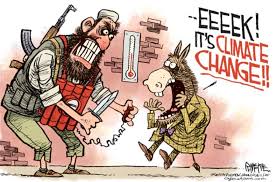
 Liese Siegenthaler’s got a ready smile; articulate demeanor and an open countenance. She could be a graduate student in environmental studies or psychology. Instead, Liese is tackling two of our planet’s biggest challenges – terrorism and climate change – in her graduate program at Middlebury Institute of International Studies at Monterey. “How are security and climate change related? We’re beginning to explore the connection. Within the last couple of months Susan Rice former US Ambassador to UN linked climate change to security.”
 Liese has an undergraduate degree from American University, worked in D.C., the UN in Geneva, and in San Francisco before returning to school. She arrived in Monterrey for a summer intensive in French and is deep into her first semester of a two-year MPA program in non-proliferation and terrorism studies. “I like it because everything is super relevant all the time. But it is disturbing because as my intro to terrorism professor said, ‘there’s no way to predict terrorist attacks.”
 Although that’s true, knowledge of the past is as important to terrorism studies as any other discipline. Liese is studying terrorism of the French Revolution and Communism of the 1960’s. “Ethno-centric and religious terrorism are different. Communist extremists tended to be more selective in their attacks, ethno-nationalists are more scattered.”
How are security and terrorism related? “Last night I went to a talk on sea level rise. I know it’s bad. Seven hundred million people will have to move. But our government’s response to it is horrible, since no steps have been taken to deal with long-term climate change challenges.” That kind of dislocation is sure to foment unrest.
 Is there something unique about terrorism targeted at Americans? “We believe in exceptionalism. Americans feel we can do whatever we want. We believe in exceptionalism. Terrorists are upset by the U.S. imposing its values more than thinking we are exceptional. Look at Boko Haram in Nigeria. Their names means, literally, ‘against Western Education’. It’s about the U.S.’ soft power. Not all terrorists are against U.S. official policies.” But soft power, being subject to interpretation, is harder to guide and control.
How will we live tomorrow?
 “I think it’s going to get pretty ugly. I spent a few weeks reading about climate change and violent conflict. We are not doing enough to prevent climate change. That is just happening. And we don’t know enough about certain kinds of violent conflict. Something on the scale of climate change has never happened to the human race, so we don’t know how to plan.”

 That may seem an extraordinary luxury for a young family, but Meg and Dean understand that financial independence is not just a function of what you earn, but also how much you spend. They never bought that second car, the bigger house, the vacation house. What they enjoy – outdoor activities and time with their children – doesn’t cost a lot.

 Being on the inside, Pete Gibson saw how a domestic solar panel manufacturer, even with federal loan guarantees, could not compete against China once the Asian behemoth decided to produce solar panels, undercut the market, let the competition fail and then dominate the market. Which is exactly what has occurred. The six largest




















 ith them to be the second company to go live. Another group is working on a $5,000 CNG recharging station. That will get it down to a residential scale. But they have a long way to go.”