Responses: How will we live tomorrow?

HWWLT Logo on yellowHow will we live tomorrow?

“We live in such a segmented society. When people ask me how old I am, I just say, ‘older’. I’m older than I was yesterday. If we can enjoy the moment, see the beauty before us; we’ll be all right. But life is like a radio dial. Hard to keep the static at bay.”

Seton Smith, vintage pick-up driver, Watts, CA

How will we live tomorrow?

“Very difficult. Let’s face it. We’re going down the tubes.”

Bill Hull, Army veteran 1970-1976, Lake Forest, CA

How will we live tomorrow?

“With as much adventure as possible.”

Chelsea, Museum staff, Richard Nixon Presidential Library, Yorba Linda, CA

How will we live tomorrow?

“What I’d like to see is living partially or totally off the grid. This can build a community of people who come together. I lived like that among Shikhs in the Sonora Desert outside of Tuscan. They were very open-hearted.”

Magarlit, Reed College student, Portland, OR

How will we live tomorrow?

“Was the mission system good or bad? People debate that. The Chumash built these buildings. People argue whether it was beneficial or whether they were slaves. As far as colonization goes, there have been worse things. But it was defiantly colonization.

“One thing is clear. California would not be what it is without the mission system. It is the backbone of California.”

Linda Bentson, Docent, Old Mission Santa Barbara, Santa Barbara, CA

How will we live tomorrow?

“The older the generation, the weaker their critical skills. The younger the generation, the sharper their critical skills. The reason is because of the Internet. We are in good hands.”

Steve Gallandti, Stout drinker, Santa Barbara, CA

How will we live tomorrow?

“As an environmental student, I have studied people’s evolving relation to the environment. I am moving away form pre-occupation with climate change and war to focus on taking care of myself. How I am going to live tomorrow is to take care of myself, so that I am able to help others. I see myself training to be a wellness practitioner and/or play music.”

Helen Spencer, Reed College student, Portland, OR

How will we live tomorrow?

“Live like there is no tomorrow.”

Joe, Caltrans Bridge Inspector, Long Beach, CA

How will we live tomorrow?

“We’ve got think about a really big ‘we’. That is hard to couple with what ‘I’ need to do. It’s not all about me, or even us.

“The good fight I want to be involved in is permaculture. It resonates with my creativity and collaboration. Its therapeutic and practical and spiritual.”

Tara, Reed College student, Portland, OR

How will we live tomorrow?

“Hopefully better than today in terms of energy. Hopefully simpler, smaller.”

Joe Walker, video editor for Notre Dame football series, at Watts Towers, CA

How will we live tomorrow?

“More than likely without my hearing….How in God’s name did you end up in Elmore? Elmore Ohio is noisiest place I’ve ever lived……Elmore is where silence went to die….I once had a T shirt made up that said…”if you’re NOT making noise, how do you really know you’re alive? No one even noticed….the volunteer fire department is the loudest….now, I know they have to use sirens but honestly, when they pass my store they are so loud I can’t help getting the image of a crew of 6 year old boys all dressed up, hunched over a steering wheel making siren noises at the top of their lungs. The frequency of these “emergency” trips are so often….(sometimes 3 time a day) at all hours of the day or night, that I wonder what the criteria is for a trip….I’ve always assumed it was when life or property is in danger…..but I can’t say for sure, anymore.
Folks here don’t so much talk as holler; as well they love to let whatever vehicle (car, truck, combine, tractor, or cyclotron) sit and idle for hours at a time, at the curb, while they shop or eat breakfast…..I ask people….why do you do this?…I mean there is this thing called global warming…..aren’t you ashamed that you’re poisoning the planet with NEEDLESS carbon dioxide….don’t you have any Grandchildren?…….they just look at me like I have lobsters crawling out of my ears…….I’ve surmised that local residents are immune to any appreciation of causality and I have come to believe, that they believe, that none of them are going to die……and life will just go on indefinitely….that is unless they spend some money…..because as we all KNOW….if you don’t spend money, you will not die…”

Ernest Scarano, Elmore Antiques, Elmore, OH


Posted in Responses | 1 Comment

Trip Log – Day 185 – Santa Ana, CA to Mission Viejo, CA

to Mission ViejoNovember 6, 2015 – Sun, 75 degrees

Miles Today: 22

Miles to Date: 9,458

States to Date: 25

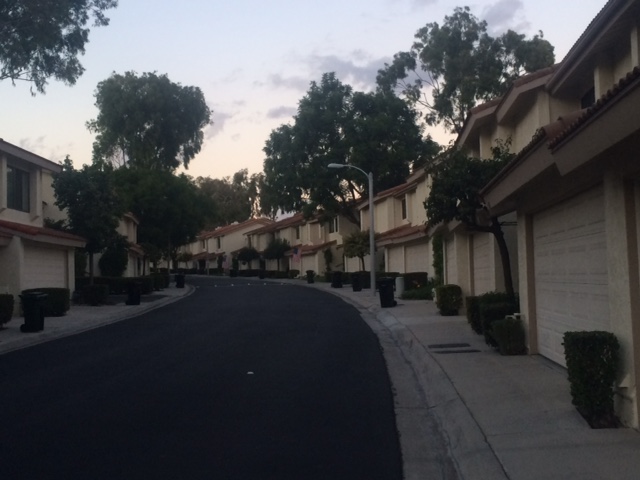
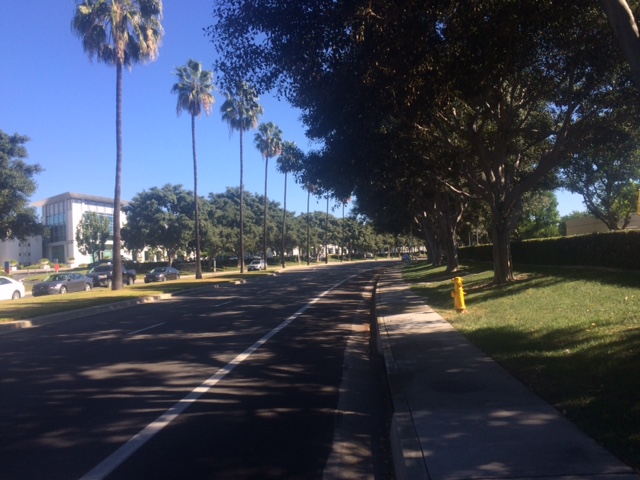
Today I am six months on the road. In a sort of reverse celebration I took a very easy riding day through the most banal landscape of my trip. Orange County California is a vast sea of low-rise development, wide streets, manicured landscaping, and few humans. The only folks about are city workers sweating in the afternoon sun while stringing Christmas lights on deciduous trees.

IMG_5103 IMG_5105 IMG_5086 IMG_5108 IMG_5112 IMG_5107 IMG_5109 IMG_5113

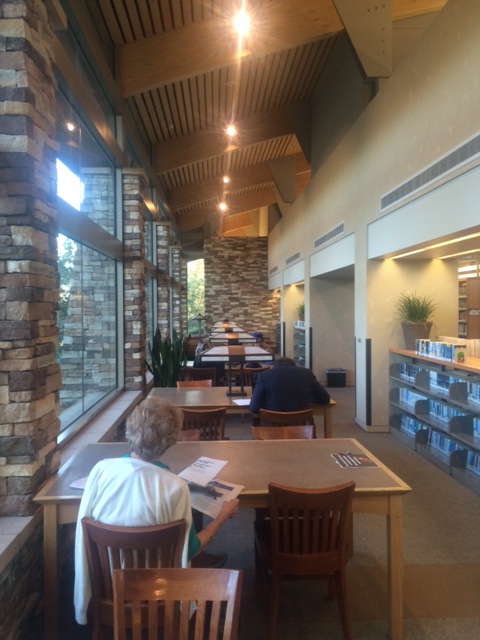
The cycling is easy, but uninteresting. The people, however, are generous. A series of welcoming hosts offered me hospitality without my asking. Since I have plenty of time to get to Phoenix before my Boston hiatus, I accepted them all and am filling out my short riding days with extra library time. The library in Mission Viejo is one of the loveliest in our country.

images-1 images IMG_5116

Posted in Bicycle Trip Log | Tagged , , | Leave a comment

Profile Response: Kirk Koenig and Lorena Landeros, University of Oregon Admissions, Eugene, OR

HWWLT Logo on yellowGetting into college is no easy feat. In fact, it gets more complex all the time. The Common Application, designed to simplify the process, has resulted in many more students applying to many more schools. University of Oregon doesn’t accept the Common App; others add additional requirements. Regardless, the Common App has resulted in more applications all around and requires competitive schools like University of Oregon to rethink their acceptance strategy. The objective is always to have many top students choose UO, but not so many as to flood the freshman class.

imgresKirk Koenig, a 37-year veteran of college admissions; and Lorena Landeros, a recent addition to the University of Oregon Admissions Department; represent the breadth of background and skills required in college admissions. Kirk explains, “Admissions as a separate process didn’t really exist until the 1970’s. Registrars used to handle it. Now admissions has its own procedures and professional organizations.”

images-2

The University of Oregon receives about 35,000 applications a year: 22,000 for fall semester freshman; the rest spread over the other three quarters and graduate schools. Last year UO admitted about 16,000 students for 4,000 spots. Half of all Oregon residents admitted accept, 17% admitted from out-of-state accept. Only about five percent of UO’s budget comes from the state, so out-of-state students provide higher per-student revenue, but there’s a political imperative to accept in-state students.

Oregon has several incentives to make college more affordable for underrepresented students. The state waives out-of-state tuition for undocumented students, offers merit scholarships for academic achievers, and initiated Pathway Oregon, state grants that supplement Federal Pell grants for low-income students.

imagesHow does UO evaluate so many applications and calculate their hit rate? Kirk is responsible for creating each years master matrix; a system of key indicators that determine how to sort applications. Each application receives a ‘total rating’ according to an algorithm that includes GPA, test scores, essays, and experience. Students with a total rating above a prescribed threshold are automatically admitted. Students below that cutoff are individually evaluated or rejected. A second admissions counselor reviews all rejected applications. No one is rejected based on a single review.

Lorena, a Mexican-American UO graduate, focuses on admissions from predominant Mexican regions: central Oregon and metropolitan Seattle. She takes a broad view of her job as encouraging Mexican-American students to consider college as a viable option. She visits schools as early as eighth grade to help students be more college-aware and college-ready. Although Lorena believes the financial assistance programs are good, “There is no more affirmative action. All students need to be academically prepared to be accepted.”

images-1I asked Kirk how college admissions will change. “In the past 37 years it’s changed completely; it’s driven by data and numbers. How it will change is for others to grapple.” Lorena added, “I’m young enough to have a good idea where students are at. UO is an option, but not everyone’s best option. My role is to help student’s find their right spot. If it’s not University of Oregon, I’m okay with that.”

How will we live tomorrow?

IMG_3924“I want to retire soon and remain in Eugene. People in Eugene are content. We go to Portland and we like it, but Eugene is our true home.” – Kirk Koenig

IMG_3928“You are asking on the anniversary of 9-11. I hope we live with more compassion.” – Lorena Landeros


Posted in Responses | Tagged , , | Leave a comment

Trip Log – Day 184 – Fullerton, CA to Santa Ana, CA

to Santa AnaNovember 5, 2015 – Sun, 70 degrees

Miles Today: 31

Miles to Date: 9,436

States to Date: 25

Poor Richard Nixon, the Rodney Dangerfield of Presidents. He gets no respect. After visiting the Ronald Reagan Library, teeming with people, upscale cafe, and Air Force One suspended in a hanger-size pavilion, I decided to visit Nixon’s Library in Yorba Linda.

IMG_5090The first thing the Admissions staff said was, “The permanent exhibits are closed.” Nixon’s birthplace home and the Marine One helicopter were open, as well as the gardens and personal timeline. But there was nothing juicy – nothing about Watergate – to whet my appetite. Even small things seemed to denigrate the man and his office: as many books on Kennedy and Nixon in the bookshop, and a presidential seal on the ice cream case in small convenience store that’s called a cafe.

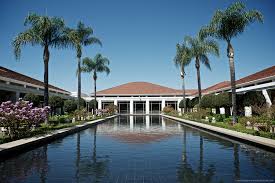
images images-1  Architecturally the library is terrific, less derivative than Reagan’s, yet appropriately formal and Mediterranean. And Nixon’s birthplace is a gem. When his parents died, Dick’s brothers kept all their original possessions knowing that Richard M. Nixon was a force whose birthplace would warrant preservation. The 1920’s kit house bungalow is perfectly preserved. And the helicopter is cool, every bit as cool as Air Force One, though ever so much smaller.

imgresA smattering of people dotted the grand foyers and halls; I can only hope more people visit when the main exhibits are open. What I wanted most to know, of course, was how Nixon’s official memorial addressed Watergate and resignation. But whatever spin was appropriate when the library opened in 1990 is now history; completely new exhibits are being installed. When they open next year, Nixon will be reinvented yet again.
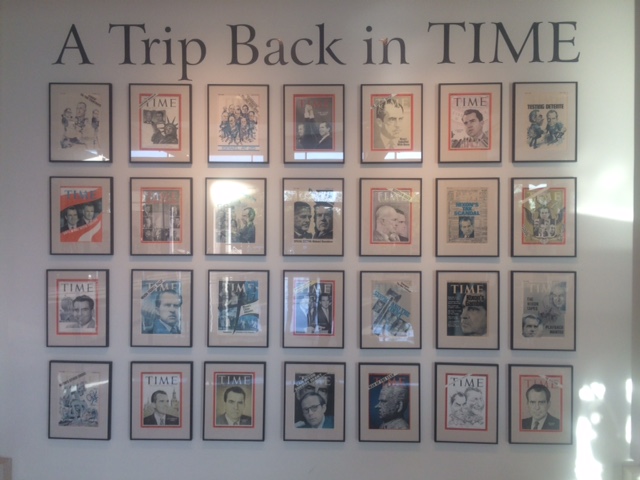
IMG_5092The most effective exhibit is the wall of Nixon Time Magazines. Nixon was on the cover of Time fifty-four times – more than any other person. Growing up, the man was always smiling or scowling at me from the coffee table. From the first cover, as Eisenhower’s VP choice, to the last, when he died, Nixon reflected his time. He did great things, which are now overshadowed by terrible things. He exuded confidence that was ultimately feeble.

I left the library with plenty of time to get to my host’s house, but missed a turn in Anaheim, wound up adding miles to my route and doing what I strive not to: riding at night. My mistake required me to make two sizable climbs. Fortunately Anaheim has great roads with wide shoulders, and I witnessed an incredible red sky over the basin.

images-2The night harkened me again after dinner. My host, Reza, whizzed me through a labyrinth of freeways to the immense scrap operation for which he runs the trucking operation. Every day six trucks haul scrap from all over SoCal to the yard. A huge claw machine deposits it into hoppers, a forklift weighs and loads the metal into containers, and a bobcat compresses the mess. They work until three in the morning to fill thirteen containers a day to empty the yard for the next day’s scrap. The containers are hauled to the Port of Long Beach and shipped to Asia. We buy finished goods from China and export our debris in return. See what Nixon ‘s China diplomacy has wrought.

IMG_5095


Posted in Bicycle Trip Log | Tagged , , , , | 4 Comments

Profile Response: Kurt Neugebauer, Eugene, OR


HWWLT Logo on yellowKurt Neugebauer loves his job as Associate Director of the University of Oregon Art Museum. “I create experiences that people will never have in other ways.” Kurt walked me through the Jordan Schnitzer Museum of Art on the UO campus, pointing out his role in curating and mounting various exhibitions. His hand is evident in the exhibit organization, descriptive text, color, and lighting. He even designed several display cases. “Our lives are a series of events that we differentiate as ‘special’. That is what separates us from other animals. The challenge of our lives now is that many of us are not fully nourished; our creativity is untapped. The closest thing I know to a god thing is our capacity to design. I don’t know where it comes from, but it’s generative.

imgres-1 images-2 IMG_3935

How will we live tomorrow?

IMG_3945“What’s going to survive? Not us. The earth will survive. It will grow and change. We are the ones who will be gone. Earth has taken so many forms before, it will evolve again.”


Posted in Responses | Tagged , , , | 2 Comments

Trip Log – Day 183 – Long Beach, CA to Fullerton, CA

to FullertonNovember 4, 2015 – Sun, 70 degrees

Miles Today: 37

Miles to Date: 9,405

States to Date: 25

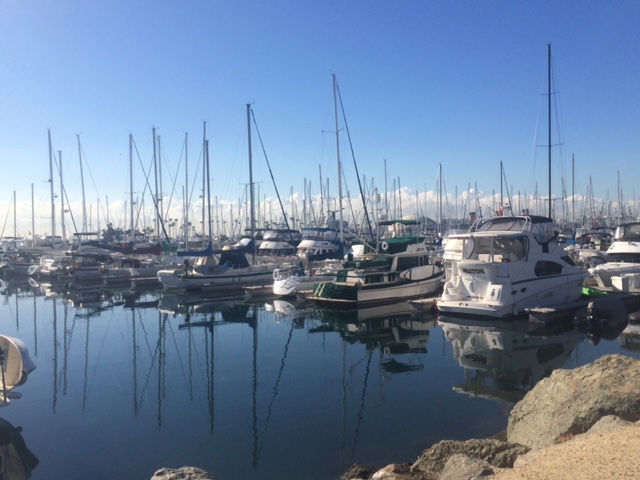
People ask me if I am on this trip to find my perfect place to retire. I am not. However, if I were, I would have to consider Long Beach. In twenty-four hours I pretty much fell in love with the place.

IMG_5073 IMG_5074 IMG_5075

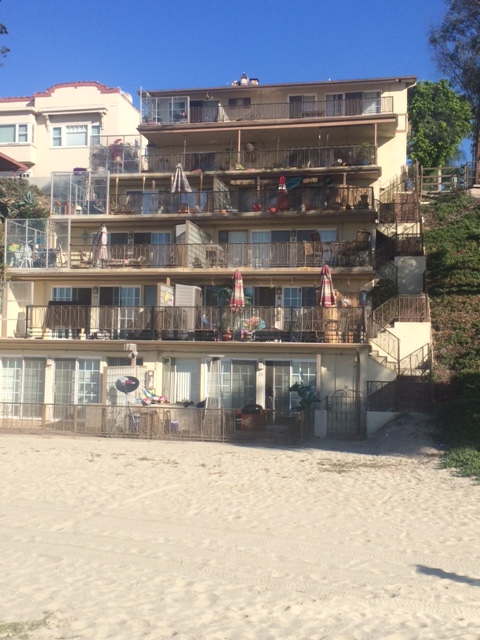
First, there are the usual reasons – near constant sun, great temperatures, ocean breezes. Then there are my own idiosyncratic reasons. I spent time in a different public library each day, and the libraries are great. The bike path system is terrific, probably the best in Southern California. And, it’s a real place. Yes, Long Beach has condos along the beach and a big Hyatt and conventional tourist stuff, but it also has the Port of LA / Long Beach, the largest port in the United States. Having ‘real’ industry saves Long Beach from the ‘plague of being precious’ that permeates places like Santa Barbara. A guy like me could grow old, happy and healthy in Long Beach.

IMG_5084 IMG_5077 IMG_5079

imgresThe Community Relations Director for the Port of Long Beach gave me a fascinating tour of the port in the morning. Before I left town I indulged in a California fast food ritual: In’n’Out. That fueled me to Fullerton where I stayed with Kevin, a Korean-American adventurer and deep-sea photographer. We exchanged hours of great conversation and I enjoyed my first Korean barbeque.

images images-1

Posted in Bicycle Trip Log | Tagged , , , , | 2 Comments

Trip Log – Day 182 – Los Angeles, CA to Long Beach, CA

to Long BeachNovember 3, 2015 – Sun, 75 degrees

Miles Today: 36

Miles to Date: 9,368

States to Date: 25

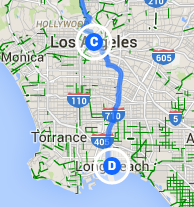
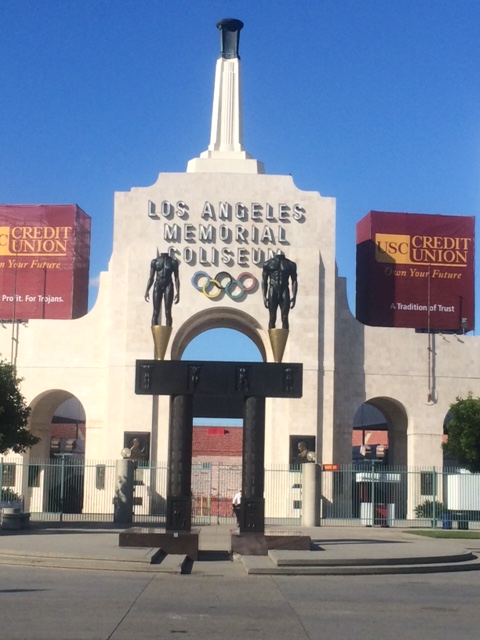
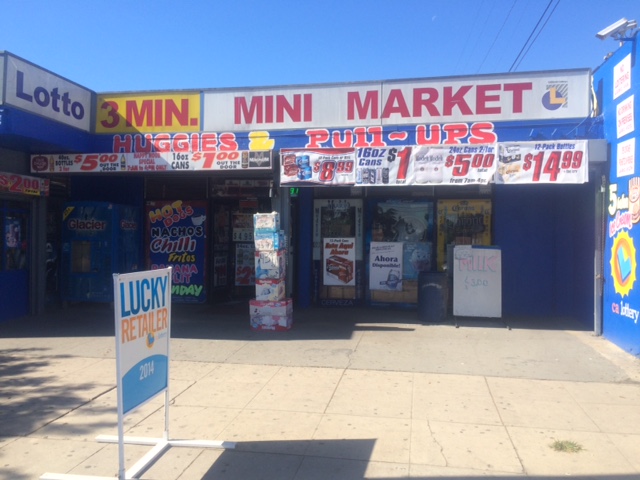
LA_type_map18x24_rainbowsToday I ventured where, I’ve learned, many Angelinos don’t go: down the dogleg of this great city to South Los Angeles and Watts, into Compton and Long Beach. In the bright mid-day sun these places aren’t the least bit scary and are full of intriguing characters. I met an eccentric meditator at the Coliseum, a wiry guy in an old pick-up in Watts, and some big mama’s at Budso’s Barbeque Shack. Still, LA’s Broadway looks more like a boulevard in a developing country than anyplace else in the United States. The garish colors, murals, used appliances, and lumpy mattresses spread across the sidewalk all proclaim that this place moves to a different set of expectations.

IMG_5053 IMG_5057 IMG_5059

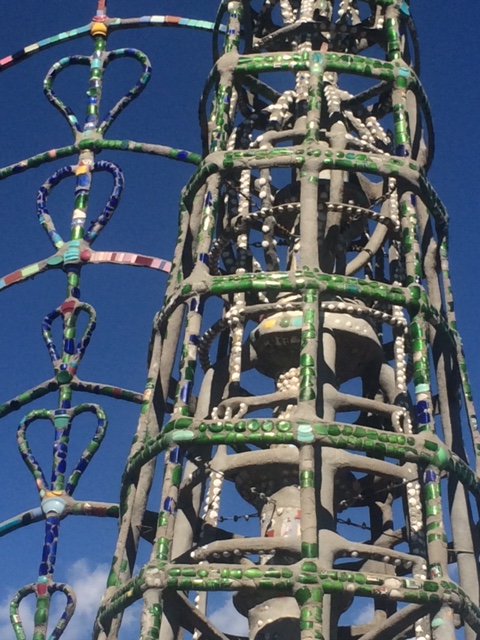
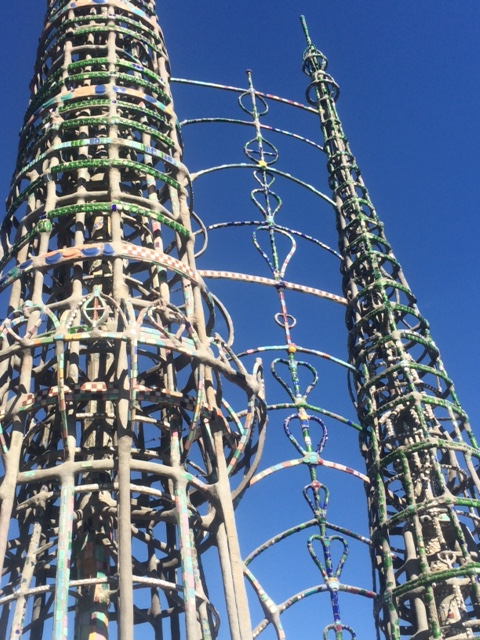
After visiting so much ‘formal’ art in LA, I was hip to visit Watts Towers. For some reason, I thought they were related to the 1965 Watts riots, but in fact they have nothing to do the riots of or the African-American community. Sam Rodia, an Italian immigrant, built Watts Towers between 1921 and 1955. Then, Sam left LA and never returned to visit his creation. They fell into disrepair, were rescued, catalogued, preserved, and are now part of a State Park complex.

IMG_5062 IMG_5063 IMG_5065

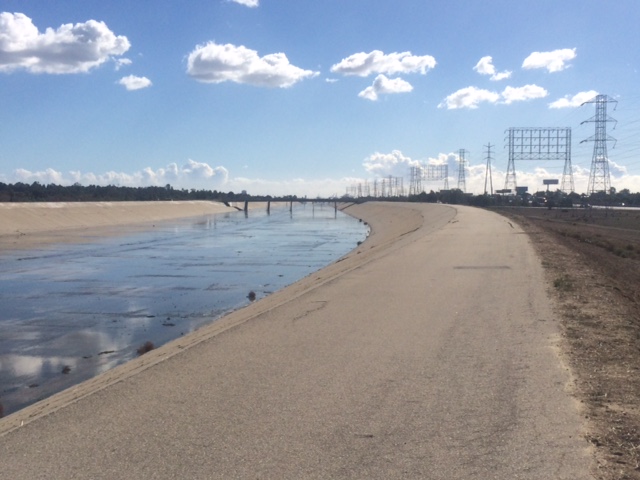
IMG_5066The rest of my ride, along the LA River Bike Path, gave me opportunity to muse on the various art I saw in LA. The Getty Villa and Getty Center are renowned centers of fine art and conservation. The Disney Concert Hall is art in itself. The central garden at The Getty Center is a living work of art, while the Watts Towers are great folk art elevated to fine art status.

I think for most of us, creating is more satisfying than maintaining, yet we’re dedicating to preserving art that often takes more human and monetary capital to preserve than it ever took to create. The tour guide at The Getty Center described the central garden as, “The Center’s most expensive piece of art, with a cost that will continue to grow.” Meanwhile the State of California is spending all kinds of money to preserve Watts Towers. Towers which, given today’s development restrictions, could never be built in the middle of the city. Towers that Sam Rodia finished, walked away from, and never saw again. Is there a limit to how many millions The Getty will spend snipping individual leaves from trees in the central garden to create specific shadows on the walking path? How long will we preserve the bits of cement and ceramic that Sam Rodia stuck together? A hundred years? A thousand years? Is it ever okay to say that a garden is a natural thing that will grow its own way and an immigrant’s vision, once executed to his satisfaction, can be allowed to disintegrate? At what point does preserving things thwart our own ability to create?

IMG_5064 imgres

Posted in Bicycle Trip Log | Tagged , , , , , , , | Leave a comment

Profile Response: Joanne Gray. Healthcare Operations Manger, Eugene, OR

HWWLT Logo on yellowWhen I have formal interviews with individuals, they often respond to “How will we live tomorrow?” in the context of their position. Others provide personal perspectives. Those perspectives don’t necessarily jive with the reality of their present: affluent executives are prone to talk about simple living without actually doing it. But I’ve never spoken with anyone whose demeanor, career, and accomplishments are more disconnected from her response to my question than Joanne Gray. Joanne is the antithesis of someone mining consumer culture while espousing simplicity. Joanne lives simply and honestly. As a healthcare administrator she’s dedicated to providing the highest care to the greatest number of people. Yet her thoughts on how we will live tomorrow reveal and entirely unexpected perspective. After we talked, Joanne asked that I not use her real name or location, for reasons that make sense to me. I am honored that Joanne responded to my question so candidly. Although the details are changed, the outline of her life, and her quotes, are accurate.

images-1Joanne Gray switched gears mid-life. She moved to the West Coast to pursue a PhD. in Health Services at University of Oregon, fell in love with Eugene, fell out of love with a lazy husband, and wound up running operations for the local hospital. She has a left-leaning heart and a hard-head for numbers. “I have never worked as an advocate. To be an advocate you have to ignore inconvenient facts.” Joanne recognizes nuance in every situation.

images-2In her work, Joanne sees first hand how our ability to extend lives affects the cost and delivery of health care. “Different cultures have different perspectives on the end of life. The challenge is not only to physicians; sometimes it’s the patients. We have many patients, often academics, who want every measure applied to extend their life. I have also known religious people who want to extend their lives. According to them, the longer the body is alive, the more chance God can intervene with a miracle.”


images

Joanne has no children and few close friends. She admits to being tied to her work. However, Joanne is also a classically trained singer whose bond with Eugene is strengthened because of the excellent voice teacher and two  choruses she belongs to here. “Singing is my relaxation, my meditation, my release from work.”

How will we live tomorrow?

images-1“I find this a disturbing question because it explores something I ignore. I have never been able to envision a future. I am single and have never had children. You would think that a person who got a PhD. would plan for the future. In the business world I can plan, but in my personal life I have no idea how to envision the future. I am very susceptible to inertia.

“I think part of it is that subconsciously, I refuse to have any expectations, because that way I can’t be disappointed. I just try to get through each day being a good person, finding small ways to help other people, and doing a good job at my job.

“The other part of not being able to answer, “How will we live tomorrow” is that I don’t consider myself to be part of any “we.” I know I don’t come across as particularly disconnected or self-effacing, but I do feel as though I could vanish tomorrow and no one would notice. But hey, I have good meds, so I’m pretty good at going through the motions of being a real person.

“I understand how it happened, that I have spent 17 years in Eugene, yet I have only one real friend in the area. I invested heavily in people who were not capable of giving back, or whose circumstances meant they passed through my life and didn’t stay. I finally like my job, I need my job, and my job claims virtually all my time and energy — another reason why it’s hard to envision the future.”


Posted in Responses | Tagged , , | 2 Comments

Trip Log – Day 181 – Los Angeles, CA

Screen Shot 2015-10-28 at 11.23.31 PMNovember 2, 2015 – Clouds, rain 65 degrees

Miles Today: 19

Miles to Date: 9,332

States to Date: 25

If there is any doubt that LA is literally the opposite corner of the country in every respect from my home world; that was dispelled today. Bostonians are so used to rain it’s just a nuisance; it’s the sun we adore. But in the land of the eternal sunshine – and record drought – nothing is greeted with more acclaim than rain.

IMG_5042The forecast was 70% change of rain. In the morning that dropped to 30%, and moods proportionately plummeted. My lunchtime companions compared various weather apps; ranging from 70% to 90% change of rain at 6 p.m. I spent the day in Northeast LA, meeting with insurance brokers and The Unusual Suspects, a non-profit theater group that works with incarcerated and disadvantaged youth. I also visited the gorgeous campus of Occidental College and the gentrifying neighborhood of Highland Park: juice bars and sushi restaurants next to pool halls and bodegas.

30611 images-1 images-2

images

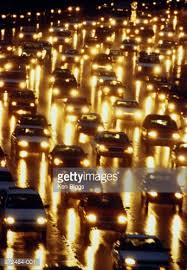
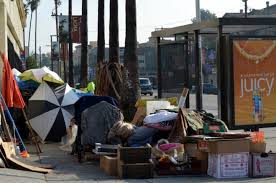
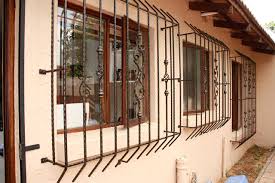
My first day of riding after the end of daylight savings time caught me short, and I had to scurry back to my niece’s before it got dark. The clouds were thick, the traffic thicker. I saw some ferocious fender benders and slithered through long lines of stalled vehicles. Within a few blocks I passed the multimillion dollar International Style homes along Silver Lake Boulevard, the makeshift hovels of shopping carts and tarps under the railroad bridge, the banners proclaiming Frank Gehry’s new tilted high-rise exhibit at LAMCA, and stucco bungalows girdled with iron bars and spear-headed fences. Los Angels is too spread out to have the face-to-face encounters of income disparity I witnessed in San Francisco. Here, it’s all expressed in where people live.

images-3 images-5 images-6 images-4

I got home by five as the first drops splattered. Within ten minutes it was pouring outside but I was in a warm shower. Within an hour the rain was over and LA began to dry out from its big event.

Posted in Bicycle Trip Log | Tagged , , , , , , , , | 1 Comment

Profile Response: Dave Cary, Salem, OR

HWWLT Logo on yellowDave Cary is hard-bodied. At age 69 he cycled from Seattle to Portland in a single day. Last year he built a deck onto his house: by himself, with twelve-foot 2×12’s. Dave’s seventy-six now, and bemoans that his physical prowess peaked at age 68.

Dave Cary is soft-souled. More than forty years ago he picked up a hitchhiker, gave him a ride and lunch money. Later that afternoon, the kid came to Dave’s office with his lunch receipt and the change. Impressed by this extreme honesty, Dave delved into the boy’s story and guided a reunion with his parents. That teenager cemented Dave’s faith in humanity.

Dave Cary is a serial entrepreneur. He’s owned a 24-hour donut shop, a seafood restaurant, three different pizza joints, and a tavern. “My strategy was to buy build-up, and sell.”

Dave Cary is a serial husband. He’s been married three times. Sharon, his wife of twenty-three years, has been married twice. They have six children total between them. “We are the marrying kind. Almost a hundred years of married life between us.”

imgresDave Cary is an atheist. He believes there is no god, and religion is for the weak. His bookshelves are lined with titles like, Why Darwin Matters. “It took me ten years to evolve from being a Christian to being an atheist. The Christian perspective is so prevalent; it took that long for me to be comfortable in my own beliefs. But Christan prevalence is recent. I was in school when the words ‘under God’ were added to our Pledge of Allegiance.” Dave raised his sons as atheists. “Two of my sons have become Christians. I consider that a failure. Christianity is an authority figure, like a parent. Adults shouldn’t need to lean on a parent. I am comfortable with what I don’t know. Look around you and the meaning of life is everywhere clear. It is to thrive. That’s why sex is fun. That’s why a seed in the ground sprouts. That’s why the hummingbirds hover at my feeder. We are all struggling to thrive.”

How will we live tomorrow?

IMG_3909“Humans are not planners, we are short-term thinkers. Gas prices are moderate now and high efficiency car sales are down. We will have crisis after crisis before we change. It’s as if we’re all Republicans. We believe in God, whom we can’t see, but we don’t believe in climate change, which is smacking us in the face.

“Religions are invented by man. They reflect his interests. If you’re going to invent a god, invent one that allows you to do what you want to do. Look at the Mormons and polygamy. Look at Crusades and Jihads. Look at male domination and female oppression. Men doing what they want, in the name of god.

“I don’t think we will survive 100 to 200 years from now if we don’t pull back on population. We will need to get back to the two to three billion range. There are different ways to reduce – genocide, war, disaster, political directive. But I am hopeful we will get there through education. I’d like to see some movement from the current Pope. But the real key is education of women. Wherever women are educated, populations level.”


Posted in Responses | Tagged , , | 1 Comment